Overview
The axial skeleton forms the central structural axis of the human body, comprising 80 bones arranged into three major divisions: the skull, the vertebral column, and the thoracic cage. Its primary roles are to protect the brain, spinal cord, heart, and lungs, and to provide the central support to which the appendicular skeleton attaches.
Think of the axial skeleton as the body’s central pillar and protective case rolled into one. The skull is a bony helmet for the brain. The vertebral column is a segmented, flexible column that surrounds the spinal cord while still allowing movement. The rib cage is a spring-loaded enclosure that expands and contracts with every breath while shielding the organs within.
Skull
The human skull consists of 22 bones: 8 cranial bones forming the neurocranium (the protective vault around the brain) and 14 facial bones forming the viscerocranium. This does not include the three tiny ear ossicles within each temporal bone.
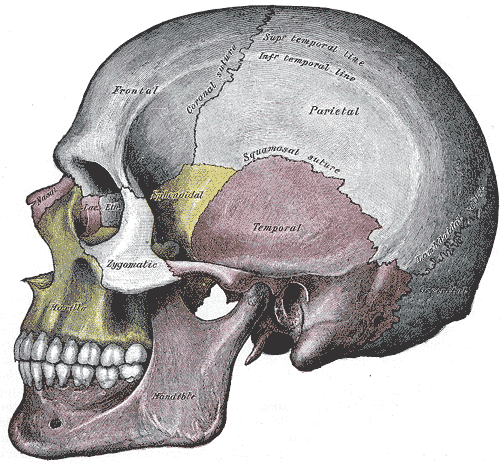
Cranial Bones (Neurocranium)
The eight cranial bones are fused together by sutures — interlocking fibrous joints that allow the skull to expand during childhood and then fuse firmly in adulthood.
| Bone | Count | Key Features |
|---|---|---|
| Frontal | 1 | Frontal sinuses, supraorbital foramen/notch, glabella |
| Parietal | 2 | Sagittal suture (midline), coronal suture (anterior) |
| Temporal | 2 | External auditory meatus, mastoid process, styloid process, petrous part |
| Occipital | 1 | Foramen magnum, occipital condyles, external occipital protuberance |
| Sphenoid | 1 | Sella turcica (pituitary fossa), greater/lesser wings, pterygoid processes |
| Ethmoid | 1 | Cribriform plate, perpendicular plate, superior/middle conchae |
The frontal bone forms the forehead and the superior part of the orbital cavities. It contains the frontal sinuses, which drain into the nasal cavity and are a common site of sinusitis. The supraorbital foramen (or notch) transmits the supraorbital nerve and vessels.
The parietal bones form the bulk of the cranial vault. They meet at the sagittal suture along the midline and articulate with the frontal bone at the coronal suture. The internal surface bears grooves for the middle meningeal arteries.
The temporal bones are complex structures that house the organs of hearing and balance. The petrous part, the densest bone in the body, contains the inner ear. The mastoid process provides attachment for the sternocleidomastoid muscle, and the styloid process serves as an anchor for several hyoid muscles and ligaments.
The occipital bone forms the posterior and inferior parts of the skull. The foramen magnum is a large opening through which the medulla oblongata and vertebral arteries pass. The occipital condyles articulate with the atlas (C1) to form the atlanto-occipital joint, which permits nodding of the head.
The sphenoid bone is a butterfly-shaped bone at the base of the skull. Its sella turcica houses the pituitary gland. The greater and lesser wings form parts of the orbital cavity, and the pterygoid processes provide attachment for masticatory muscles.
The ethmoid bone sits between the orbital cavities and forms much of the nasal cavity’s roof and walls. The cribriform plate allows the olfactory nerves (CN I) to pass from the nasal cavity to the olfactory bulbs. The perpendicular plate forms the superior part of the nasal septum.
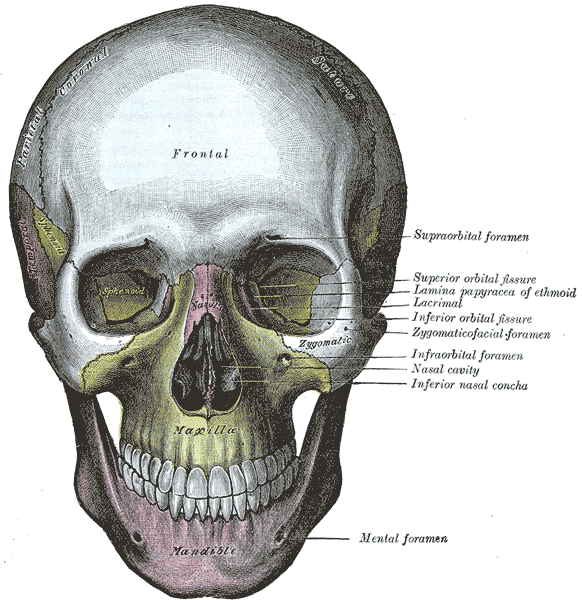
Sutures
The cranial bones are connected by sutures — fibrous joints that permit growth during childhood and ossify in adulthood. The four major sutures are:
| Suture | Between | Closure Age |
|---|---|---|
| Coronal | Frontal + parietal | ~30 years |
| Sagittal | Parietal + parietal | ~30 years |
| Lambdoid | Parietal + occipital | ~30 years |
| Squamous | Parietal + temporal | Variable |
Cranial Fossae
The internal base of the skull is divided into three fossae that house different parts of the brain:
| Fossa | Bones | Contents |
|---|---|---|
| Anterior cranial fossa | Frontal, ethmoid, sphenoid (lesser wing) | Frontal lobes, olfactory bulbs |
| Middle cranial fossa | Sphenoid, temporal | Temporal lobes, pituitary gland, cavernous sinuses |
| Posterior cranial fossa | Temporal (petrous), occipital | Brainstem, cerebellum, fourth ventricle |
Facial Bones (Viscerocranium)
The 14 facial bones form the framework of the face — the orbits, nasal cavity, oral cavity, and the structural support for the soft tissues of the face.
| Bone | Count | Key Features |
|---|---|---|
| Nasal | 2 | Bridge of nose |
| Maxilla | 2 | Alveolar processes (upper teeth), maxillary sinuses, palatine processes |
| Zygomatic | 2 | Cheek bones, zygomatic arch (with temporal bone) |
| Mandible | 1 | Body, ramus, angle, coronoid process, condylar process, alveolar processes (lower teeth) |
| Palatine | 2 | Hard palate (posterior), orbital floor |
| Lacrimal | 2 | Lacrimal groove (tear drainage into nasolacrimal duct) |
| Inferior nasal concha | 2 | Turbinate in nasal cavity |
| Vomer | 1 | Nasal septum (posterior portion) |
The mandible is the largest and strongest facial bone and the only movable bone of the skull (excluding the ear ossicles). It forms the temporomandibular joint (TMJ) with the temporal bone. The body of the mandible contains the alveolar processes that hold the lower teeth, and the mental foramen transmits the mental nerve and vessels.
Skull Foramina
The skull is perforated by numerous foramina that transmit nerves and blood vessels. These passages are critical landmarks in surgical approaches to the skull base and in understanding patterns of injury and disease.
| Foramen | Bone | Contents |
|---|---|---|
| Cribriform plate | Ethmoid | CN I (olfactory nerves) |
| Optic canal | Sphenoid (lesser wing) | CN II (optic nerve), ophthalmic artery |
| Superior orbital fissure | Sphenoid | CN III, IV, V₁, VI |
| Foramen rotundum | Sphenoid | CN V₂ (maxillary division) |
| Foramen ovale | Sphenoid | CN V₃ (mandibular division) |
| Foramen spinosum | Sphenoid | Middle meningeal artery |
| Internal acoustic meatus | Temporal (petrous) | CN VII, VIII |
| Jugular foramen | Temporal + occipital | CN IX, X, XI, internal jugular vein |
| Hypoglossal canal | Occipital | CN XII |
| Foramen magnum | Occipital | Medulla oblongata, vertebral arteries, CN XI (spinal accessory) |
| Stylomastoid foramen | Temporal | CN VII (facial nerve) |
| Carotid canal | Temporal | Internal carotid artery |
Paranasal Sinuses
The paranasal sinuses are air-filled cavities within the bones surrounding the nasal cavity. They lighten the skull, humidify inspired air, and influence voice resonance. Each sinus drains into the nasal cavity through narrow openings that are susceptible to blockage during sinusitis.
| Sinus | Location | Drainage |
|---|---|---|
| Frontal | Frontal bone | Middle meatus |
| Maxillary | Maxilla | Middle meatus |
| Ethmoid (anterior) | Ethmoid bone | Middle meatus |
| Ethmoid (posterior) | Ethmoid bone | Superior meatus |
| Sphenoid | Sphenoid bone | Sphenoethmoidal recess |
Vertebral Column
The vertebral column, or spine, is a segmented, flexible column composed of 33 vertebrae in childhood (reducing to 26 in adults through fusion of the sacral and coccygeal segments). It has four main functions: protecting the spinal cord, supporting the weight of the head and trunk, providing attachment for muscles and ribs, and allowing controlled movement.
Regional Organization
The vertebrae are organized into five regions, each with distinct structural features that reflect their mechanical demands:
| Segment | Number | Region | Special Features |
|---|---|---|---|
| Cervical | 7 (C1-C7) | Neck | Transverse foramina, bifid spinous processes (C2-C6) |
| Thoracic | 12 (T1-T12) | Chest | Costal facets (for rib articulation), long spinous processes |
| Lumbar | 5 (L1-L5) | Lower back | Large bodies, mammillary processes |
| Sacrum | 5 (fused) | Pelvis | Sacral foramina, sacral canal |
| Coccyx | 4 (fused) | Tailbone | Small triangular bone |
Curvatures
The adult vertebral column has four curvatures that increase its strength, flexibility, and ability to absorb shock. The cervical and lumbar curvatures are concave posteriorly (lordosis), while the thoracic and sacral curvatures are convex posteriorly (kyphosis).
| Curvature | Direction | Region |
|---|---|---|
| Cervical | Lordosis (anterior concavity) | Neck |
| Thoracic | Kyphosis (posterior convexity) | Upper back |
| Lumbar | Lordosis (anterior concavity) | Lower back |
| Sacral | Kyphosis (posterior convexity) | Sacrum |
Structure of a Typical Vertebra
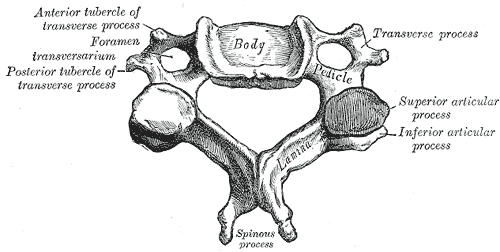
Each vertebra shares a common structural plan adapted to its region. The basic design consists of an anterior weight-bearing body and a posterior vertebral arch that encloses and protects the spinal cord.
| Feature | Description |
|---|---|
| Body (centrum) | Anterior, weight-bearing portion; increases in size from cervical to lumbar |
| Vertebral arch | Posterior portion formed by two pedicles and two laminae |
| Vertebral foramen | Opening between body and arch through which the spinal cord passes |
| Transverse processes | Two lateral projections for muscle and ligament attachment |
| Spinous process | Single posterior projection; palpable along the midline of the back |
| Articular processes | Four processes (two superior, two inferior) forming facet joints with adjacent vertebrae |
| Intervertebral foramina | Openings between adjacent vertebrae through which spinal nerves exit |
The vertebral canal is formed by the successive vertebral foramina of all the vertebrae. Its diameter varies by region — it is widest in the cervical region (to accommodate the cervical enlargement of the spinal cord) and narrowest in the thoracic region.
Cervical Vertebrae (C1-C7)
Cervical vertebrae are the smallest and most mobile. They are distinguished by the presence of transverse foramina — openings in the transverse processes that transmit the vertebral artery and vein (important structures that supply blood to the brain).
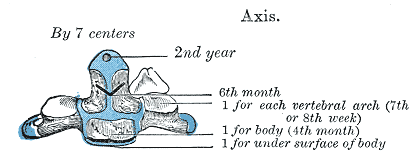
Atlas (C1) is a ring-shaped vertebra with no body and no spinous process. It consists of anterior and posterior arches connected by lateral masses. The superior articular facets articulate with the occipital condyles of the skull, allowing nodding (“yes” movement). The inferior facets articulate with the axis.
Axis (C2) has a prominent tooth-like projection called the odontoid process (dens) that projects superiorly from its body. The dens acts as a pivot around which the atlas rotates, allowing side-to-side head movement (“no”). The transverse ligament of the atlas holds the dens in place against the anterior arch of the atlas.
C3-C6 are typical cervical vertebrae with small bodies, short bifid (split) spinous processes, and transverse foramina. C7 (vertebra prominens) has a long, prominent spinous process that is easily palpable at the base of the neck and serves as a surface landmark.
| Vertebra | Unique Features |
|---|---|
| Atlas (C1) | No body, ring-shaped, articulates with occipital condyles |
| Axis (C2) | Odontoid process (dens) — pivot for C1 rotation |
| C3-C6 | Typical: small body, transverse foramina, bifid spinous processes |
| C7 | Vertebra prominens: long spinous process (palpable landmark) |
Thoracic Vertebrae (T1-T12)
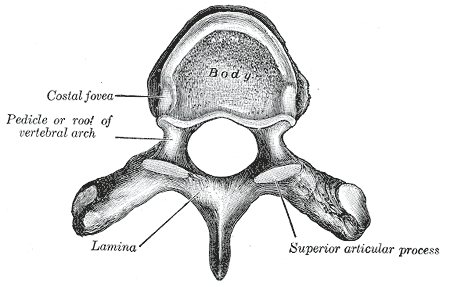
Thoracic vertebrae have a distinctive heart-shaped body and are larger than cervical but smaller than lumbar. Their key feature is the presence of costal facets — smooth surfaces on the body and transverse processes that articulate with the ribs. Each typical thoracic vertebra has bilateral facets for the head of its corresponding rib and for the tubercle of the rib. Thoracic spinous processes are long and angled inferiorly, overlapping like roof shingles.
Lumbar Vertebrae (L1-L5)
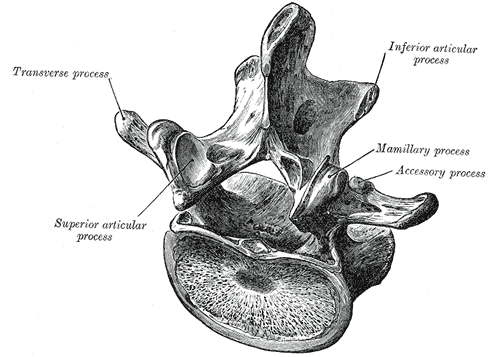
Lumbar vertebrae are the largest and strongest, designed to bear the weight of the upper body. They have massive kidney-shaped bodies, short thick pedicles, and flat, rectangular spinous processes. The vertebral foramen is triangular and larger than in the thoracic region.
Sacrum and Coccyx
The sacrum is a triangular bone formed by the fusion of five sacral vertebrae (S1-S5). It wedges between the two hip bones to form the posterior wall of the pelvis. The sacral promontory (the anterior ridge of S1) is an important obstetric landmark for measuring the pelvic inlet.
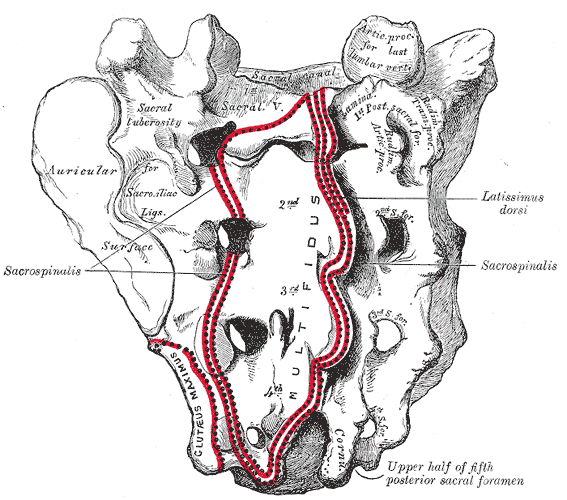
The anterior surface of the sacrum is smooth and concave, with four pairs of anterior sacral foramina for the exit of ventral rami of sacral spinal nerves. The dorsal surface is rough and irregular, marked by a median sacral crest (representing fused spinous processes), and four pairs of posterior sacral foramina. The sacral canal, a continuation of the vertebral canal, contains the cauda equina and terminates at the sacral hiatus, an opening in the posterior wall of S5.
The coccyx (tailbone) is a small triangular bone formed by the fusion of 3-5 rudimentary coccygeal vertebrae. It provides attachment for muscles of the pelvic floor and the gluteus maximus.
Thoracic Cage
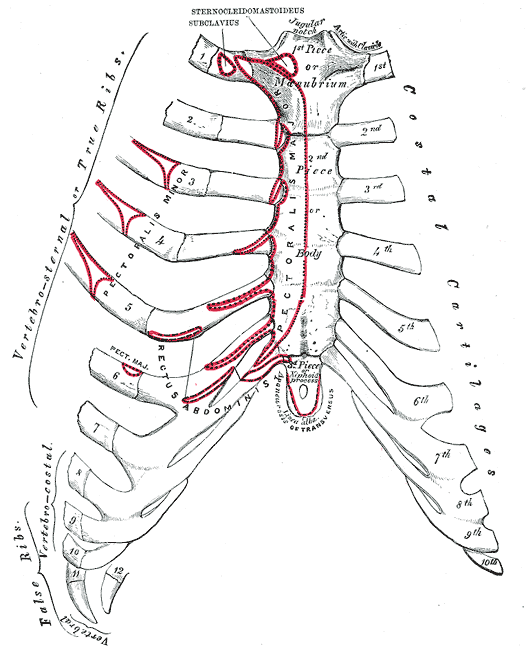
The thoracic cage is a bony and cartilaginous enclosure that protects the heart, lungs, and great vessels while allowing the respiratory movements of breathing. It consists of the sternum anteriorly, 12 pairs of ribs laterally, and the 12 thoracic vertebrae posteriorly.
Sternum
The sternum, or breastbone, is a flat elongated bone forming the anterior midline of the thoracic cage. It consists of three parts:
Manubrium — The broad, triangular upper portion. It articulates with the clavicles at the sternoclavicular joints and with the first rib via a costal cartilage. The manubriosternal joint (sternal angle or angle of Louis) is a palpable ridge at T4 level that serves as an important anatomical landmark: it marks the level of the tracheal bifurcation, the aortic arch, and the junction of the superior and inferior mediastina.
Body (gladiolus) — The longest portion, articulating with the costal cartilages of ribs 2 through 7. Its lateral borders bear facets for costal cartilage attachment.
Xiphoid process — The small, pointed inferior tip. It is cartilaginous in young individuals and gradually ossifies with age. It serves as an attachment point for the diaphragm and rectus abdominis.
| Part | Description | Articulations |
|---|---|---|
| Manubrium | Upper portion | Clavicles, rib 1, costal cartilage of rib 2 (partial) |
| Body (gladiolus) | Middle portion | Costal cartilages of ribs 2-7 |
| Xiphoid process | Inferior tip | Diaphragm, rectus abdominis |
Ribs
There are 12 pairs of ribs, all of which articulate posteriorly with the thoracic vertebrae. Anteriorly, their attachment varies:
| Type | Number | Description |
|---|---|---|
| True ribs | 7 (ribs 1-7) | Attach directly to sternum via own costal cartilage |
| False ribs | 3 (ribs 8-10) | Attach indirectly via costal cartilage of rib 7 |
| Floating ribs | 2 (ribs 11-12) | No anterior attachment |
A typical rib (ribs 3-9) consists of a head with two articular facets for articulation with the corresponding vertebral body and the vertebra above, a neck separating the head from the tubercle, a tubercle that articulates with the transverse process of the corresponding vertebra, and a shaft that curves anteriorly and inferiorly. The costal groove along the inferior margin of the shaft protects the intercostal vessels and nerve.
Ribs 1, 2, 10, 11, and 12 are atypical. The first rib is short, flat, and sharply curved — its scalene tubercle marks the insertion of the scalenus anterior muscle. Rib 2 is longer than rib 1 and has a roughened area for the origin of the serratus anterior. Ribs 11 and 12 are short and have no neck or tubercle.
Intercostal Spaces
The intercostal spaces are the gaps between adjacent ribs, occupied by three layers of intercostal muscles and a neurovascular bundle.
| Layer | Fiber Direction | Function |
|---|---|---|
| External intercostal | Oblique (superomedial to inferolateral) | Elevates ribs (inspiration) |
| Internal intercostal | Oblique (inferomedial to superolateral) | Depresses ribs (forced expiration) |
| Innermost intercostal | Variable, deep to internal | Proprioception, assists other layers |
The intercostal neurovascular bundle (vein, artery, nerve — VAN) runs in the costal groove of each rib, protected by the overhanging inferior lip. The order from superior to inferior is: intercostal vein, intercostal artery, intercostal nerve. Clinical procedures such as thoracentesis or intercostal nerve blocks are performed just above the superior border of the rib below the target space to avoid the bundle.