Overview
The appendicular skeleton comprises all the bones that anchor our limbs to the body axis and form the limbs themselves — 126 bones in total, out of the 206 that make up the adult human skeleton. If the axial skeleton is the chassis of the car, the appendicular skeleton is the wheels and axles. It gets us from place to place, lets us reach and grasp, and performs the vast majority of the movements that define daily life.
The division is simple: the pectoral girdle and upper limbs (32 bones per side) handle manipulation, while the pelvic girdle and lower limbs (31 bones per side) handle weight-bearing and locomotion. These two pairs are homologous — the human arm and leg share a common structural plan inherited from our tetrapod ancestors — but they have diverged dramatically to serve very different mechanical demands.
| Division | Components | Count |
|---|---|---|
| Pectoral girdle | Clavicle, scapula | 4 |
| Upper limbs | Humerus, radius, ulna, carpals (8), metacarpals (5), phalanges (14) | 60 |
| Pelvic girdle | Hip bone (os coxae) | 2 |
| Lower limbs | Femur, patella, tibia, fibula, tarsals (7), metatarsals (5), phalanges (14) | 60 |
Pectoral Girdle
The pectoral girdle connects each upper limb to the axial skeleton. Unlike the pelvic girdle, which forms a rigid ring, the pectoral girdle connects to the trunk at only one point — the sternoclavicular joint — and is held in place largely by muscles. This arrangement sacrifices stability for extraordinary mobility. We can reach behind our backs, above our heads, and across our bodies because the shoulder girdle is not locked to the rib cage.
Clavicle
The clavicle (collar bone) is a long, S-shaped bone that struts horizontally between the sternum and the acromion of the scapula. It is the only long bone in the body that normally lies horizontally and the first bone to begin ossifying (during the fifth week of fetal development, via intramembranous ossification).
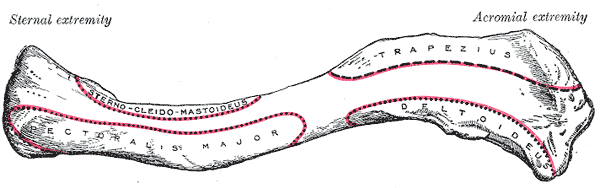
The clavicle has two ends and a shaft. The sternal end is triangular and articulates with the manubrium of the sternum at the sternoclavicular joint — the only bony attachment of the upper limb to the axial skeleton. The acromial end is flat and articulates with the acromion of the scapula at the acromioclavicular joint. The shaft curves medially convex in its medial two-thirds and laterally concave in its lateral third. On the inferior surface, the conoid tubercle and trapezoid line mark the attachments of the coracoclavicular ligament, which anchors the clavicle to the scapula.
The clavicle serves three functions: it supports the shoulder away from the trunk (increasing the range of arm movement), transmits forces from the upper limb to the axial skeleton, and protects the neurovascular bundle (subclavian vessels and brachial plexus) that passes beneath it.
Scapula
The scapula (shoulder blade) is a large, triangular flat bone that lies on the posterior thoracic wall, covering ribs 2 through 7. It has two surfaces, three borders, three angles, and three processes. Unlike the clavicle, the scapula has no direct bony attachment to the axial skeleton — it is held in position entirely by muscles.
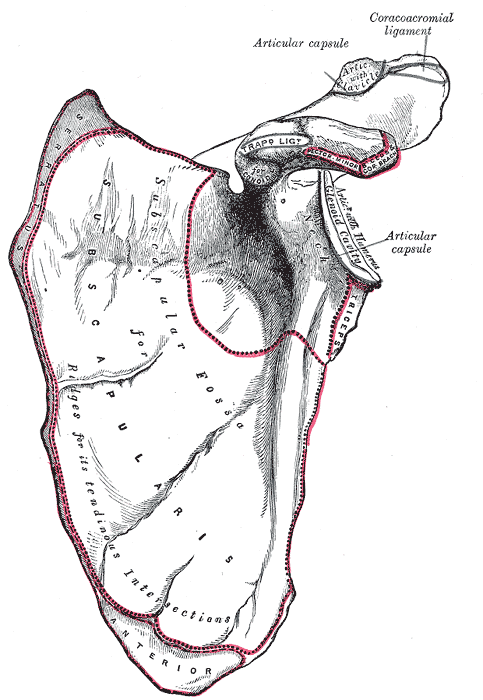
The costal (anterior) surface is concave and marked by the subscapular fossa, which houses the subscapularis muscle. The posterior surface is divided by the spine of the scapula — a prominent ridge that terminates laterally in the acromion (the bony point of the shoulder). Above the spine is the supraspinous fossa (containing the supraspinatus muscle); below it is the much larger infraspinous fossa (containing the infraspinatus muscle).
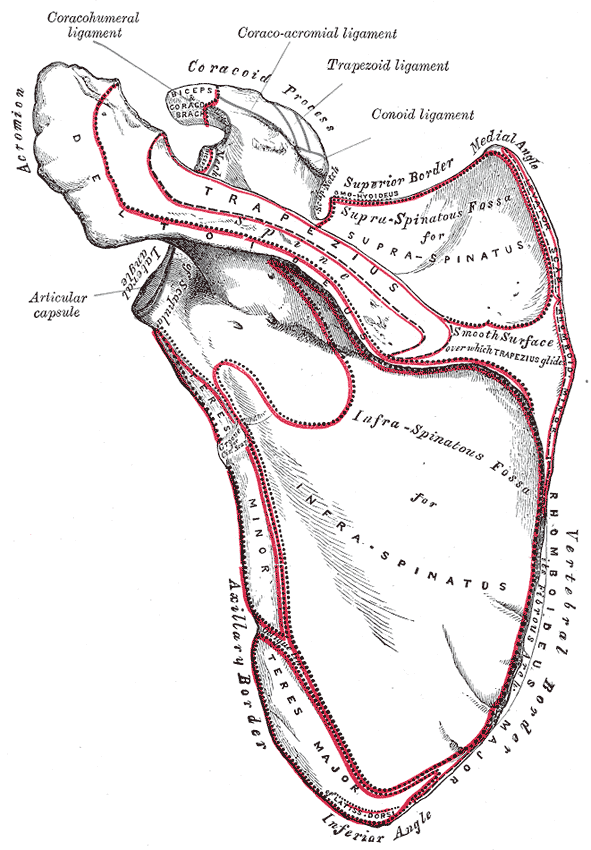
The three borders — superior, medial (vertebral) , and lateral (axillary) — and three angles — superior, inferior (at the level of T7), and lateral — define the scapula’s triangular shape. The lateral angle bears the glenoid cavity, a shallow, pear-shaped socket that articulates with the femoral head. Above and below the glenoid cavity are the supraglenoid and infraglenoid tubercles, attachment sites for the long heads of the biceps and triceps brachii, respectively.
The coracoid process projects anteriorly from the superior border, like a thumb hooking forward. It serves as an attachment point for the pectoralis minor, coracobrachialis, and short head of the biceps, as well as the coracoclavicular and coracoacromial ligaments.
| Feature | Description |
|---|---|
| Subscapular fossa | Anterior surface; houses subscapularis |
| Supraspinous fossa | Posterior, above spine; houses supraspinatus |
| Infraspinous fossa | Posterior, below spine; houses infraspinatus |
| Glenoid cavity | Lateral angle; articulates with humeral head |
| Acromion | Lateral end of spine; forms acromioclavicular joint |
| Coracoid process | Anterior projection; muscle and ligament attachments |
Upper Limb
The upper limb consists of the arm (humerus), forearm (radius and ulna), wrist (carpals), and hand (metacarpals and phalanges). Each segment builds on the one above it, trading stability for dexterity as we move distally.
Humerus
The humerus is the longest and largest bone of the upper limb, articulating proximally with the scapula at the shoulder joint and distally with the radius and ulna at the elbow joint.
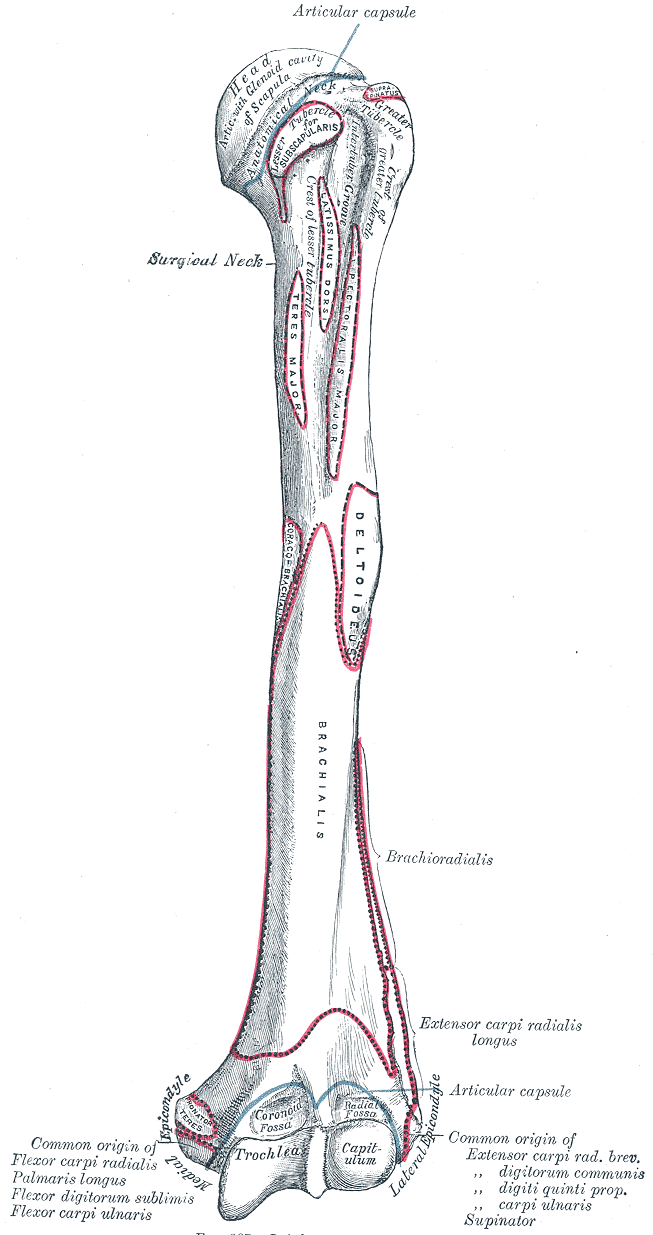
The proximal humerus consists of the head, which is hemispherical and articulates with the glenoid cavity of the scapula. The anatomical neck marks the margin of the articular surface. Just below it are the greater and lesser tubercles — bony prominences for muscle attachment — separated by the intertubercular sulcus (bicipital groove), which houses the tendon of the long head of the biceps. The surgical neck is the narrowed region below the tubercles; it is called surgical because it is a common fracture site, in contrast to the anatomical neck, which is rarely fractured.
The shaft is cylindrical proximally and becomes triangular distally. The deltoid tuberosity on the lateral surface marks the attachment of the deltoid muscle. The radial groove winds obliquely around the posterior aspect of the shaft and shelters the radial nerve and deep brachial artery.
The distal humerus expands into the medial and lateral epicondyles. Between them lies the articular surface, divided into the trochlea (medial, spool-shaped; articulates with the ulna) and the capitulum (lateral, rounded; articulates with the radius). Above the trochlea, anteriorly, is the coronoid fossa; posteriorly is the deep olecranon fossa, which receives the olecranon of the ulna during extension.
Radius and Ulna
The forearm contains two parallel bones: the radius (on the thumb side, lateral) and the ulna (on the little finger side, medial). They articulate with each other at the proximal and distal radioulnar joints and are connected along their length by the interosseous membrane, a fibrous sheet that transfers forces from the radius to the ulna and provides attachment for deep forearm muscles.
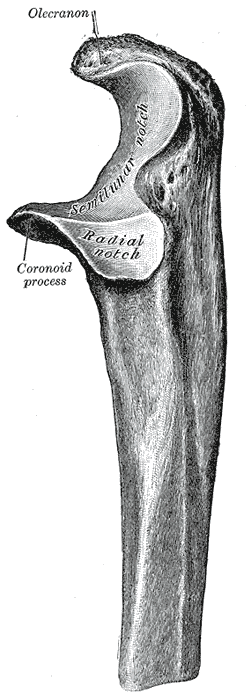
Ulna — The ulna is the dominant bone at the elbow. Its proximal end features the olecranon (the bony point of the elbow), the coronoid process, and the trochlear notch that grasps the trochlea of the humerus like a wrench. On the lateral side of the coronoid process is the radial notch, which articulates with the head of the radius. The shaft is triangular in cross-section. The distal end is a rounded head with a styloid process on its posteromedial side.
Radius — The radius is the dominant bone at the wrist. Its proximal end is a disc-shaped head that articulates with the capitulum of the humerus and the radial notch of the ulna. Below the head, the radial tuberosity marks the attachment of the biceps brachii tendon. The shaft widens distally to form the articular surface that contacts most of the carpal bones (scaphoid and lunate). The distal styloid process projects laterally.
| Feature | Ulna | Radius |
|---|---|---|
| Proximal | Olecranon, coronoid, trochlear notch, radial notch | Head, neck, radial tuberosity |
| Shaft | Triangular, interosseous border | Triangular, interosseous border |
| Distal | Head, styloid process | Styloid process, carpal articular surface |
| Dominance | Elbow joint | Wrist joint |
Wrist and Hand
The wrist (carpus) consists of eight carpal bones arranged in two rows of four. The proximal row (lateral to medial) is: scaphoid, lunate, triquetrum, and pisiform. The distal row is: trapezium, trapezoid, capitate, and hamate. The carpal bones are short bones that glide on one another, allowing the complex movements of the wrist.
| Row | Bones (lateral to medial) | Mnemonic |
|---|---|---|
| Proximal | Scaphoid, lunate, triquetrum, pisiform | Some Lovers Try Positions |
| Distal | Trapezium, trapezoid, capitate, hamate | That They Can’t Handle |
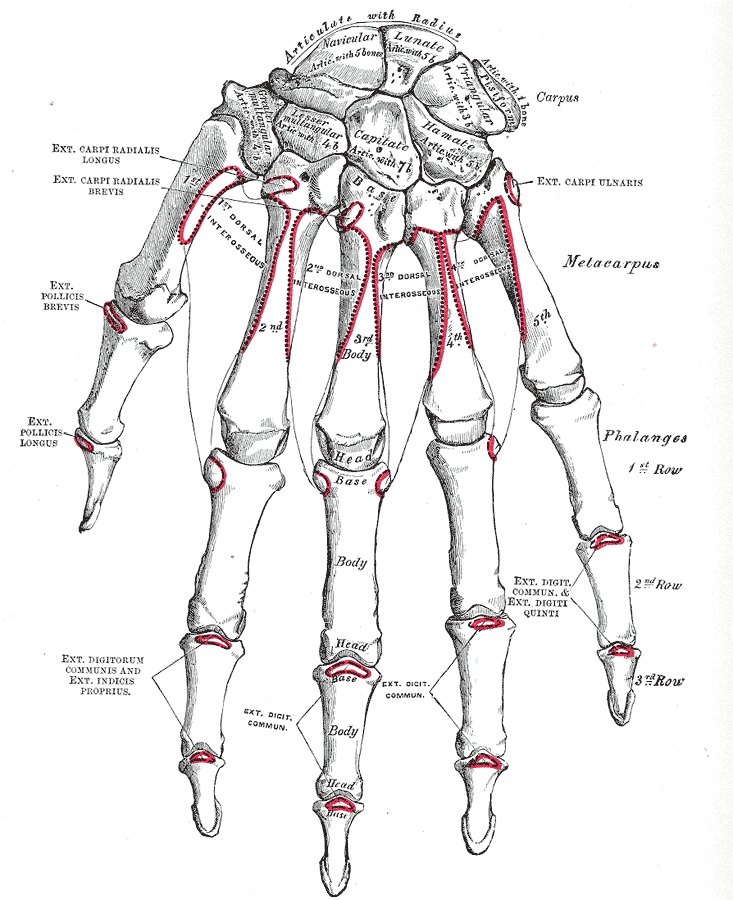
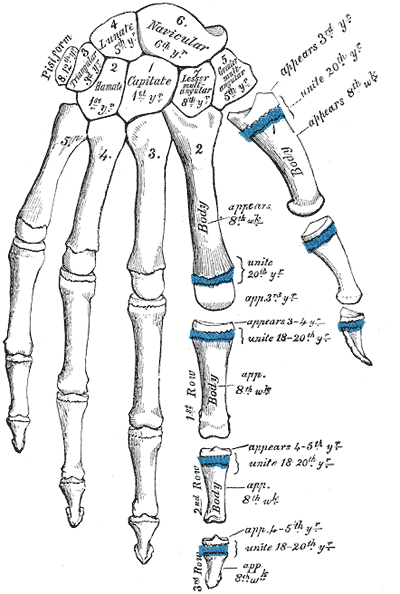
The hand contains five metacarpal bones (numbered 1–5 from thumb to little finger) and fourteen phalanges — two for the thumb (proximal and distal) and three each for fingers two through five (proximal, middle, distal). Each finger is a long bone lever, and the opposable thumb — with its saddle carpometacarpal joint — is the anatomical feature that makes the human hand uniquely capable of precision grip.
Pelvic Girdle
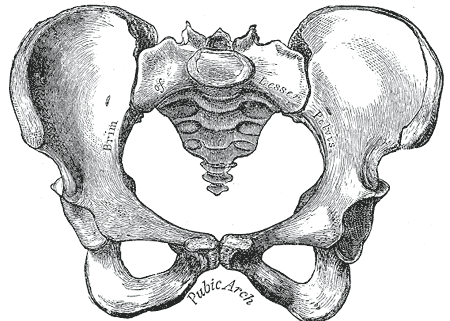
The pelvic girdle consists of the two hip bones (ossa coxae), which meet anteriorly at the pubic symphysis and articulate posteriorly with the sacrum, forming a complete bony ring called the pelvis. This ring is rigid — in contrast to the mobile pectoral girdle — because its primary function is weight-bearing and transmission of forces from the axial skeleton to the lower limbs.
Hip Bone (Os Coxae)
Each hip bone is formed from three fused bones that meet at the acetabulum (the deep socket for the femoral head): the ilium (above), ischium (below and behind), and pubis (below and in front). The fusion is complete by the mid-teenage years, and the triradiate lines of fusion are visible on the inner surface of the acetabulum.
The ilium is the large, fan-shaped superior portion. Its upper margin, the iliac crest, is palpable along the flank. The crest ends anteriorly at the anterior superior iliac spine (ASIS) and posteriorly at the posterior superior iliac spine (PSIS). Below these are the anterior and posterior inferior iliac spines. The inner surface of the ilium is concave, forming the iliac fossa, and bears the auricular surface for articulation with the sacrum.
The ischium forms the posteroinferior portion. Its ischial tuberosity is the large, rough prominence that bears the body’s weight when sitting (“sits bone”). The ischial spine projects medially and separates the greater sciatic notch (above) from the lesser sciatic notch (below). The ischial ramus extends forward to join the pubis.
The pubis forms the anteroinferior portion. Its superior and inferior pubic rami enclose the obturator foramen, a large opening closed by the obturator membrane except for the obturator canal, through which nerves and vessels pass. The two pubic bones meet at the pubic symphysis, a secondary cartilaginous joint stabilized by fibrocartilage.
The acetabulum is a cup-shaped depression on the lateral aspect of the hip bone, formed by contributions from all three constituent bones (ilium approximately 40%, ischium 40%, pubis 20%). Its articular surface is horseshoe-shaped, with the non-articular central floor called the acetabular fossa. The acetabular labrum — a fibrocartilage rim — deepens the socket and enhances joint stability.
Pelvis as a Whole
The pelvis is divided into the false (greater) pelvis — the flared portion above the pelvic brim — and the true (lesser) pelvis — the narrower, bowl-shaped cavity below. The pelvic brim is defined by the sacral promontory posteriorly, the arcuate lines of the ilia laterally, and the pubic crest anteriorly.
The male and female pelves differ significantly in shape, reflecting the demands of childbirth:
| Feature | Male | Female |
|---|---|---|
| Shape | Heart-shaped (narrow) | Round/oval (wide) |
| Pelvic inlet | Narrow | Wide |
| Pelvic outlet | Narrow | Wide |
| Pubic arch angle | < 70° | > 80° |
| Iliac wings | Less flared | More flared |
| Obturator foramen | Round | Oval |
| Sacrum | Narrower, longer | Wider, shorter |
Lower Limb
The lower limb is built for weight-bearing and propulsion. Its bones are thicker and denser than those of the upper limb, with larger articular surfaces and more powerful muscle attachments. The structural plan mirrors the upper limb (thigh = arm, leg = forearm, foot = hand), but the functional differences are profound.
Femur
The femur is the longest, heaviest, and strongest bone in the body. It articulates proximally with the acetabulum at the hip joint and distally with the tibia and patella at the knee joint.
The proximal femur consists of a spherical head (with a small depression called the fovea capitis for the ligamentum teres), a neck that connects the head to the shaft at an angle of approximately 125°, and two large processes — the greater trochanter (lateral, palpable at the hip) and the lesser trochanter (posteromedial). The neck is the weakest part of the proximal femur and is the site of most hip fractures.
The shaft is roughly cylindrical and bowed anteriorly. Its posterior surface bears the linea aspera, a prominent ridge that serves as the attachment site for multiple thigh muscles. The gluteal tuberosity (continuation of the linea aspera proximally) receives the gluteus maximus tendon.
The distal femur expands into the medial and lateral condyles, which articulate with the tibia at the knee. The intercondylar notch separates them posteriorly. Above the condyles are the medial and lateral epicondyles. The anterior surface between the condyles is the smooth patellar surface, which articulates with the patella.
Patella
The patella (kneecap) is the largest sesamoid bone in the body, embedded within the quadriceps tendon. It is triangular, with a broad base (superior) and pointed apex (inferior). The posterior surface has two articular facets (medial and lateral) that glide on the femoral condyles. The patella increases the leverage of the quadriceps muscle by displacing the patellar tendon away from the knee’s axis of rotation.
Tibia and Fibula
The leg contains two parallel bones: the tibia (medial, weight-bearing) and the fibula (lateral, non-weight-bearing). Like the radius and ulna, they are connected by an interosseous membrane.
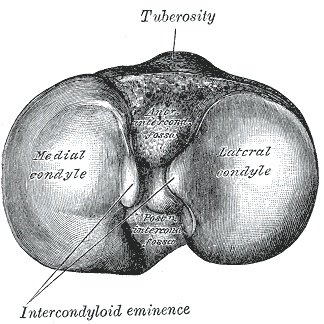
Tibia — The tibia (shin bone) is the second largest bone in the body after the femur. Its proximal end is expanded into the medial and lateral condyles (tibial plateau), which bear the articular surfaces for the femoral condyles. Between them is the intercondylar eminence, which anchors the cruciate ligaments. The tibial tuberosity on the anterior surface is the attachment of the patellar tendon. The shaft is triangular in cross-section, with a sharp anterior crest (shin) that is subcutaneous and easily palpable. The distal end expands into the medial malleolus (the inner ankle prominence), which articulates with the talus.
Fibula — The fibula is slender and lies lateral to the tibia. It does not articulate with the femur or bear weight. Its proximal head articulates with the tibia at the proximal tibiofibular joint. Its distal lateral malleolus forms the outer ankle prominence and articulates with the talus, providing lateral stability to the ankle joint. The fibula serves primarily as a site for muscle attachment.
| Feature | Tibia | Fibula |
|---|---|---|
| Proximal | Medial/lateral condyles, intercondylar eminence, tibial tuberosity | Head |
| Shaft | Triangular, anterior crest | Narrow, irregular |
| Distal | Medial malleolus | Lateral malleolus |
| Function | Weight-bearing (transmits forces to ankle) | Muscle attachment, ankle stability |
Ankle and Foot
The ankle (tarsus) consists of seven tarsal bones that transmit the body’s weight from the tibia to the foot. Like the carpal bones of the wrist, they are arranged in proximal and distal groups, but the tarsal bones are larger and更强 to bear load.
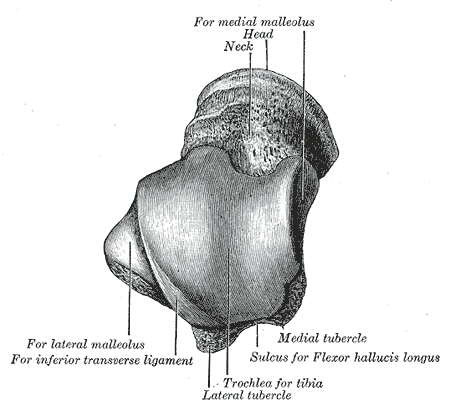
The talus is the key bone of the proximal tarsus. Its dome-shaped trochlea articulates with the tibia at the ankle joint. It sits atop the calcaneus (heel bone), the largest tarsal bone. The navicular lies anterior to the talus. The cuboid is lateral, and the three cuneiforms (medial, intermediate, lateral) lie anterior to the navicular.
| Bone | Position | Key Feature |
|---|---|---|
| Talus | Superior (ankle) | Trochlea for tibial articulation |
| Calcaneus | Posterior, inferior | Calcaneal tuberosity (Achilles tendon) |
| Navicular | Anterior to talus | Tuberosity (tibialis posterior attachment) |
| Medial cuneiform | Medial (midfoot) | Articulates with 1st metatarsal |
| Intermediate cuneiform | Middle | Articulates with 2nd metatarsal |
| Lateral cuneiform | Lateral | Articulates with 3rd metatarsal |
| Cuboid | Lateral (distal) | Groove for peroneus longus tendon |
The foot contains five metatarsal bones (numbered 1–5 from medial to lateral) and fourteen phalanges — two for the great toe (hallux) and three each for toes two through five.
Arches of the Foot
The foot is not flat. It is built as a three-dimensional series of arches that distribute weight, absorb shock, and provide spring during walking and running. The arches are maintained by the shapes of the bones, the tension of ligaments (especially the plantar aponeurosis and long plantar ligament), and the pull of the intrinsic foot muscles and tendons.
Medial longitudinal arch — The highest and most important arch, composed of the calcaneus, talus, navicular, three cuneiforms, and the first three metatarsals. It is the primary shock absorber during gait.
Lateral longitudinal arch — Lower and flatter than the medial arch, composed of the calcaneus, cuboid, and the fourth and fifth metatarsals. It provides stability during the push-off phase of gait.
Transverse arch — Runs across the midfoot, formed by the cuneiforms, the cuboid, and the bases of the metatarsals. It is maintained by the interosseous ligaments and the tendons of the peroneus longus and tibialis posterior.
| Arch | Bones | Function |
|---|---|---|
| Medial longitudinal | Calcaneus, talus, navicular, cuneiforms, metatarsals 1–3 | Shock absorption, weight bearing |
| Lateral longitudinal | Calcaneus, cuboid, metatarsals 4–5 | Stability, propulsion |
| Transverse | Tarsals (cuneiforms, cuboid), metatarsal bases | Weight distribution, foot flexibility |