Dietary guidelines provide evidence-based recommendations for healthy eating patterns that promote health, prevent chronic disease, and meet nutritional needs. They are updated every five years in the United States and form the basis for federal nutrition policy, food assistance programs, and public health education.
The Dietary Guidelines for Americans (2020–2025)
The DGA provides four overarching guidelines. Follow a healthy dietary pattern at every life stage — from infancy through older adulthood. Customize and enjoy nutrient-dense food and beverage choices to reflect personal preferences, cultural traditions, and budgetary considerations. Focus on meeting food group needs with nutrient-dense foods and beverages, and stay within calorie limits. Limit foods and beverages higher in added sugars, saturated fat, and sodium, and limit alcoholic beverages.

Key Recommendations
Vegetables. A variety of vegetables from all subgroups: dark green, red and orange, legumes (beans and peas), starchy, and other vegetables.
Fruits. Whole fruits (including fresh, frozen, canned, dried) rather than fruit juice.
Grains. At least half of grains should be whole grains. Whole grains include whole wheat, brown rice, oats, quinoa, barley, and whole cornmeal.
Dairy. Fat-free or low-fat milk, yogurt, cheese, and fortified soy beverages. Lactose-free options and other fortified plant milks are alternatives.
Protein foods. A variety from animal and plant sources: lean meats, poultry, eggs, seafood, beans, peas, lentils, nuts, seeds, and soy products.
Oils. Plant oils (olive, canola, soybean, corn, sunflower, safflower) rather than solid fats.
Limits. Added sugars: less than 10% of total calories per day (first recommendation to include added sugars for children under 2 years — avoid added sugars entirely). Saturated fat: less than 10% of total calories. Sodium: less than 2300 mg per day. Alcoholic beverages: up to one drink per day for women, up to two drinks per day for men.
MyPlate
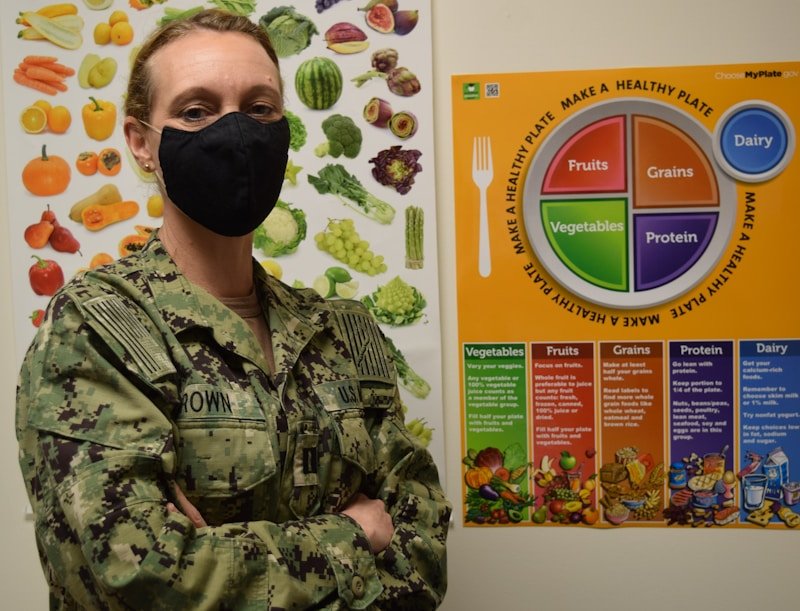
MyPlate is the USDA’s visual guide for building healthy meals. The plate is divided into four sections: fruits (1/4), vegetables (1/4), grains (1/4), and protein (1/4), with a side of dairy. Key messages: make half your plate fruits and vegetables, make half your grains whole grains, vary your protein routine, and move to low-fat or fat-free dairy.
Dietary Patterns
A dietary pattern is the combination of foods and beverages that constitute an individual’s habitual intake. The DGA defines three healthy dietary patterns.
Healthy US-Style Pattern
Based on typical American foods, optimized for nutrient adequacy and chronic disease prevention. Emphasizes vegetables, fruits, whole grains, low-fat dairy, seafood, legumes, nuts, and seeds; limits red and processed meats, added sugars, saturated fat, and sodium. This pattern meets nutrient needs at 12 calorie levels.
Healthy Mediterranean-Style Pattern
Based on the traditional dietary patterns of Greece, Italy, and other Mediterranean countries. Higher in fruits, seafood, and unsaturated fats (particularly olive oil), and lower in dairy, compared to the US-style pattern. The Mediterranean diet is the most extensively studied dietary pattern for cardiovascular health. The PREDIMED trial demonstrated that a Mediterranean diet supplemented with extra-virgin olive oil or nuts reduced major cardiovascular events by 30% compared to a low-fat diet. The Mediterranean diet is also associated with reduced risk of type 2 diabetes, cognitive decline, and certain cancers.
Healthy Vegetarian Pattern
Excludes meat, poultry, and seafood. Includes soy, legumes, nuts, seeds, whole grains, vegetables, fruits, and eggs and dairy (lacto-ovo vegetarian). Well-planned vegetarian diets are nutritionally adequate and associated with lower risks of heart disease, hypertension, type 2 diabetes, and obesity. Special attention is needed for adequate intake of vitamin B12, iron, zinc, calcium, vitamin D, and omega-3s.
Applying the Guidelines
The DGA emphasizes that the total dietary pattern, not individual foods, determines health outcomes. All foods can fit within a healthy diet when consumed in appropriate portions and frequency. Practical strategies: plan meals around vegetables, fruits, and whole grains; choose water as the primary beverage; include seafood twice per week; limit red and processed meats; use herbs and spices to reduce sodium; and read Nutrition Facts labels to identify added sugars, saturated fat, and sodium.
The guidelines acknowledge that dietary changes should be gradual, sustainable, and culturally appropriate. Personalized approaches within the framework of healthy patterns are more successful than rigid rules.
Global Guidelines
The WHO recommends: at least 400 g (5 portions) of fruits and vegetables daily; less than 10% of total energy from free sugars (ideally less than 5%); less than 30% of total energy from fat (with less than 10% from saturated fat and less than 1% from trans fat); less than 5 g of salt per day; and limiting alcohol. Many countries have adapted dietary guidelines to their food cultures, producing food-based guides that reflect locally available foods and traditional eating patterns.
Summary
The Dietary Guidelines for Americans provide evidence-based recommendations for healthy eating across the lifespan. MyPlate offers a practical visual guide for meal composition. Three healthy dietary patterns — US-style, Mediterranean-style, and vegetarian — meet nutrient needs and reduce chronic disease risk. Nutrient-dense choices are the foundation. The total dietary pattern, not individual foods, determines health outcomes. Gradual, sustainable changes within cultural and personal contexts are most effective.