Overview
Joints — also called articulations — are the sites where two or more bones meet. They give the skeleton its mobility, allowing us to walk, reach, bend, and grasp, while also providing the stability needed to support our body weight against gravity. Without joints, the skeleton would be a rigid, immobile shell — like a suit of armor rather than a flexible framework.
Every joint represents a trade-off between mobility and stability. At one extreme, the sutures of the skull are immovable but provide absolute stability for protecting the brain. At the other extreme, the shoulder joint sacrifices bony stability for the greatest range of motion of any joint in the body. Most joints of the limbs fall somewhere in between — mobile enough for functional movement, stable enough to resist dislocation under load.
Classification of Joints
Joints are classified in two complementary ways: structurally (by the type of tissue that connects the bones and whether a joint cavity is present) and functionally (by the degree of movement they allow).
Structural Classification
| Type | Connective Tissue | Joint Cavity | Movement | Examples |
|---|---|---|---|---|
| Fibrous | Dense connective tissue | No | None (synarthrosis) or minimal | Skull sutures, tibiofibular syndesmosis |
| Cartilaginous | Cartilage | No | None or slight (amphiarthrosis) | Intervertebral discs, pubic symphysis |
| Synovial | Joint capsule + synovial fluid | Yes | Free (diarthrosis) | Most limb joints |
Functional Classification
Synarthrosis (immovable joint) — The bones are united by fibrous tissue or cartilage with no joint cavity. These joints provide maximum stability. Examples include the sutures of the skull, the gomphosis of the tooth in its socket, and the first sternocostal joint.
Amphiarthrosis (slightly movable joint) — The bones are connected by cartilage or fibrous tissue that allows limited motion while providing significant shock absorption. Examples include the intervertebral discs (which permit small movements between adjacent vertebrae while absorbing compressive forces) and the pubic symphysis (which allows slight movement during childbirth).
Diarthrosis (freely movable joint) — These are synovial joints, characterized by a joint cavity filled with synovial fluid. The vast majority of limb joints are diarthroses, and they are the joints most relevant to clinical practice.
Fibrous Joints
Fibrous joints are held together by dense connective tissue, with no joint cavity. The amount of movement depends on the length of the connective tissue fibers connecting the bones.
Sutures are found only in the skull. The bones have irregular, interlocking edges that are united by a thin layer of dense fibrous connective tissue. In infants and children, sutures are somewhat flexible, allowing the skull to deform during birth and the brain to expand during growth. In adults, many sutures ossify completely (synostosis), fusing the adjacent bones into a single unit. The major sutures of the skull — coronal, sagittal, lambdoid, and squamous — are named for their locations and shapes.
Syndesmoses are fibrous joints where the bones are farther apart than in sutures and are connected by a ligament or interosseous membrane. The distal tibiofibular joint is a syndesmosis held together by the anterior and posterior tibiofibular ligaments. This joint allows a small amount of movement during ankle dorsiflexion. Another example is the interosseous membrane between the radius and ulna.
Gomphoses are specialized fibrous joints where a cone-shaped peg fits into a socket. The only example in the human body is the articulation of a tooth with its alveolar socket in the mandible or maxilla, held in place by the periodontal ligament — a dense collagenous connective tissue that anchors the tooth while allowing slight movement under the forces of chewing.
Cartilaginous Joints
In cartilaginous joints, the bones are united by cartilage. There is no joint cavity, and the degree of movement depends on the type of cartilage and the surrounding connective tissue.
Synchondroses are joints united by hyaline cartilage. Many are temporary joints that ossify with age. The epiphyseal (growth) plate in growing children is a synchondrosis between the diaphysis and epiphysis of a long bone. The first sternocostal joint (between the first rib and the manubrium) is a permanent synchondrosis. The costochondral junctions, where the ribs meet their costal cartilages, are also synchondroses.
Symphyses are joints united by fibrocartilage, which is stronger and more resistant to compression than hyaline cartilage. The intervertebral discs between the vertebrae are symphyses — each disc consists of a tough outer annulus fibrosus and a gelatinous inner nucleus pulposus that distributes compressive forces. The pubic symphysis is another symphysis, joining the two pubic bones anteriorly with a fibrocartilaginous disc. The manubriosternal joint is also a symphysis.
Synovial Joints
Synovial joints are the most mobile and most numerous joints in the body. They are characterized by the presence of a joint cavity filled with synovial fluid and are surrounded by a joint capsule.
General Structure
All synovial joints share six basic components:
Joint capsule — A sleeve of fibrous connective tissue that encloses the joint and is continuous with the periosteum of the articulating bones. The capsule provides passive stability and contains the other joint components. Its thickness and strength vary widely between joints — the hip capsule is thick and strong, while the shoulder capsule is thin and loose.
Synovial membrane — The inner layer of the joint capsule, composed of specialized cells (synoviocytes) that secrete synovial fluid. The membrane lines the entire joint cavity except the articular cartilage surfaces. It is richly vascularized and contains both phagocytic cells (type A synoviocytes) and secretory cells (type B synoviocytes).
Synovial fluid — A viscous, egg-white-like fluid that fills the joint cavity. It is an ultrafiltrate of plasma enriched with hyaluronic acid (which gives it its viscosity) and lubricin (a lubricating glycoprotein). Synovial fluid has three functions: lubrication of the articular surfaces, nutrition of the articular cartilage (which has no blood supply), and shock absorption.
Articular cartilage — A layer of hyaline cartilage that covers the articulating surfaces of the bones. It is smooth, white, and resilient. Articular cartilage has no blood vessels, nerves, or lymphatics — it receives its nutrition solely from the synovial fluid. Its low coefficient of friction (lower than ice on ice) is essential for pain-free joint movement.
Ligaments — Bands of dense connective tissue that connect bone to bone, guiding and limiting joint movement. They may be capsular (thickenings of the joint capsule), intracapsular (inside the capsule but outside the synovial cavity), or extracapsular (outside the capsule entirely). The cruciate ligaments of the knee are intracapsular; the medial collateral ligament is extracapsular.
Bursae and tendon sheaths — Bursae are closed, fluid-filled sacs lined by a synovial membrane that reduce friction between structures that move against each other (e.g., between a tendon and bone, or between skin and bone). Tendon sheaths are elongated bursae that wrap around tendons in areas of high friction, such as the wrist and ankle.
Synovial Joint Types
Synovial joints are classified into six types based on the shape of their articulating surfaces and the type of movement they allow:
| Type | Axes | Movement | Examples |
|---|---|---|---|
| Ball and socket | 3 | Flexion/extension, abduction/adduction, rotation, circumduction | Shoulder, hip |
| Hinge | 1 | Flexion/extension | Elbow (humeroulnar), knee, ankle, interphalangeal |
| Pivot | 1 | Rotation | Atlantoaxial, proximal radioulnar |
| Condylar (ellipsoid) | 2 | Flexion/extension, abduction/adduction (no rotation) | Wrist (radiocarpal), metacarpophalangeal |
| Saddle | 2 | Flexion/extension, abduction/adduction, circumduction | Carpometacarpal of thumb |
| Plane (gliding) | Multiple | Sliding | Intercarpal, intertarsal, facet joints |
Ball and socket joints — The most mobile type, consisting of a spherical head fitting into a cup-shaped socket. The shoulder has a shallow socket (glenoid) for maximum mobility; the hip has a deep socket (acetabulum) for stability.
Hinge joints — Allow movement in one plane (flexion-extension) around a single transverse axis. The trochlea of the humerus and the trochlear notch of the ulna form a pure hinge. The knee is a modified hinge that also allows a small amount of rotation when flexed.
Pivot joints — Allow rotation around a single longitudinal axis. The dens of the axis (C2) rotates within the ring of the atlas (C1), allowing head rotation. The radial head rotates within the radial notch of the ulna, enabling pronation and supination.
Condylar joints — An oval convex surface fits into an elliptical concave surface, permitting movement in two planes but no axial rotation. The radiocarpal (wrist) joint and the metacarpophalangeal joints are examples.
Saddle joints — Each bone surface is concave in one direction and convex in the perpendicular direction, like a rider on a saddle. This allows a wide range of movement, including opposition. The carpometacarpal joint of the thumb is the classic example.
Plane joints — Flat or slightly curved articular surfaces glide past each other. They allow limited sliding in multiple directions. The intercarpal and intertarsal joints, the facet joints of the vertebrae, and the sacroiliac joint are plane joints.
Major Joints
Shoulder Joint (Glenohumeral)
The shoulder is the most mobile joint in the body and, consequently, the most commonly dislocated major joint. It is a ball-and-socket joint between the hemispherical head of the humerus and the shallow, pear-shaped glenoid cavity of the scapula.
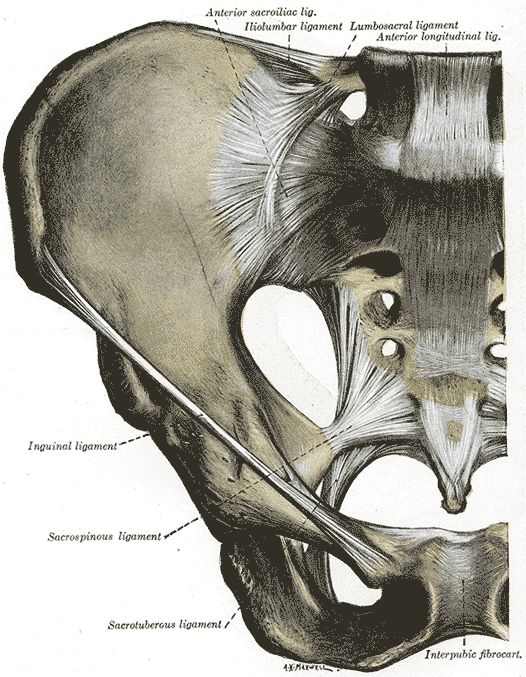
The glenoid cavity is deepened slightly by the glenoid labrum, a rim of fibrocartilage that also serves as an attachment for the joint capsule and the tendon of the long head of the biceps. The joint capsule is thin, loose, and redundant — allowing maximal range of motion but providing little passive stability. The capsule is reinforced by the glenohumeral ligaments (superior, middle, inferior) on its anterior aspect and the coracohumeral ligament superiorly.
Dynamic stability is provided by the rotator cuff — four muscles whose tendons blend with and reinforce the joint capsule:
| Muscle | Action | Tendon Location |
|---|---|---|
| Supraspinatus | Initiates abduction | Superior |
| Infraspinatus | External rotation | Posterior |
| Teres minor | External rotation | Posterior |
| Subscapularis | Internal rotation | Anterior |
Between the rotator cuff and the overlying deltoid and acromion lie the subacromial and subdeltoid bursae, which reduce friction during movement.
Movements: Flexion (180°), extension (50°), abduction (180°), adduction (30°), internal rotation (90°), external rotation (90°), circumduction
Elbow Joint
The elbow is a complex hinge joint that consists of three articulations within a single joint capsule:
Humeroulnar joint — Trochlea of the humerus with the trochlear notch of the ulna. This is the primary hinge, responsible for flexion and extension.
Humeroradial joint — Capitulum of the humerus with the head of the radius. This joint allows the radius to rotate during pronation and supination.
Proximal radioulnar joint — Head of the radius with the radial notch of the ulna. This is a pivot joint that, together with the distal radioulnar joint, enables pronation and supination.
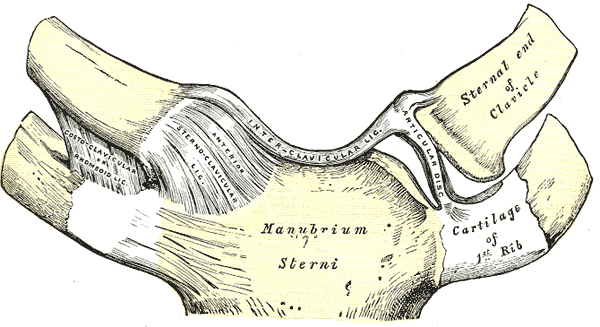
The joint capsule encloses all three articulations. It is thin anteriorly and posteriorly but reinforced on the sides by strong collateral ligaments:
Ulnar collateral ligament — A triangular band on the medial side, composed of anterior, posterior, and transverse bundles. It provides valgus stability and is stressed during throwing motions.
Radial collateral ligament — A triangular band on the lateral side, extending from the lateral epicondyle to the annular ligament. It provides varus stability.
Annular ligament — A band of fibrous tissue that encircles the radial head and holds it against the radial notch of the ulna. It allows the radius to rotate while preventing distal displacement.
Movements: Flexion (145°), extension (0°), pronation (80°), supination (80°)
Hip Joint
The hip is a ball-and-socket joint between the head of the femur and the acetabulum of the hip bone. It is the most stable major joint in the body, sacrificing mobility for the demands of weight-bearing and locomotion.
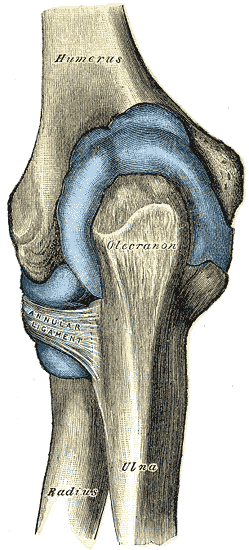
The acetabulum is deep and horseshoe-shaped, with articular cartilage only on its peripheral surface. The central, non-articular acetabular fossa is occupied by a fat pad. The acetabular labrum — a fibrocartilage rim — deepens the socket and seals the joint, creating negative intra-articular pressure that contributes to joint stability.
The joint capsule is thick, strong, and reinforced by three major ligaments that are spirally oriented around the joint. These ligaments become taut in extension, effectively “screwing” the femoral head into the acetabulum:
| Ligament | Location | Function |
|---|---|---|
| Iliofemoral (Y ligament of Bigelow) | Anterior (strongest) | Prevents hyperextension |
| Pubofemoral | Anteromedial | Limits abduction and extension |
| Ischiofemoral | Posterior | Limits internal rotation and extension |
The ligamentum teres (ligament of the head of the femur) runs from the fovea capitis of the femoral head to the acetabular notch. It contains a small artery that supplies blood to the femoral head in children, but its contribution to adult circulation is minimal.
Movements: Flexion (120°), extension (15°), abduction (45°), adduction (25°), internal rotation (30°), external rotation (45°)
Knee Joint
The knee is the largest joint in the body and one of the most complex. It is a modified hinge joint that allows flexion-extension with a small amount of rotation when flexed. The knee actually consists of two separate articulations: the tibiofemoral joint (between the femoral condyles and the tibial plateau) and the patellofemoral joint (between the patella and the patellar surface of the femur).
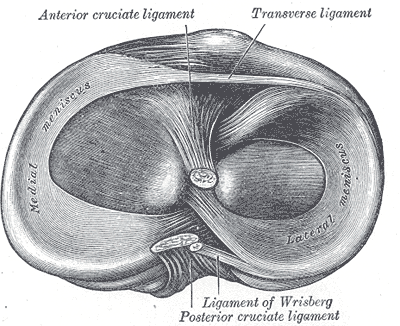
The articular surfaces are incongruent — the rounded femoral condyles do not fit neatly onto the flat tibial plateau. This incongruence is resolved by the menisci, two C-shaped wedges of fibrocartilage that sit on the tibial plateau and deepen the articulation:
| Meniscus | Shape | Key Feature |
|---|---|---|
| Medial | C-shaped | Attached to the MCL (more commonly torn) |
| Lateral | O-shaped (nearly circular) | Not attached to the LCL (less commonly torn) |
The menisci improve joint congruity, distribute weight across the joint surface, absorb shock, and contribute to joint stability. They have a limited blood supply — only the peripheral third is vascularized — which explains why meniscal tears in the avascular zone do not heal.
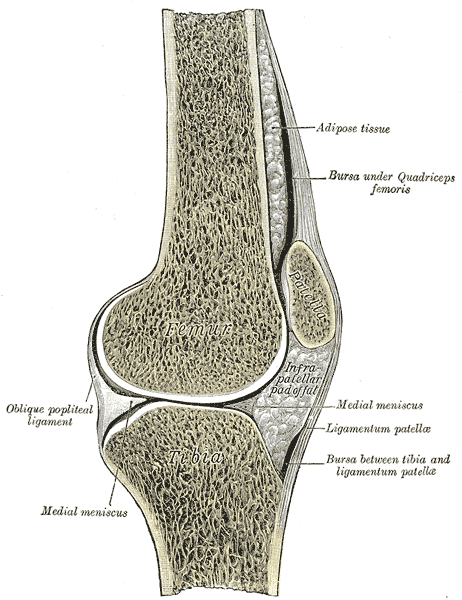
The knee’s stability depends heavily on its ligaments. The four main ligaments are:
Anterior cruciate ligament (ACL) — Intracapsular, running from the anterior intercondylar area of the tibia to the medial aspect of the lateral femoral condyle. It prevents anterior translation of the tibia relative to the femur and is the most commonly injured knee ligament in athletes.
Posterior cruciate ligament (PCL) — Intracapsular, running from the posterior intercondylar area of the tibia to the lateral aspect of the medial femoral condyle. It prevents posterior translation of the tibia and is typically injured by a blow to the front of the bent knee (dashboard injury).
Medial collateral ligament (MCL) — Extracapsular, running from the medial epicondyle of the femur to the medial tibial condyle. It resists valgus (outward) stress and is attached to the medial meniscus.
Lateral collateral ligament (LCL) — Extracapsular, running from the lateral epicondyle of the femur to the head of the fibula. It resists varus (inward) stress.
The extensor mechanism consists of the quadriceps tendon (attaching the quadriceps muscle to the superior patella), the patella, and the patellar tendon (attaching the inferior patella to the tibial tuberosity). The patella increases the lever arm of the quadriceps, improving the efficiency of knee extension.
Bursae: Multiple bursae surround the knee, including the suprapatellar (continuous with the joint cavity), prepatellar (between patella and skin), and infrapatellar (superficial and deep) bursae.
Movements: Flexion (140°), extension (0°), internal rotation (10–15°), external rotation (10–15°)
Ankle Joint (Talocrural)
The ankle joint is a hinge joint (mortise and tenon) formed by the distal ends of the tibia and fibula clasping the trochlea of the talus. The medial malleolus (tibia), lateral malleolus (fibula), and the inferior transverse tibiofibular ligament form a rectangular socket (mortise) that grasps the dome-shaped trochlea of the talus.
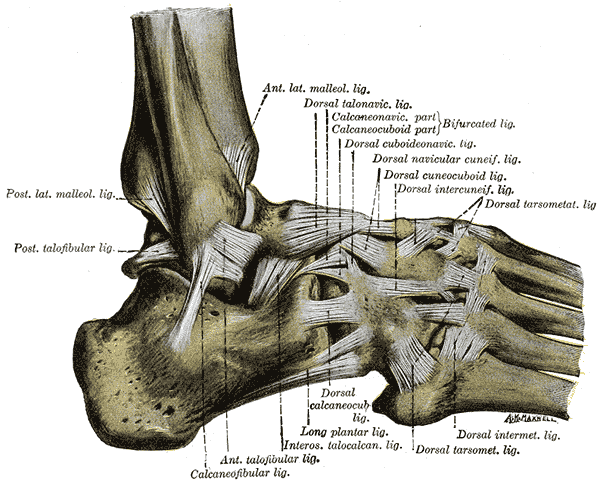
The joint capsule is thin anteriorly and posteriorly but reinforced on the sides by strong collateral ligaments:
Deltoid ligament — A strong, triangular ligament on the medial side of the ankle, fanning from the medial malleolus to the talus, calcaneus, and navicular. It provides medial stability and is rarely torn — when it is, it often involves an avulsion fracture of the medial malleolus.
Lateral ligament complex — Three separate bands on the lateral side:
| Ligament | Position | Notes |
|---|---|---|
| Anterior talofibular | Anterior lateral | Most commonly sprained ligament |
| Calcaneofibular | Middle lateral | Second most commonly sprained |
| Posterior talofibular | Posterior lateral | Intact in all but the most severe sprains |
The ankle’s stability depends on both the bony architecture (the mortise-and-tenon configuration) and the ligaments. The fibula bears approximately 15% of the weight transmitted through the ankle; the tibia bears 85%.
Movements: Dorsiflexion (20°), plantarflexion (40°). Inversion and eversion occur primarily at the subtalar and transverse tarsal joints, not at the talocrural joint.