Overview
The respiratory system is the body’s gas exchange apparatus — it delivers oxygen from the air to the blood and removes carbon dioxide from the blood to the air. But breathing is more than just gas exchange: the respiratory system also filters and conditions inspired air, produces vocal sounds, houses the sense of smell, and plays a critical role in pH balance by regulating the body’s carbon dioxide levels.
The system is divided anatomically into the upper respiratory tract (nasal cavity, pharynx, and larynx) and the lower respiratory tract (trachea, bronchi, bronchioles, and alveoli). Functionally, it is divided into the conducting portion (passages that transport air: nasal cavity through terminal bronchioles) and the respiratory portion (sites of gas exchange: respiratory bronchioles, alveolar ducts, and alveolar sacs).
Upper Respiratory Tract
Nasal Cavity
The nasal cavity is the entrance to the respiratory system. It is divided into left and right halves by the nasal septum (composed of the vomer, perpendicular plate of the ethmoid, and septal cartilage). Air enters through the external nares (nostrils), passes through the nasal vestibule (lined by skin and coarse hairs called vibrissae that filter large particles), and enters the main nasal cavity proper.
The lateral walls of the nasal cavity are marked by three bony projections called nasal conchae (turbinates): the superior, middle, and inferior conchae. Beneath each concha is a corresponding meatus — a passageway that receives drainage from the paranasal sinuses and the nasolacrimal duct. The conchae increase the surface area of the nasal cavity by a factor of three and create turbulent airflow, which ensures that inspired air makes maximal contact with the warm, moist mucosal surface.
The nasal mucosa is lined by respiratory epithelium — pseudostratified ciliated columnar epithelium with goblet cells. The cilia beat in coordinated waves to move the mucus layer (loaded with trapped particles) toward the pharynx, where it is swallowed. The rich vascular network of the nasal mucosa heats and humidifies inspired air — by the time it reaches the pharynx, air is warmed to near body temperature and saturated with water vapor. The olfactory epithelium, located in the roof of the nasal cavity, contains the sensory receptors for smell.
The paranasal sinuses — frontal, maxillary, ethmoid (anterior and posterior), and sphenoid — are air-filled cavities within the skull bones that open into the nasal cavity. They lighten the skull, add resonance to the voice, and produce mucus that drains into the nasal cavity.
Pharynx
The pharynx (throat) is a fibromuscular tube that serves as a common passageway for both air and food. It extends from the base of the skull to the level of the cricoid cartilage (C6) and is divided into three sections:
The nasopharynx lies posterior to the nasal cavity, from the choanae (posterior nasal openings) to the soft palate. It is lined by respiratory epithelium. Its lateral walls contain the pharyngeal openings of the Eustachian (auditory) tubes, which connect to the middle ear and equalize air pressure. Its posterior wall contains the pharyngeal tonsil (adenoid), which is part of Waldeyer’s ring of lymphoid tissue.
The oropharynx lies posterior to the oral cavity, from the soft palate to the epiglottis. It is lined by stratified squamous epithelium (to withstand the abrasion of food). Its lateral walls contain the palatine tonsils (commonly referred to simply as “the tonsils”), and its anterior boundary is marked by the palatoglossal arches.
The laryngopharynx extends from the epiglottis to the cricoid cartilage, where it becomes the esophagus. It is also lined by stratified squamous epithelium. Its lateral recesses — the piriform recesses — are common sites for swallowed foreign bodies to become lodged.
Larynx
The larynx (voice box) is a complex structure of cartilages, ligaments, and muscles that connects the pharynx to the trachea. It serves three critical functions: it protects the lower airway during swallowing, it houses the vocal cords for phonation, and it provides a patent airway for breathing.
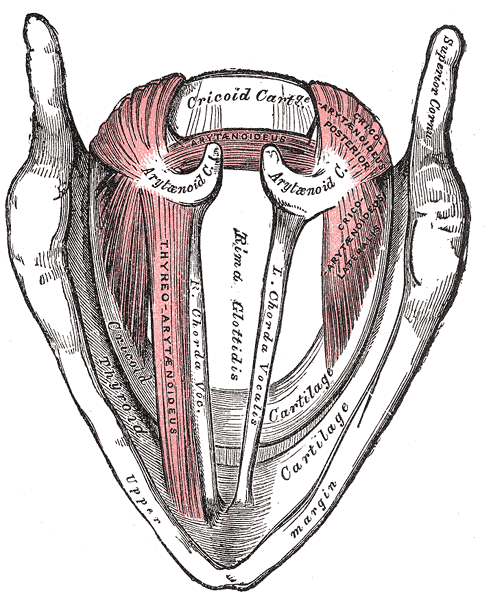
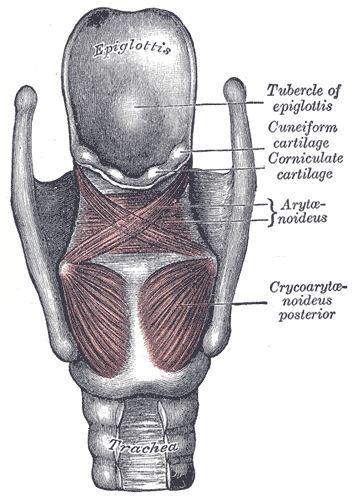
The skeleton of the larynx is composed of nine cartilages. The thyroid cartilage is the largest, forming the anterior prominence (Adam’s apple). It is U-shaped in males (more prominent) and more V-shaped in females. The cricoid cartilage sits below the thyroid as a complete signet ring — it is the only complete cartilaginous ring in the airway. The epiglottis is a leaf-shaped elastic cartilage that covers the laryngeal inlet during swallowing, directing food into the esophagus. The paired arytenoid cartilages sit on the cricoid and serve as the posterior attachment of the vocal cords. Smaller cartilages — the corniculate and cuneiform — sit above the arytenoids.
The vocal cords (true vocal folds) stretch between the arytenoid cartilages posteriorly and the thyroid cartilage anteriorly. They vibrate during exhalation to produce sound. The vestibular folds (false vocal cords) lie above the true cords and do not participate in phonation; they close during swallowing to protect the airway.
| Cartilage | Type | Key Feature |
|---|---|---|
| Thyroid | Hyaline | Adam’s apple; largest laryngeal cartilage |
| Cricoid | Hyaline | Complete ring; only complete airway cartilage |
| Epiglottis | Elastic | Covers laryngeal inlet during swallowing |
| Arytenoid (×2) | Hyaline | Vocal process for cord attachment |
| Corniculate (×2) | Hyaline | Above arytenoid apex |
| Cuneiform (×2) | Elastic | Within aryepiglottic fold |
Lower Respiratory Tract
Trachea
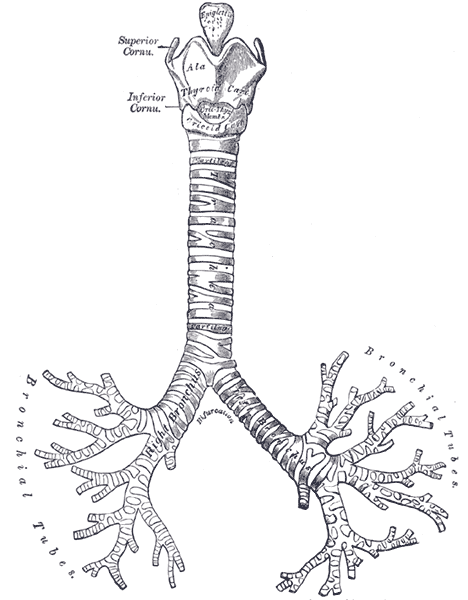
The trachea (windpipe) is a 10–12 cm long tube that extends from the cricoid cartilage (C6) to the carina at the level of the sternal angle (T4–T5), where it bifurcates into the right and left main bronchi. Its diameter is approximately 2–2.5 cm.
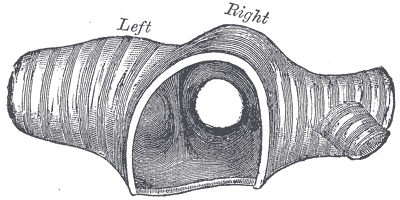
The tracheal wall is reinforced by 16–20 C-shaped rings of hyaline cartilage that prevent collapse during inspiration. The open posterior ends of the rings are bridged by the trachealis muscle (smooth muscle) and fibroelastic tissue, forming the membranous posterior wall. This arrangement allows the esophagus (which lies immediately posterior to the trachea) to expand during swallowing. The trachea is lined by ciliated pseudostratified columnar epithelium with goblet cells — the mucociliary escalator that traps and propels particles upward.
The carina is the internal ridge at the tracheal bifurcation. Its mucosa is densely innervated and is the most sensitive area of the trachea for triggering the cough reflex. The right main bronchus is wider, shorter, and more vertical than the left — this anatomical difference makes the right bronchus the most common site for aspirated foreign bodies.
Bronchial Tree
From the tracheal bifurcation, the airways divide in a pattern of approximately 23 generations, each branching into smaller and more numerous passages. This is the bronchial tree.
Generations 1 through 16 (from trachea through terminal bronchioles) constitute the conducting zone — they conduct air but have no alveoli and therefore no gas exchange. Generations 17 through 23 (respiratory bronchioles, alveolar ducts, and alveolar sacs) constitute the respiratory zone — their walls are lined with alveoli and gas exchange occurs.
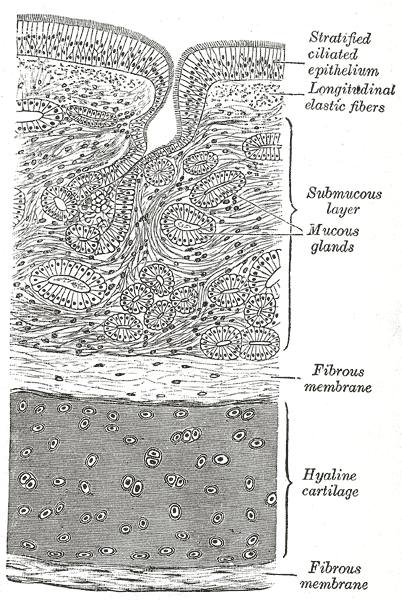
As the airways become smaller, their structure changes progressively. Cartilage is present in the main, lobar, and segmental bronchi but disappears at the level of the bronchioles (around generation 10). The epithelium transitions from pseudostratified columnar in the bronchi to simple ciliated cuboidal in the bronchioles and finally to simple squamous in the alveoli. Smooth muscle becomes relatively more prominent in the bronchioles, where it controls airway resistance and is the primary site of bronchoconstriction in asthma.
| Generation | Structure | Cartilage | Epithelium |
|---|---|---|---|
| 1 | Main bronchi | C-shaped rings | Pseudostratified columnar |
| 2–3 | Lobar bronchi | Irregular plates | Pseudostratified columnar |
| 4–9 | Segmental bronchi | Irregular plates | Pseudostratified columnar |
| 10–16 | Bronchioles | None | Ciliated cuboidal |
| 17–19 | Respiratory bronchioles | None | Cuboidal → squamous |
| 20–22 | Alveolar ducts | None | Squamous |
| 23 | Alveolar sacs | None | Squamous |
Each lung is divided into bronchopulmonary segments — functionally independent units of lung tissue, each supplied by its own segmental bronchus and a corresponding branch of the pulmonary artery. The right lung has 10 segments; the left lung has 8–10 (some medial segments fuse). Surgical resection can be performed at the segmental level, removing diseased tissue while preserving healthy adjacent segments.
Alveoli
The alveoli are the functional units of the lung — tiny, thin-walled air sacs where gas exchange occurs. There are 300–500 million alveoli in the adult human lung, providing a total surface area of 70–100 square meters.
The alveolar wall is lined by two cell types. Type I pneumocytes are extremely thin, squamous cells that cover approximately 95% of the alveolar surface area. They are the primary site of gas exchange. Type II pneumocytes are cuboidal cells that produce pulmonary surfactant — a complex mixture of phospholipids (primarily dipalmitoylphosphatidylcholine, DPPC) and surfactant proteins (SP-A, SP-B, SP-C, SP-D). Surfactant reduces surface tension within the alveoli, preventing their collapse at the end of expiration and reducing the work of breathing.
Lungs
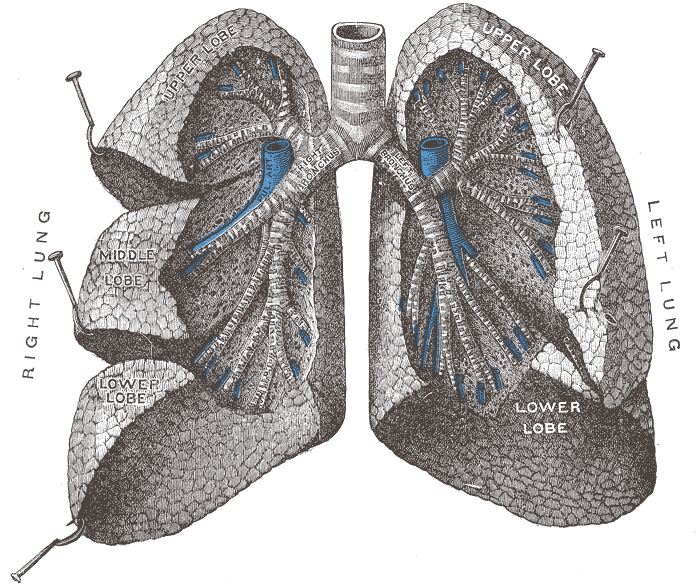
The lungs are paired, cone-shaped organs located in the thoracic cavity, separated by the mediastinum (which contains the heart, great vessels, trachea, and esophagus). Each lung has an apex (which projects above the clavicle into the root of the neck) and a base (which rests on the diaphragm).
The right lung is larger and divided into three lobes — upper, middle, and lower — by the horizontal and oblique fissures. The left lung has two lobes — upper and lower — separated by the oblique fissure. The left lung also features the cardiac notch, a concave indentation on its medial border where the heart sits, and a tongue-like projection called the lingula (the homolog of the right middle lobe).
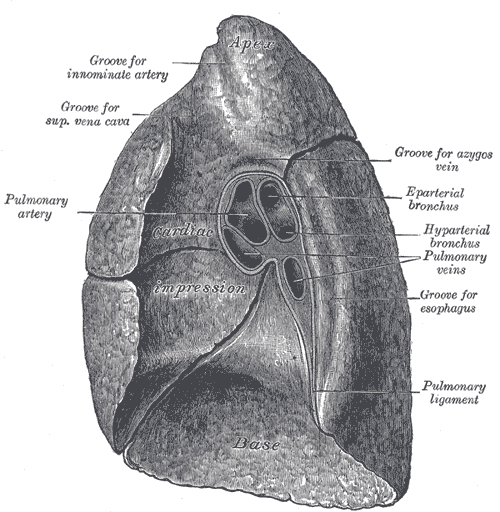
The hilum is the region on the medial surface of each lung where structures enter and leave the lung — the main bronchus, pulmonary artery, pulmonary veins, bronchial vessels, nerves, and lymphatics. The root of the lung is the collective term for these structures as they are surrounded by a sleeve of pleura at the hilum.
| Feature | Right Lung | Left Lung |
|---|---|---|
| Lobes | 3 (upper, middle, lower) | 2 (upper, lower) |
| Fissures | Horizontal, oblique | Oblique |
| Cardiac notch | Absent | Present |
| Lingula | Absent | Present |
| Weight | ~600 g | ~500 g |
Pleura
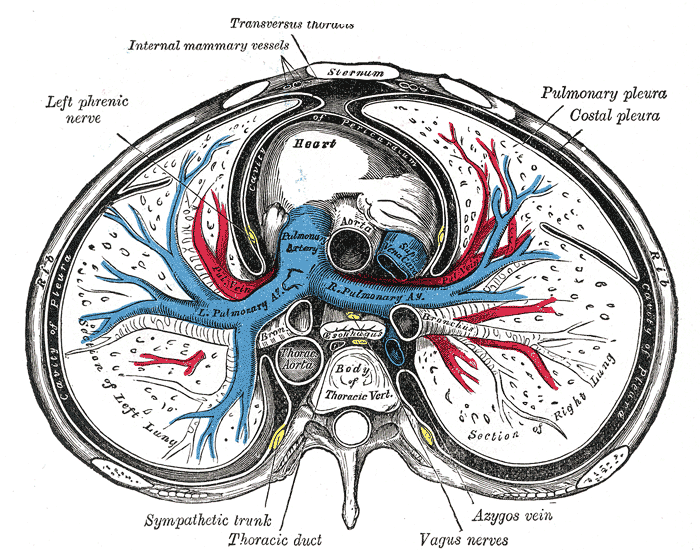
The pleura is a serous membrane that lines the thoracic cavity and covers the lungs. It consists of two layers. The visceral pleura adheres to the surface of the lung, including within the fissures. The parietal pleura lines the inner surface of the thoracic wall, the mediastinum, and the diaphragm. Between them is the pleural cavity — a potential space containing 5–15 mL of serous fluid that lubricates the two surfaces and allows friction-free movement during breathing.
The parietal pleura is divided into four parts based on location: cervical (cupula, extending above the first rib), costal (lining the ribs and intercostal spaces), mediastinal (lining the mediastinum), and diaphragmatic (covering the diaphragm). The costodiaphragmatic recess is the deepest part of the pleural cavity, located between the costal and diaphragmatic pleura — it is the site of choice for thoracocentesis (pleural fluid drainage).
Blood Supply
The lungs have a dual blood supply. The pulmonary circulation is the functional circulation for gas exchange: deoxygenated blood from the right ventricle is delivered via the pulmonary arteries to the pulmonary capillaries surrounding the alveoli, and oxygenated blood returns to the left atrium via the pulmonary veins (four total: two from each lung). The pulmonary circulation is a low-pressure, low-resistance system — the mean pulmonary artery pressure is only approximately 15 mmHg.
The bronchial circulation provides oxygenated blood to the tissues of the airways, from the trachea to the respiratory bronchioles. The bronchial arteries (one on the right, two on the left) arise from the descending thoracic aorta and the intercostal arteries. The bronchial veins drain partly into the azygos and hemiazygos systems and partly into the pulmonary veins — this small amount of deoxygenated blood mixing with oxygenated blood in the pulmonary veins creates the normal anatomic shunt (approximately 1–2% of cardiac output).
Mechanics of Breathing
Breathing is accomplished by the contraction and relaxation of the respiratory muscles, which change the volume of the thoracic cavity and thereby change intrapulmonary pressure relative to atmospheric pressure.
The diaphragm is the primary muscle of inspiration. It is a dome-shaped skeletal muscle innervated by the phrenic nerve (C3–C5). When it contracts, it flattens and descends, increasing the vertical dimension of the thoracic cavity. The external intercostal muscles contract during inspiration to elevate the ribs, increasing the transverse and anteroposterior dimensions. During quiet breathing, expiration is entirely passive — the elastic recoil of the lungs and chest wall returns them to their resting position.
During forced breathing, additional muscles are recruited. Forced inspiration uses the accessory muscles — the sternocleidomastoid and scalenes raise the sternum and first two ribs. Forced expiration uses the internal intercostal muscles (depress the ribs) and the abdominal muscles (increase intra-abdominal pressure, pushing the diaphragm upward).
| Muscle | Action | Innervation |
|---|---|---|
| Diaphragm | Primary inspiration | Phrenic (C3–C5) |
| External intercostals | Inspiration (elevate ribs) | Intercostal nerves (T1–T11) |
| Internal intercostals | Forced expiration | Intercostal nerves (T1–T11) |
| Sternocleidomastoid | Forced inspiration | CN XI, C2–C3 |
| Scalenes | Forced inspiration | C3–C8 |
Intrapleural pressure is normally negative (subatmospheric) at approximately –4 to –8 cmH₂O during quiet breathing. This negative pressure keeps the lungs expanded against the chest wall. If the pleural cavity is opened (pneumothorax), intrapleural pressure equalizes with atmospheric pressure and the lung collapses. Transpulmonary pressure (the difference between alveolar pressure and intrapleural pressure) is the distending force that keeps the airways and alveoli open.
| Volume | Value (mL) | Description |
|---|---|---|
| Tidal volume | 500 | Normal breath at rest |
| Inspiratory reserve | 3,000 | Maximal additional inspiration |
| Expiratory reserve | 1,100 | Maximal additional expiration |
| Residual volume | 1,200 | Air remaining after maximal expiration |
| Vital capacity | 4,600 | IRV + TV + ERV |
| Total lung capacity | 5,800 | VC + RV |
| Anatomical dead space | 150 | Volume of conducting airways |