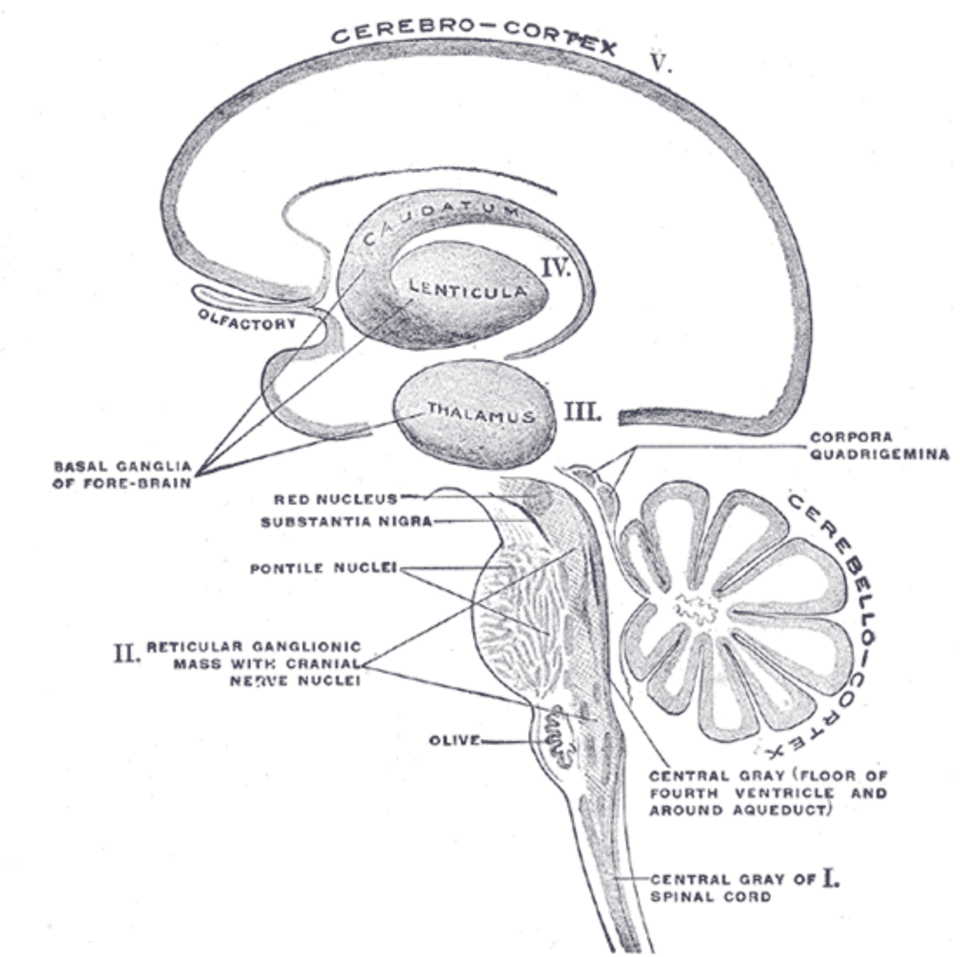
The 31 pairs of spinal nerves connect the spinal cord to the body, forming the communication link between the CNS and every region below the head. Each spinal nerve carries both sensory (afferent) and motor (efferent) fibers, and the major plexuses redistribute these fibers into functionally organized peripheral nerves.
Organization of Spinal Nerves
Thirty-one pairs of spinal nerves are grouped by the vertebral region from which they emerge:
| Region | Pairs | Spinal Segments |
|---|---|---|
| Cervical | 8 | C1–C8 |
| Thoracic | 12 | T1–T12 |
| Lumbar | 5 | L1–L5 |
| Sacral | 5 | S1–S5 |
| Coccygeal | 1 | Co1 |
The first cervical nerve emerges between the skull and the atlas (C1). Despite having only seven cervical vertebrae, there are eight cervical nerves — the first seven emerge above their corresponding vertebrae, while C8 emerges below the C7 vertebra and above T1. From T1 downward, each nerve emerges below its corresponding vertebra.
Root and Ramus Anatomy
Each spinal nerve is formed by the union of two roots:
Dorsal (posterior) root. Contains sensory (afferent) fibers whose cell bodies reside in the dorsal root ganglion (DRG). The DRG is a swelling on the dorsal root just outside the spinal cord. These pseudounipolar neurons have one process extending to the periphery (skin, muscle, joint) and another entering the spinal cord through the dorsal root entry zone.
Ventral (anterior) root. Contains motor (efferent) fibers whose cell bodies lie in the ventral horn of the spinal cord (somatic motor neurons) and the intermediolateral cell column (preganglionic autonomic neurons). The ventral root has no ganglion.
After the dorsal and ventral roots unite, the mixed spinal nerve immediately divides into two major branches:
Dorsal ramus. Innervates the intrinsic muscles of the back and the skin of the posterior trunk. It supplies the deep back muscles (erector spinae, transversospinalis) and the overlying dermatome.
Ventral ramus. Innervates the limbs and the anterolateral trunk. In the thoracic region, the ventral rami form the intercostal nerves. In the cervical, lumbar, and sacral regions, the ventral rami interweave to form plexuses.
Dermatomes and Myotomes
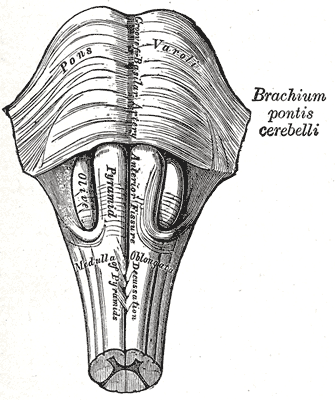
Dermatomes. Each spinal nerve (except C1) supplies sensation to a specific, segmentally organized area of skin called a dermatome. Adjacent dermatomes overlap considerably, so injury to a single nerve root typically produces sensory loss that is less extensive than a full dermatome. Dermatomal maps are essential clinical tools for localizing radiculopathy (nerve root compression).
Key dermatomal landmarks include:
- C5 — Lateral shoulder (deltoid region)
- C6 — Lateral forearm and thumb
- C7 — Middle finger
- C8 — Medial forearm and little finger
- T4 — Nipple line
- T10 — Umbilicus
- L4 — Medial lower leg and great toe
- L5 — Lateral lower leg and middle toes
- S1 — Lateral foot and little toe
- S2–4 — Perineal region (saddle area)
Myotomes. A myotome is the group of muscles innervated by a single spinal nerve. Like dermatomes, myotomes follow a segmental pattern and are central to neurological examination:
- C5 — Shoulder abduction (deltoid)
- C6 — Elbow flexion (biceps)
- C7 — Elbow extension (triceps)
- C8 — Finger flexion
- T1 — Finger abduction
- L2 — Hip flexion
- L3 — Knee extension
- L4 — Ankle dorsiflexion
- L5 — Great toe extension
- S1 — Ankle plantarflexion
Plexuses of the Ventral Rami
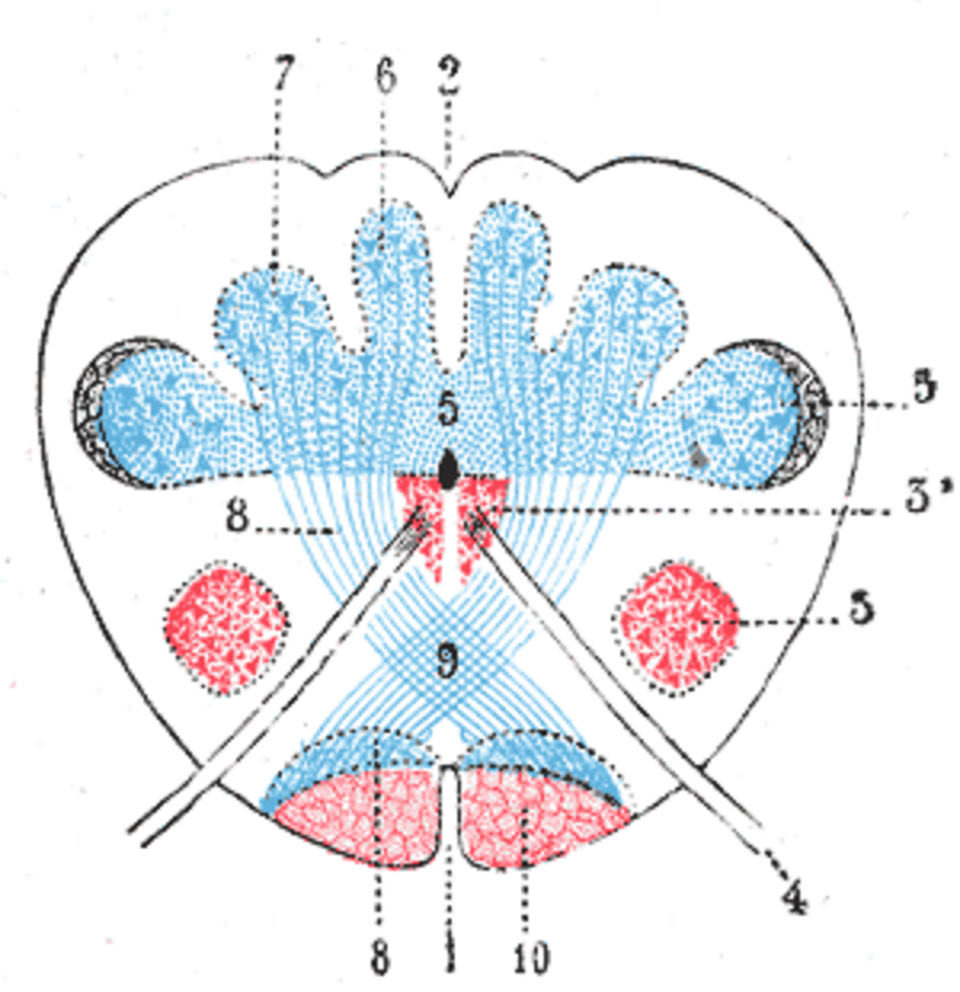
In the cervical, lumbar, and sacral regions, the ventral rami merge and then reorganize into peripheral nerves. This arrangement ensures that a single peripheral nerve carries fibers from multiple spinal segments, so damage to one nerve root does not completely paralyze a muscle group.
Cervical Plexus (C1–C4)
The cervical plexus lies deep to the sternocleidomastoid muscle. Its major branches include:
- Phrenic nerve (C3–C5). The most important branch — it innervates the diaphragm. C3 and C4 contribute, but C5 (from the brachial plexus) provides additional fibers (“C3, 4, 5 keep the diaphragm alive”).
- Lesser occipital nerve. Sensory to the scalp posterior to the ear.
- Great auricular nerve. Sensory to the ear and angle of the mandible.
- Transverse cervical nerve. Sensory to the anterior neck.
- Supraclavicular nerves. Sensory to the shoulder and upper chest.
- Ansa cervicalis. Motor innervation to the infrahyoid muscles (sternohyoid, sternothyroid, omohyoid, thyrohyoid).
Brachial Plexus (C5–T1)
The brachial plexus is the most complex peripheral nerve network. It supplies the entire upper limb and is organized into roots, trunks, divisions, cords, and terminal branches:
Roots (C5–T1). The five ventral rami emerge from the intervertebral foramina.
Trunks. C5 and C6 unite to form the upper trunk. C7 continues as the middle trunk. C8 and T1 unite to form the lower trunk.
Divisions. Each trunk splits into anterior and posterior divisions. Anterior divisions supply flexor muscles (anterior compartment of limb); posterior divisions supply extensor muscles.
Cords. The divisions reorganize into three cords, named for their relationship to the axillary artery:
- Lateral cord — anterior divisions of upper and middle trunks (C5–C7)
- Medial cord — anterior division of lower trunk (C8–T1)
- Posterior cord — posterior divisions of all three trunks (C5–T1)
Terminal branches:
- Musculocutaneous nerve (C5–C7). From lateral cord. Innervates elbow flexors (biceps, brachialis, coracobrachialis) and provides sensation to the lateral forearm.
- Median nerve (C5–T1). From lateral and medial cords. Innervates most forearm flexors and thenar muscles. Provides sensation to the palmar aspect of the thumb, index, middle, and half of the ring finger.
- Ulnar nerve (C8–T1). From medial cord. Innervates most intrinsic hand muscles and provides sensation to the little finger and medial half of the ring finger.
- Radial nerve (C5–T1). From posterior cord. Innervates the triceps and extensors of the forearm, wrist, and fingers. Provides sensation to the posterior arm and forearm and the dorsum of the hand.
- Axillary nerve (C5–C6). From posterior cord. Innervates the deltoid and teres minor; sensory to the lateral shoulder.
Lumbar Plexus (L1–L4)
The lumbar plexus lies within the psoas major muscle. Its major branches include:
- Femoral nerve (L2–L4). The largest branch. Innervates the quadriceps (knee extension), iliacus, and sartorius. Sensory to the anterior thigh and medial lower leg (saphenous nerve).
- Obturator nerve (L2–L4). Innervates the adductors of the thigh (adductor longus, brevis, magnus, gracilis). Sensory to the medial thigh.
- Iliohypogastric and ilioinguinal nerves (L1). Sensory to the lower abdomen and inguinal region.
- Genitofemoral nerve (L1–L2). Sensory to the anterior scrotum/labia and medial thigh.
- Lateral femoral cutaneous nerve (L2–L3). Sensory to the lateral thigh. Compression causes meralgia paresthetica.
Sacral Plexus (L4–S4)
The sacral plexus lies on the posterior pelvic wall. Its major branches include:
- Sciatic nerve (L4–S3). The largest nerve in the body. It actually consists of two nerves bound by a common sheath: the tibial nerve and the common peroneal (fibular) nerve. It exits the pelvis through the greater sciatic foramen and descends in the posterior thigh, innervating the hamstrings.
- Tibial nerve (L4–S3). Continues from the sciatic nerve into the posterior leg. Innervates the gastrocnemius, soleus, and posterior compartment muscles. Sensory to the sole of the foot. Terminal branches are the medial and lateral plantar nerves.
- Common peroneal (fibular) nerve (L4–S2). Wraps around the fibular neck and divides into superficial (lateral compartment: peroneals; dorsum of foot sensory) and deep (anterior compartment: dorsiflexors and toe extensors; first web space sensory) branches.
- Superior and inferior gluteal nerves (L4–S2). Innervate the gluteal muscles (gluteus maximus, medius, minimus, tensor fasciae latae).
- Pudendal nerve (S2–S4). Innervates the perineal muscles and provides sensory innervation to the external genitalia and perianal region.
- Posterior femoral cutaneous nerve (S1–S3). Sensory to the posterior thigh and popliteal region.
Summary
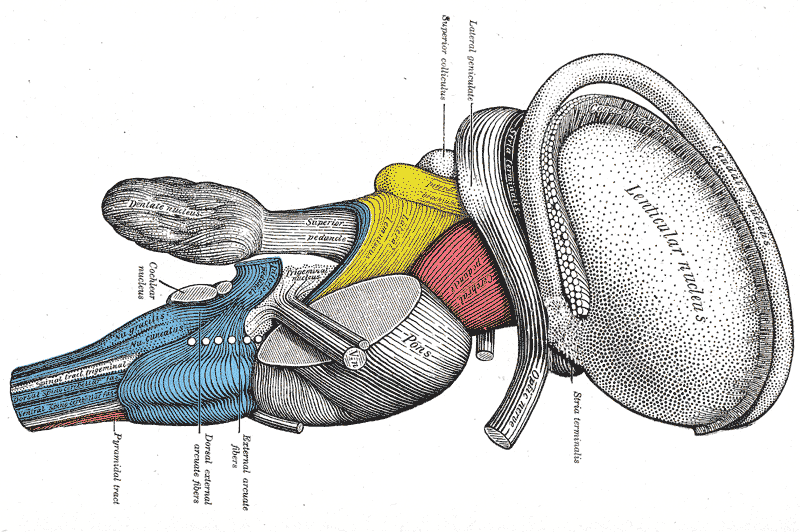
The 31 pairs of spinal nerves connect the spinal cord to the periphery in a segmental pattern. Dorsal and ventral roots carry sensory and motor fibers respectively, which unite and then branch into dorsal and ventral rami. In the cervical, lumbar, and sacral regions, the ventral rami form complex plexuses that redistribute fibers into functionally coherent peripheral nerves. Dermatomes and myotomes provide the segmental map essential for localizing neurological lesions, and understanding the brachial and lumbosacral plexuses is critical for diagnosing peripheral nerve injuries.