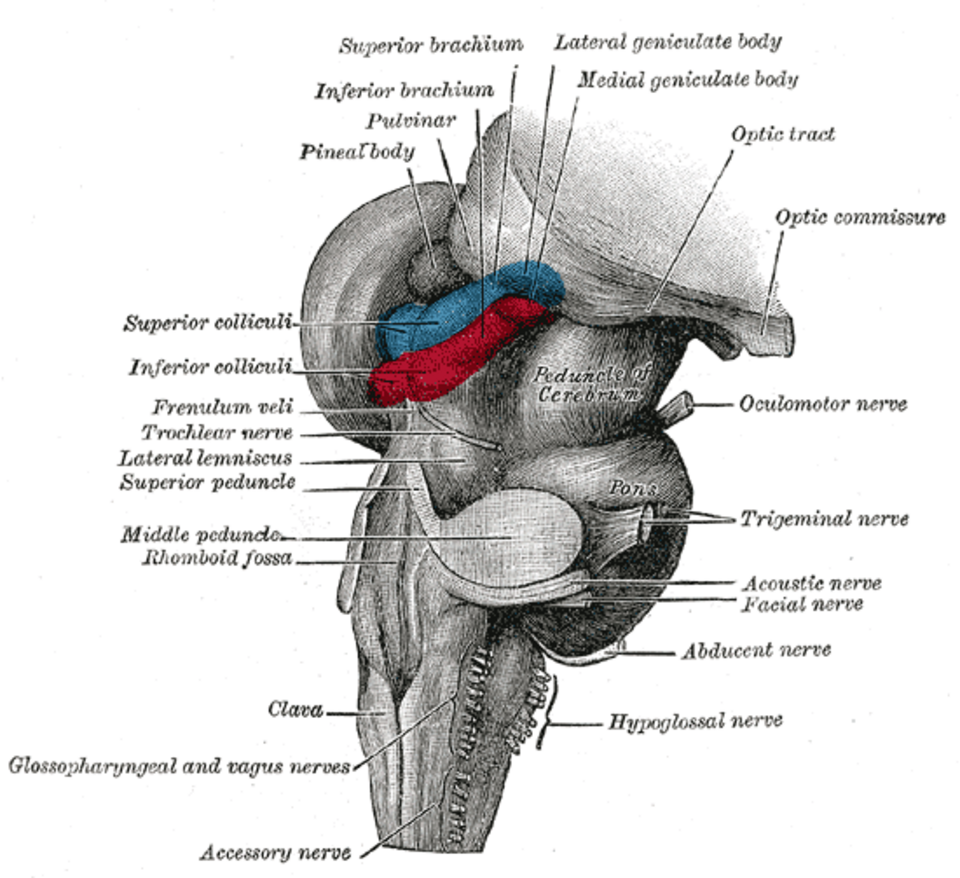
The twelve pairs of cranial nerves emerge directly from the brain and brainstem, bypassing the spinal cord. They provide the motor and sensory innervation of the head and neck, including the special senses of vision, hearing, smell, and taste. Several also carry parasympathetic fibers that control pupillary constriction, lens accommodation, salivation, and lacrimation.
Overview of the Twelve Cranial Nerves
The cranial nerves are designated by Roman numerals (I through XII) in rostral-to-caudal order, from the olfactory nerve (anterior) to the hypoglossal nerve (posterior). Each nerve can be classified by its predominant fiber type:
- Sensory (afferent) nerves: CN I (olfactory), CN II (optic), CN VIII (vestibulocochlear)
- Motor (efferent) nerves: CN III (oculomotor), CN IV (trochlear), CN VI (abducens), CN XI (spinal accessory), CN XII (hypoglossal)
- Mixed (sensory and motor) nerves: CN V (trigeminal), CN VII (facial), CN IX (glossopharyngeal), CN X (vagus)
A useful mnemonic for the names in order: Oh, Oh, Oh, To Touch And Feel Very Green Vegetables, AH!
Detailed Anatomy of Each Cranial Nerve
CN I — Olfactory Nerve (Sensory)
The olfactory nerve carries the sense of smell. Its fibers originate from olfactory receptor neurons in the nasal mucosa (the olfactory epithelium), pass through the cribriform plate of the ethmoid bone, and synapse in the olfactory bulb. From the bulb, the olfactory tract projects to the primary olfactory cortex (piriform cortex), amygdala, and entorhinal cortex.
CN II — Optic Nerve (Sensory)
The optic nerve transmits visual information from the retina to the brain. The axons of retinal ganglion cells converge at the optic disc, exit the eye, and form the optic nerve. The two optic nerves join at the optic chiasm, where fibers from the nasal (medial) retinas cross to the opposite side. After the chiasm, the optic tracts project to the lateral geniculate nucleus of the thalamus, which relays visual information to the primary visual cortex (BA 17) in the occipital lobe.
The visual field has a precise topographic organization: lesions at different points along the visual pathway produce characteristic visual field defects. A lesion of the optic nerve produces unilateral blindness. A lesion of the optic chiasm produces bitemporal hemianopia (loss of the outer half of each visual field), classically from a pituitary tumor. A lesion of the optic tract posterior to the chiasm produces contralateral homonymous hemianopia.
CN III — Oculomotor Nerve (Motor)
The oculomotor nerve innervates most of the extraocular muscles: the medial rectus, superior rectus, inferior rectus, and inferior oblique. It also innervates the levator palpebrae superioris (eyelid elevation). In addition, it carries parasympathetic fibers to the ciliary ganglion, which controls pupillary constriction (sphincter pupillae) and lens accommodation (ciliary muscle).
Complete oculomotor nerve palsy produces the classic “down and out” appearance: the eye is depressed and abducted (by the unopposed action of the superior oblique and lateral rectus). The eyelid droops (ptosis), the pupil is dilated and fixed (due to unopposed sympathetic tone), and the eye cannot move upward, downward, or medially.
CN IV — Trochlear Nerve (Motor)
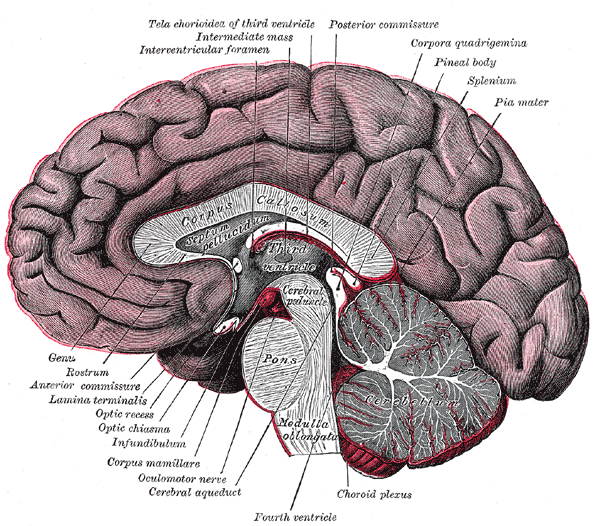
The trochlear nerve is the only cranial nerve to emerge from the dorsal aspect of the brainstem. It innervates the superior oblique muscle, which depresses the eye when it is abducted and intorts the eye when it is adducted. Trochlear nerve palsy causes vertical diplopia (double vision) that is worse when looking downward and inward — patients often tilt their head to compensate.
CN V — Trigeminal Nerve (Mixed)
The trigeminal nerve is the largest cranial nerve. It provides sensory innervation to the face and motor innervation to the muscles of mastication. It has three major divisions:
- V₁ (Ophthalmic division). Sensory to the scalp, forehead, upper eyelid, cornea, nasal cavity, and frontal sinuses. Exits the skull through the superior orbital fissure.
- V₂ (Maxillary division). Sensory to the mid-face, lower eyelid, upper lip, maxillary sinus, upper teeth, and palate. Exits through the foramen rotundum.
- V₃ (Mandibular division). Sensory to the lower face, lower lip, lower teeth, and anterior two-thirds of the tongue. Motor to the temporalis, masseter, medial and lateral pterygoids, tensor veli palatini, and mylohyoid. Exits through the foramen ovale.
CN VI — Abducens Nerve (Motor)
The abducens nerve innervates the lateral rectus muscle, which abducts the eye. It has the longest intracranial course of any cranial nerve, making it vulnerable to increased intracranial pressure. Abducens nerve palsy causes convergent strabismus (the eye deviates medially) and horizontal diplopia that is worse when looking toward the affected side.
CN VII — Facial Nerve (Mixed)
The facial nerve has both motor and sensory components. Its motor division innervates the muscles of facial expression, the stapedius muscle (dampening loud sounds), and the posterior belly of the digastric. Its sensory division (nervus intermedius) carries taste from the anterior two-thirds of the tongue and parasympathetic fibers to the submandibular and sublingual salivary glands, the lacrimal gland, and the nasal mucosa.
The facial nerve exits the skull through the stylomastoid foramen. Before exiting, it passes through the facial canal in the temporal bone, where it is vulnerable to inflammation (Bell’s palsy).
CN VIII — Vestibulocochlear Nerve (Sensory)
The vestibulocochlear nerve consists of two anatomically distinct divisions:
Cochlear division. Carries auditory information from the hair cells of the organ of Corti (within the cochlea) to the cochlear nuclei in the brainstem. Sound frequency is mapped tonotopically, with high frequencies processed at the base of the cochlea and low frequencies at the apex.
Vestibular division. Carries information about balance and head position from the semicircular canals (angular acceleration), utricle (linear acceleration), and saccule (gravity) to the vestibular nuclei and cerebellum.
Hearing loss is classified as conductive (problem in the outer or middle ear) or sensorineural (problem in the cochlea or auditory nerve). Vertigo — the false sensation of spinning — typically indicates vestibular dysfunction.
CN IX — Glossopharyngeal Nerve (Mixed)
The glossopharyngeal nerve has a wide range of functions. It carries taste from the posterior third of the tongue, general sensation from the pharynx and tonsils, and sensory information from the carotid body (chemoreceptors) and carotid sinus (baroreceptors). Its motor fibers innervate the stylopharyngeus muscle (pharyngeal elevation). Its parasympathetic fibers innervate the parotid gland via the otic ganglion.
The pharyngeal reflex (gag reflex) is mediated by CN IX (afferent) and CN X (efferent). Absence of the gag reflex can indicate damage to either nerve.
CN X — Vagus Nerve (Mixed)
The vagus nerve is the longest and most widely distributed cranial nerve. It has the most extensive autonomic functions of any nerve, providing parasympathetic innervation to nearly every thoracic and abdominal organ. Its functions include:
- Motor: Pharyngeal and laryngeal muscles (speech and swallowing), soft palate (except tensor veli palatini)
- Sensory: Sensation from the pharynx, larynx, trachea, esophagus, and the external auditory meatus
- Visceral sensory: Taste from the epiglottis and sensation from the thoracic and abdominal viscera
- Parasympathetic: Heart rate reduction (bradycardia), bronchoconstriction, increased gastrointestinal motility and secretion
The recurrent laryngeal nerve, a branch of the vagus, loops around the aortic arch on the left and the subclavian artery on the right before ascending to innervate the intrinsic laryngeal muscles. Damage to the recurrent laryngeal nerve causes vocal cord paralysis and hoarseness.
CN XI — Spinal Accessory Nerve (Motor)
The spinal accessory nerve has a unique origin: its motor neurons are located in the cervical spinal cord (C1–C5/6), not in the brainstem. The fibers ascend through the foramen magnum, briefly enter the cranial cavity, and then exit through the jugular foramen. It innervates the sternocleidomastoid (which turns the head to the opposite side) and the trapezius (which elevates the shoulders and retracts the scapula).
CN XII — Hypoglossal Nerve (Motor)
The hypoglossal nerve innervates the intrinsic and extrinsic muscles of the tongue (all except the palatoglossus). It emerges from the medulla as a series of rootlets that converge and exit the skull through the hypoglossal canal. Damage causes unilateral tongue weakness — when the tongue is protruded, it deviates toward the side of the injury.
Summary of Cranial Nerve Functions
| Nerve | Type | Major Functions | Exit from Skull |
|---|---|---|---|
| I (Olfactory) | Sensory | Smell | Cribriform plate |
| II (Optic) | Sensory | Vision | Optic canal |
| III (Oculomotor) | Motor | Eye movement, pupil constriction, lens accommodation | Superior orbital fissure |
| IV (Trochlear) | Motor | Eye movement (superior oblique) | Superior orbital fissure |
| V (Trigeminal) | Mixed | Facial sensation (V₁, V₂, V₃); mastication (V₃) | SOF (V₁), rotundum (V₂), ovale (V₃) |
| VI (Abducens) | Motor | Eye movement (lateral rectus) | Superior orbital fissure |
| VII (Facial) | Mixed | Facial expression, taste (anterior ⅔ tongue), salivation, lacrimation | Stylomastoid foramen |
| VIII (Vestibulocochlear) | Sensory | Hearing, balance | Internal acoustic meatus |
| IX (Glossopharyngeal) | Mixed | Taste (posterior ⅓ tongue), pharyngeal sensation, swallowing, salivation | Jugular foramen |
| X (Vagus) | Mixed | Pharynx/larynx motor, visceral sensation and parasympathetic, taste (epiglottis) | Jugular foramen |
| XI (Spinal Accessory) | Motor | Sternocleidomastoid, trapezius (head turning, shoulder elevation) | Jugular foramen |
| XII (Hypoglossal) | Motor | Tongue movement | Hypoglossal canal |
Summary
The twelve cranial nerves are a fundamental component of neurological anatomy. They provide all motor and sensory innervation to the head and neck, mediate the special senses, and the vagus nerve extends parasympathetic control throughout the body. Systematic examination of the cranial nerves is a cornerstone of the neurological physical examination, and understanding their anatomy is essential for localizing lesions in the brainstem and skull base.