The endocrine system is the body’s network of ductless glands that secrete hormones directly into the bloodstream. These chemical messengers travel to distant target cells, regulating growth, metabolism, reproduction, circadian rhythms, and homeostasis. Together with the nervous system, the endocrine system coordinates the body’s physiological responses.
Principles of Endocrine Function
Hormones are chemical signals released by endocrine glands into the interstitial fluid and then into the blood. They act on target cells that possess specific receptors. Hormones are classified by chemical structure:
- Peptide hormones. Chains of amino acids (e.g., insulin, growth hormone, ACTH). These are water-soluble, cannot cross the cell membrane, and act via cell-surface receptors linked to second-messenger systems.
- Steroid hormones. Derived from cholesterol (e.g., cortisol, testosterone, estrogen). These are lipid-soluble, cross the cell membrane freely, and act via intracellular receptors that directly regulate gene transcription.
- Amine hormones. Modified amino acids (e.g., thyroid hormones, epinephrine, dopamine). Thyroid hormones are lipid-soluble and act like steroids; catecholamines are water-soluble and act like peptides.
Feedback regulation is the key mechanism controlling hormone secretion. In negative feedback, rising hormone levels inhibit further release. In positive feedback (less common), rising hormone levels stimulate further release, as seen during the luteinizing hormone surge that triggers ovulation.
The Hypothalamus-Pituitary Axis
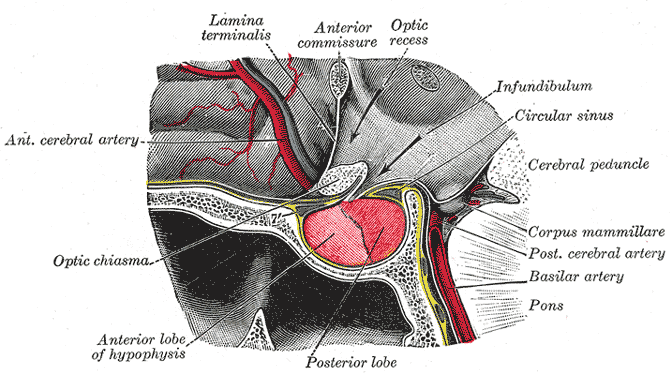
The hypothalamus and pituitary gland form the central command of the endocrine system. The pituitary sits in the sella turcica of the sphenoid bone, connected to the hypothalamus by the infundibulum (pituitary stalk).
Hypothalamus
The hypothalamus produces two types of hormonal output:
Releasing and inhibiting hormones. These are secreted into the hypothalamic-hypophyseal portal system, a specialized venous network that carries them directly to the anterior pituitary. Key hypothalamic hormones include:
- Thyrotropin-releasing hormone (TRH) — stimulates TSH release
- Corticotropin-releasing hormone (CRH) — stimulates ACTH release
- Gonadotropin-releasing hormone (GnRH) — stimulates LH and FSH release
- Growth hormone-releasing hormone (GHRH) — stimulates GH release
- Somatostatin (growth hormone-inhibiting hormone) — inhibits GH and TSH release
- Prolactin-inhibiting hormone (dopamine) — inhibits prolactin release
Posterior pituitary hormones. These are synthesized in the hypothalamus and transported along axons to the posterior pituitary for storage and release:
- Antidiuretic hormone (ADH, vasopressin) — promotes water reabsorption in the kidney
- Oxytocin — stimulates uterine contraction during labor and milk ejection during breastfeeding
Anterior Pituitary (Adenohypophysis)
The anterior pituitary produces and secretes six major hormones:
| Hormone | Target | Primary Actions |
|---|---|---|
| Growth hormone (GH) | Liver, bone, muscle | Promotes growth, protein synthesis, lipolysis |
| Thyroid-stimulating hormone (TSH) | Thyroid gland | Stimulates thyroid hormone production and release |
| Adrenocorticotropic hormone (ACTH) | Adrenal cortex | Stimulates cortisol release |
| Prolactin (PRL) | Mammary glands | Stimulates milk production |
| Follicle-stimulating hormone (FSH) | Ovaries/testes | Stimulates follicle development, sperm production |
| Luteinizing hormone (LH) | Ovaries/testes | Triggers ovulation, stimulates testosterone |
Posterior Pituitary (Neurohypophysis)
The posterior pituitary stores and releases two hormones synthesized in the hypothalamus:
Antidiuretic hormone (ADH). Acts on the collecting ducts of the kidney to increase water reabsorption, concentrating the urine. ADH release is stimulated by increased plasma osmolality (detected by osmoreceptors in the hypothalamus) and decreased blood volume.
Oxytocin. In women, it stimulates uterine smooth muscle contraction during labor and myoepithelial cell contraction for milk ejection. In both sexes, it is involved in social bonding and pair formation.
Hypothalamic-Pituitary Portal System
This specialized vascular network is essential for anterior pituitary regulation. The superior hypophyseal artery supplies the median eminence of the hypothalamus, where it forms a capillary plexus. Hypothalamic releasing and inhibiting hormones enter this plexus and travel through the portal veins to the anterior pituitary, where they diffuse into a second capillary plexus to reach their target cells. This direct route ensures that tiny amounts of hypothalamic hormones reach the pituitary without dilution in the systemic circulation.
Thyroid Gland
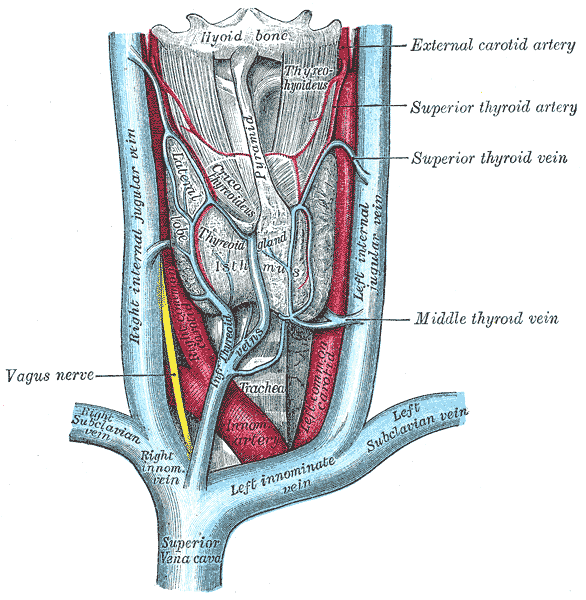
The thyroid gland is located in the anterior neck, inferior to the thyroid cartilage, with two lobes connected by an isthmus. It produces three hormones:
- Triiodothyronine (T₃). The more active form, with approximately four times the potency of T₄.
- Thyroxine (T₄). The precursor form, converted to T₃ in peripheral tissues.
- Calcitonin. Produced by parafollicular (C) cells; lowers blood calcium by inhibiting osteoclast activity.
Thyroid hormones increase basal metabolic rate, promote growth and development, and are essential for fetal and neonatal brain development. TSH from the pituitary stimulates all aspects of thyroid hormone synthesis and release, while elevated T₃/T₄ levels inhibit TSH through negative feedback.
Parathyroid Glands
Four small parathyroid glands lie on the posterior surface of the thyroid gland. They secrete parathyroid hormone (PTH), which increases blood calcium by:
- Stimulating osteoclast activity (bone resorption)
- Increasing renal calcium reabsorption
- Stimulating renal production of active vitamin D (calcitriol), which increases intestinal calcium absorption
PTH secretion is regulated by blood calcium levels through negative feedback — low calcium stimulates PTH release, high calcium suppresses it.
Adrenal Glands
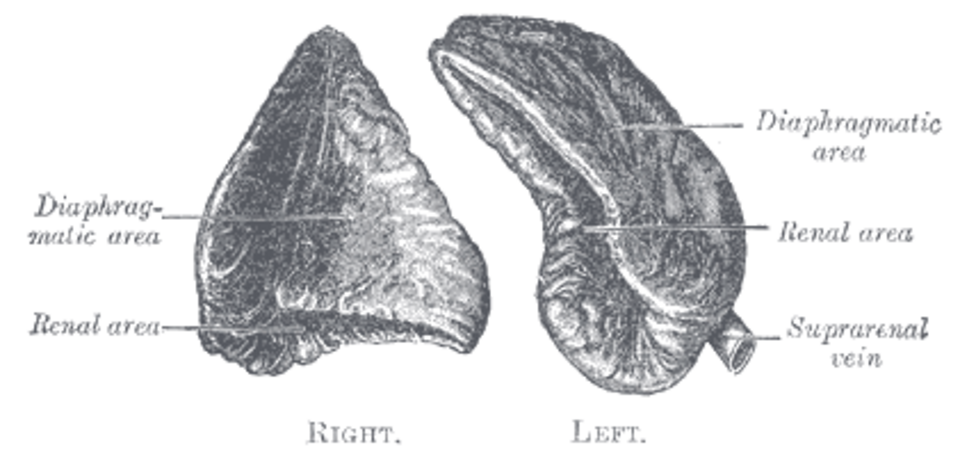
The adrenal glands sit atop each kidney, encased in perirenal fat. Each gland has two functionally distinct regions:
Adrenal Cortex (80–90% of gland mass)
The cortex produces steroid hormones in three zones:
Zona glomerulosa (outermost). Produces mineralocorticoids (primarily aldosterone), which regulate sodium and potassium balance. Aldosterone promotes sodium reabsorption and potassium excretion in the kidney, indirectly controlling blood volume and blood pressure. Its secretion is regulated by the renin-angiotensin-aldosterone system (RAAS) and plasma potassium levels.
Zona fasciculata (middle). Produces glucocorticoids (primarily cortisol), which regulate metabolism, suppress inflammation, and help the body respond to stress. Cortisol secretion is controlled by ACTH from the pituitary, with a strong circadian rhythm — peak levels in the early morning, nadir at night.
Zona reticularis (innermost). Produces adrenal androgens (dehydroepiandrosterone, DHEA), which are converted to testosterone and estrogen in peripheral tissues.
Adrenal Medulla (10–20% of gland mass)
The medulla is essentially a modified sympathetic ganglion. It produces epinephrine (80%) and norepinephrine (20%) in response to sympathetic preganglionic stimulation. Unlike postganglionic sympathetic neurons (which release norepinephrine locally), the medulla releases these catecholamines directly into the bloodstream, producing a sustained, whole-body fight-or-flight response.
Pancreatic Islets (Islets of Langerhans)
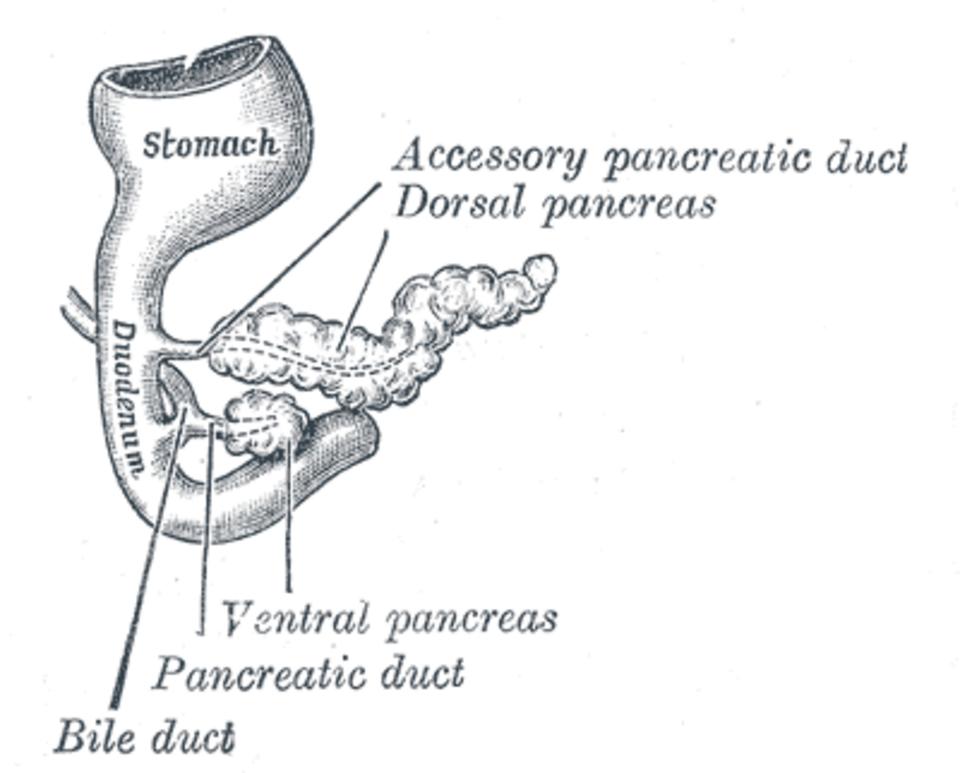
The pancreas has both exocrine (digestive enzyme secretion) and endocrine functions. The endocrine portion consists of approximately 1 million microscopic clusters called islets of Langerhans, scattered throughout the pancreas but concentrated in the tail.
Four cell types produce distinct hormones:
- Beta cells (50–80% of islet cells). Produce insulin, which lowers blood glucose by promoting cellular glucose uptake and storage as glycogen.
- Alpha cells (15–20%). Produce glucagon, which raises blood glucose by stimulating glycogen breakdown and gluconeogenesis.
- Delta cells (3–10%). Produce somatostatin, which inhibits both insulin and glucagon release (paracrine regulation).
- PP cells (1%). Produce pancreatic polypeptide, which regulates digestive function.
Pineal Gland
The pineal gland is a small, pinecone-shaped gland in the epithalamus, posterior to the third ventricle. It secretes melatonin, a hormone derived from serotonin that regulates circadian rhythms. Melatonin production is high at night (induced by darkness, detected by the retina and relayed via the suprachiasmatic nucleus) and suppressed during daylight. The pineal gland calcifies with age and is visible on CT scans as a landmark.
Gonads
The ovaries and testes (gonads) produce sex hormones in addition to gametes:
Testes. Leydig (interstitial) cells produce testosterone under the influence of LH. Testosterone drives spermatogenesis, development of male secondary sexual characteristics, libido, and muscle growth. Sertoli cells support spermatogenesis and produce inhibin, which inhibits FSH.
Ovaries. Theca and granulosa cells produce estrogen and progesterone under the influence of FSH and LH. Estrogen drives development of female secondary sexual characteristics, regulates the menstrual cycle, and supports pregnancy. Progesterone prepares the endometrium for implantation and maintains pregnancy.
Summary
The endocrine system uses hormones as chemical messengers to regulate virtually every physiological process. The hypothalamus-pituitary axis serves as the master regulator, controlling the thyroid, adrenal, and reproductive glands through feedback loops. The pancreatic islets regulate blood glucose, the pineal gland governs circadian rhythms, and the gonads control reproduction. Understanding these glands, their hormones, and their regulatory mechanisms is essential for comprehending both normal physiology and the broad range of endocrine disorders.