New Zealand Spinach

Botanical Overview

New Zealand Spinach (Tetragonia tetragonioides) belongs to the Aizoaceae family. Limited but reliable traditional records indicate this plant has recognized medicinal applications in one or more healing traditions. This species belongs to the Aizoaceae family, a group of flowering plants.
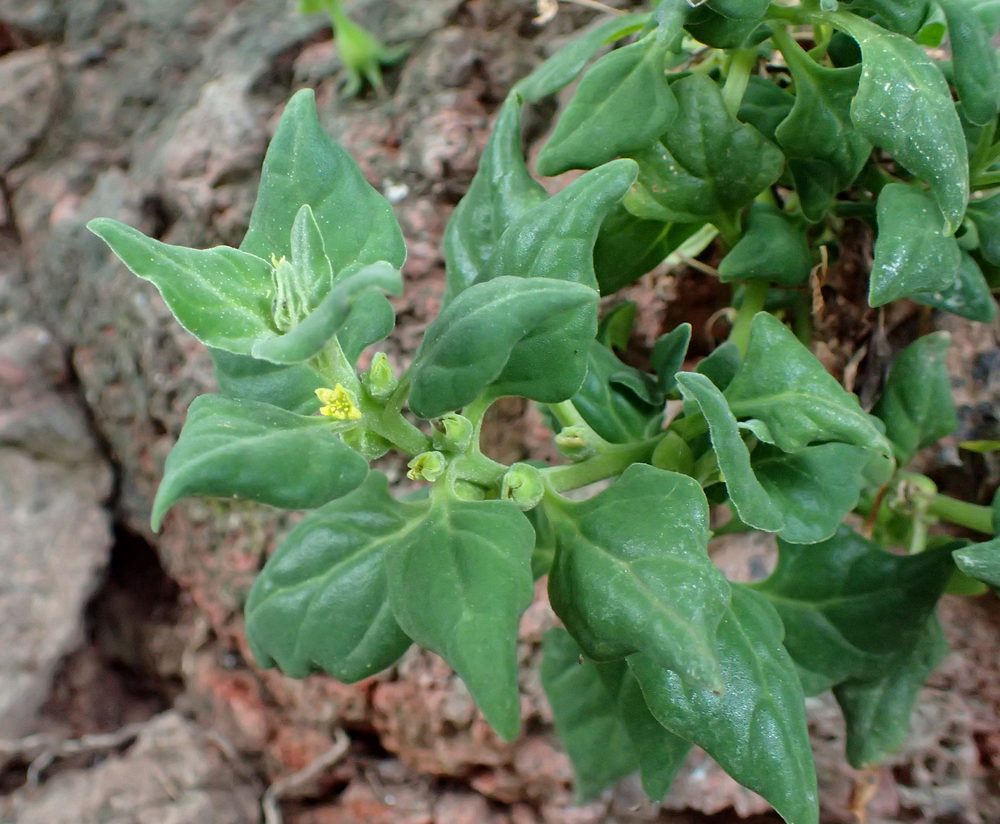
General Description

It is often cultivated as a leafy vegetable.

ⓘ Information
Description adapted from Wikipedia (CC BY-SA 4.0).

Geographic Distribution

New Zealand Spinach has been recorded in 10 countries and territories worldwide, including Spain, France, United Kingdom, Japan, South Korea, and others.

Traditional Uses

New Zealand Spinach has been traditionally used for immune system support.

Immune system support.

  • Cancer

Immune support involves taking the herb as a decoction or tincture over extended periods. The active compounds stimulate immune cell activity and provide antimicrobial protection.

Active Compounds

Phytochemical research has identified 30 compounds in this species, including a diverse array of phytochemical classes (see the Complete Chemical Inventory below for the full list).

The identified compounds include the following categories:

  • Alkaloid: nitrogenous compounds with diverse pharmacological activities
ⓘ Information
Information on this page is compiled from Dr. Duke’s Phytochemical and Ethnobotanical Databases (USDA ARS), a public domain resource. Consult a healthcare professional before using any herbal preparation.

Distribution and Conservation

Reported distribution: Spain, France, United Kingdom, Japan, South Korea, New Caledonia, Portugal, Reunion, United States, Unknown.

Complete Use Records

CategoryCultural Context
CancerElsewhere
LarvicideElsewhere
LungElsewhere
ScurvyElsewhere
IntestineElsewhere

Complete Chemical Inventory

CompoundFormulaMW
(2E)-3,7,11,15-TETRAMETHYLHEXADECANAL
6,10,14-TRIMETHYL-2-METHYLENEPENTADECANALC₁₉H₃₆O280.5 Da
ASCORBIC-ACIDC₆H₈O₆176.12 Da
ASH
BETA-CAROTENEC₄₀H₅₆536.9 Da
CALCIUMCa40.08 Da
CARBOHYDRATES
FATC₁₆H₃₂O₂256.42 Da
FIBER
IRONFe55.84 Da
KILOCALORIES
LINOLEIC-ACIDC₁₈H₃₂O₂280.4 Da
LINOLENIC-ACIDC₁₈H₃₀O₂278.4 Da
MAGNESIUMMg24.305 Da
MUFA
MYRISTIC-ACIDC₁₄H₂₈O₂228.37 Da
NIACINC₆H₅NO₂123.11 Da
OLEIC-ACIDC₁₈H₃₄O₂282.5 Da
PALMITIC-ACIDC₁₆H₃₂O₂256.42 Da
PALMITOLEIC-ACIDC₁₆H₃₀O₂254.41 Da
PANTOTHENIC-ACIDC₉H₁₇NO₅219.23 Da
PHOSPHORUSP30.97376200 Da
POTASSIUMK39.0983 Da
PROTEIN
PUFA
RIBOFLAVINC₁₇H₂₀N₄O₆376.4 Da
SFAC₆₀H₉₁N₅O₁₃1090.4 Da
SODIUMNa22.9897693 Da
STEARIC-ACIDC₁₈H₃₆O₂284.5 Da
THIAMINC₁₂H₁₇N₄OS+265.36 Da

Data from PubChem (NIH/NLM, public domain).


References & Further Reading

External Research Links

Data Sources