Botanical Overview
Verbena (Stachytarpheta cayennensis) belongs to the Verbenaceae family. Limited but reliable traditional records indicate this plant has recognized medicinal applications in one or more healing traditions. The verbena family (Verbenaceae) includes herbs, shrubs, and trees with opposite leaves and spikes or clusters of small, tubular flowers with four or five petals. Many species produce aromatic oils in glandular hairs on their leaves and stems.
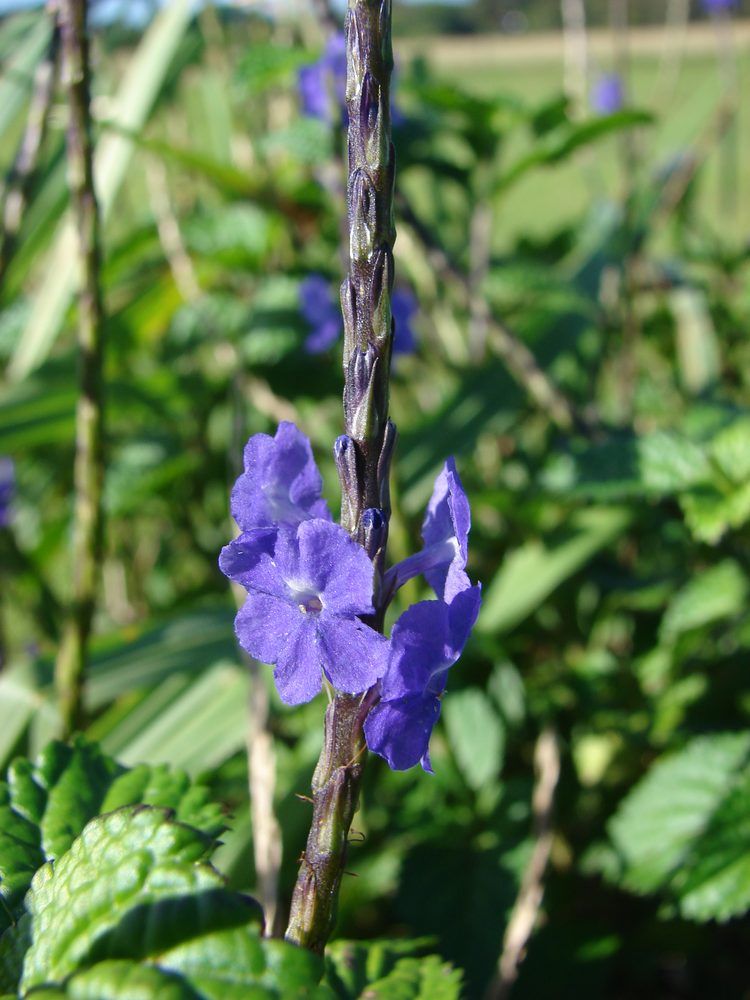
General Description
Names in other languages include honagasō (Japanese), gervão-urticante, piche de gato, rabo de zorro (Spanish), herbe à chenille, herbe bleue, queue de rat (French), ōi or ōwī (Hawaiian), sakura or ouchung (Chuukese), and tiāki (Māori). It is native to the Americas, from Mexico south through Central and South America to Argentina, as well as many islands of the Caribbean. It is known in many other parts of the world as an introduced species, including regions in Africa, India, Indonesia, Australia, Florida in the United States, and many Pacific Islands. Its distribution is now considered pantropical. In many places, such as New Caledonia, it has become an invasive species.
Family Context
The Verbenaceae family is widely distributed. Notable medicinal members include:
- Lantana — 59 documented uses
- Vervain — 58 documented uses
- Brazilian Tea — 55 documented uses
- White Lippia — 20 documented uses
Geographic Distribution
Verbena has been recorded in 10 countries and territories worldwide, including Argentina, Australia, Bolivia, Brazil, Colombia, and others.
Traditional Uses
Verbena has been traditionally used for digestive health, fever management, and cardiovascular health, among other applications.
Digestive health.
- Dysentery
- Vermifuge
For digestive complaints, the herb is typically prepared as a tea or decoction taken before meals. The bitter compounds stimulate digestive secretions and improve nutrient absorption. Some traditions use the powdered root or leaves in small doses as a stomachic tonic.
Fever management.
- Fever
Febrifuge preparations are typically administered as hot teas to induce perspiration, which helps the body regulate temperature. The patient is kept warm and encouraged to rest while the herb promotes sweating.
Cardiovascular health.
- Heart
Active Compounds
Phytochemical research has identified 3 compounds in this species: citral, geraniol, salicylic-acid.