Botanical Overview
Indian Pink (Spigelia marilandica) belongs to the Loganiaceae family. Limited but reliable traditional records indicate this plant has recognized medicinal applications in one or more healing traditions. This species belongs to the Loganiaceae family, a group of flowering plants.
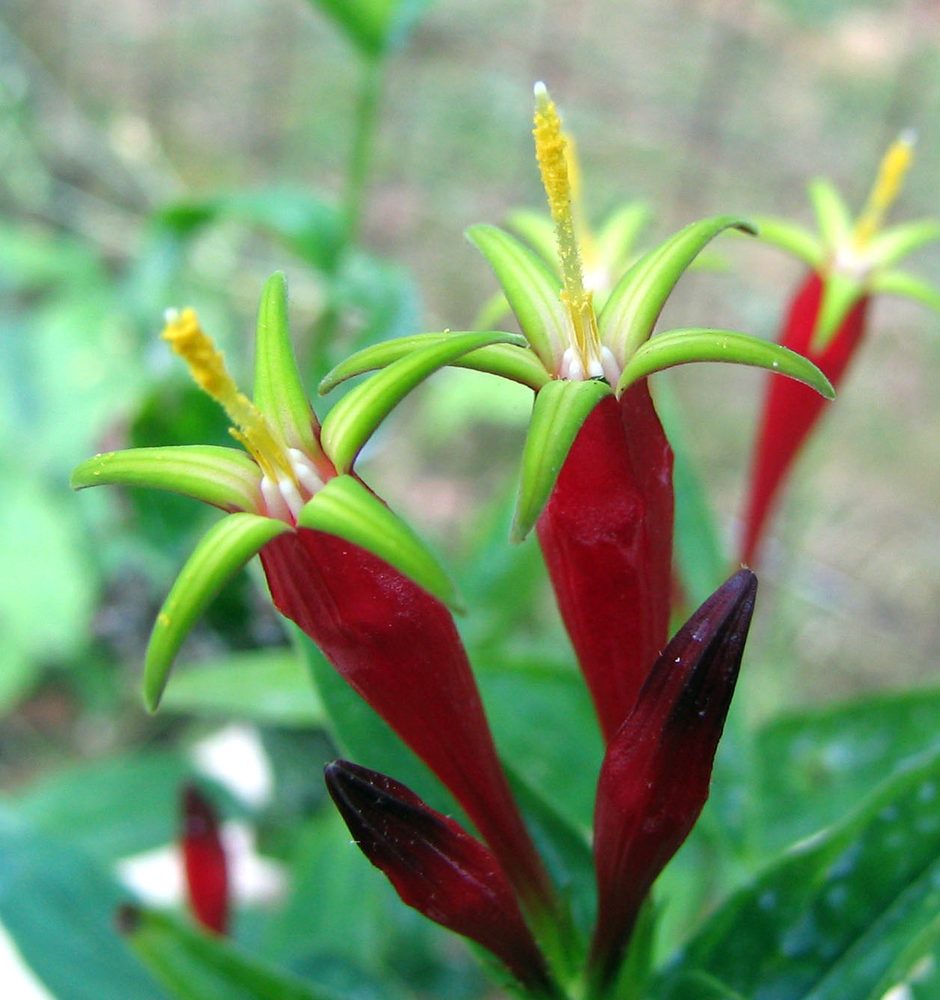
General Description
It flowers in late spring and early summer and tends to be found in low moist woods, ravines, or stream banks in partial or full shade. The flowers are red, erect, tubes with a star-shaped yellow center at the tip. It will grow 30–61 cm (1–2 ft) high with a spread of 15–46 cm (0. 5–1. 5 ft). It is used as an ornamental plant, more popular in the UK and Europe than its native US. Its dried roots are used as an anthelmintic (dewormer), and are followed by a saline aperient to avoid unpleasant side effects and ensure that the toxic root is expelled along with the worms. The roots are also a narcotic hallucinogen, but the alkaloid spigiline, which is largely responsible for both its hallucinogenic and medicinal action, can cause increased heart action, vertigo, convulsions and death if overdosed.
Family Context
The Loganiaceae family is widely distributed. Notable medicinal members include:
- Yellow Jessamine — 34 documented uses
- Nux-Vomica — 34 documented uses
Geographic Distribution
Indian Pink has been recorded in 10 countries and territories worldwide, including Austria, Belgium, Canada, France, Kiribati, and others.
Traditional Uses
Indian Pink has been traditionally used for digestive health, nervous system disorders, and fever management.
Digestive health.
- Vermifuge
For digestive complaints, the herb is typically prepared as a tea or decoction taken before meals. The bitter compounds stimulate digestive secretions and improve nutrient absorption. Some traditions use the powdered root or leaves in small doses as a stomachic tonic.
Nervous system disorders.
- Narcotic
- Sedative
Nervous system support involves taking the herb as a warm tea, often in the evening or before bed. The calming compounds interact with neurotransmitter systems to promote relaxation and restful sleep.
Fever management.
- Malaria
Febrifuge preparations are typically administered as hot teas to induce perspiration, which helps the body regulate temperature. The patient is kept warm and encouraged to rest while the herb promotes sweating.
Active Compounds
Phytochemical research has identified 6 compounds in this species, including a diverse array of phytochemical classes (see the Complete Chemical Inventory below for the full list).
The identified compounds include the following categories:
- Alkaloid: nitrogenous compounds with diverse pharmacological activities
- Tannin: astringent compounds that tighten tissues and resist infection