Botanical Overview
Cassabanana (Sicana odorifera) belongs to the Cucurbitaceae family. While not among the most extensively documented medicinal plants, this species has recorded uses that warrant attention from researchers and practitioners. The gourd family (Cucurbitaceae) includes climbing or trailing vines with tendrils, large alternate leaves, and showy yellow or white flowers that are typically unisexual. The fruits are fleshy gourds, melons, or squashes with many seeds. Many species produce cucurbitacins, bitter compounds with purgative and anti-inflammatory activity.
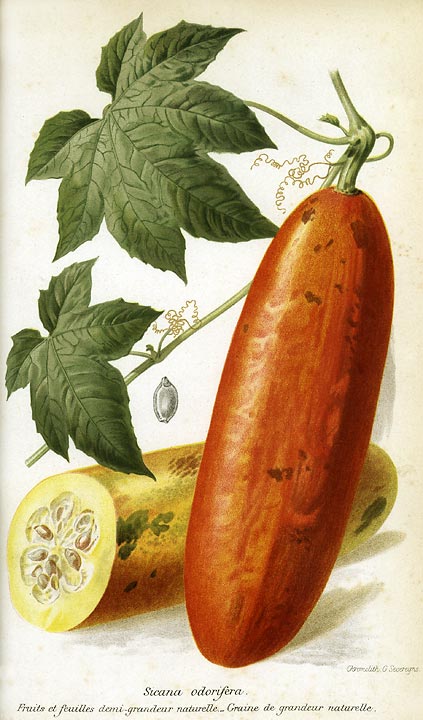
General Description
English names include cassabanana or casbanan, sikana, puttigel and musk cucumber. Grown as an ornamental plant and for its sweet edible fruit, the vigorous, fleshy vine can reach up to 50 feet (or 15 meters) in height, climbing with four-part adhesive tendrils with suction-cup discs to climb surfaces, including trees and buildings. The large, hairy, palmately lobed leaves grow to 30 cm (12 in) in width. The fruit is long and cylindrical, similar to a giant hot dog or oversized cucumber, reaching 12 to 24 inches (or 60 cm) in length. Despite its name, it is a relative of melons and squash, featuring a tough, waxy rind that turns shades of deep purple, maroon, or orange when mature. It is most famous for its intense, melon-like taste when ripe and requires high temperatures to ripen. The sweet, aromatic, yellow-to-orange flesh of the mature fruit is eaten raw or made into preserves. The immature fruit can be cooked as a vegetable. Its fragrance is so potent that it’s often used as a natural air freshener or moth repellent in homes and linen closets.
Family Context
The Cucurbitaceae family is widely distributed in tropical and subtropical regions. Notable medicinal members include:
- Bitter Melon — 88 documented uses
- Luffa — 41 documented uses
- Calabash Gourd — 38 documented uses
- Chinese Cucumber — 31 documented uses
Geographic Distribution
Cassabanana has been recorded in 10 countries and territories worldwide, including Bolivia, Brazil, Colombia, Costa Rica, Ecuador, and others.
Active Compounds
Phytochemical research has identified 15 compounds in this species, including a diverse array of phytochemical classes (see the Complete Chemical Inventory below for the full list).
The identified compounds include the following categories:
- Alkaloid: nitrogenous compounds with diverse pharmacological activities