Botanical Overview
Sugarcane (Saccharum officinarum) is a species in the Poaceae family. The grass family (Poaceae) includes annual and perennial herbs with hollow, jointed stems and narrow leaves with parallel venation. The flowers are reduced and arranged in spikelets, and the fruits are grains (caryopses). This family provides the majority of the world’s food calories through cereals. Phytochemical data for this species are limited at present.
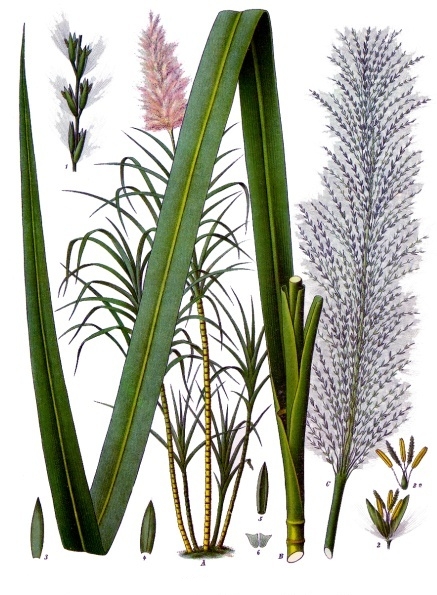
General Description
Its stout stalks are rich in sucrose, a disaccharide sugar which accumulates in the stalk internodes. It originated in New Guinea, and is now cultivated in tropical and subtropical countries worldwide for the production of sugar, ethanol and other products. It is one of the most productive and most intensively cultivated kinds of sugarcane.
Family Context
The Poaceae family is very large and globally distributed. Notable medicinal members include:
- Adlay — 54 documented uses
- Corn — 51 documented uses
- Rice — 47 documented uses
- West Indian Lemongrass — 43 documented uses
Geographic Distribution
Sugarcane has been recorded in 10 countries and territories worldwide, including Benin, Brazil, China, Colombia, Indonesia, and others.
Active Compounds
Phytochemical research has identified 2 compounds in this species: aconitic-acid, sucrose.
Research Status
Although this species has documented phytochemical constituents, its ethnobotanical and clinical documentation remains incomplete. Additional phytochemical investigation could identify novel bioactive compounds in this plant.