Botanical Overview
Butcher’s Broom (Ruscus aculeatus) belongs to the Liliaceae family. Limited but reliable traditional records indicate this plant has recognized medicinal applications in one or more healing traditions. The lily family (Liliaceae) includes bulbous herbs with erect stems, alternate leaves, and showy six-parted flowers with prominent stamens. The underground bulbs serve as storage organs rich in carbohydrates. Many species contain steroidal saponins and alkaloids with medicinal properties.
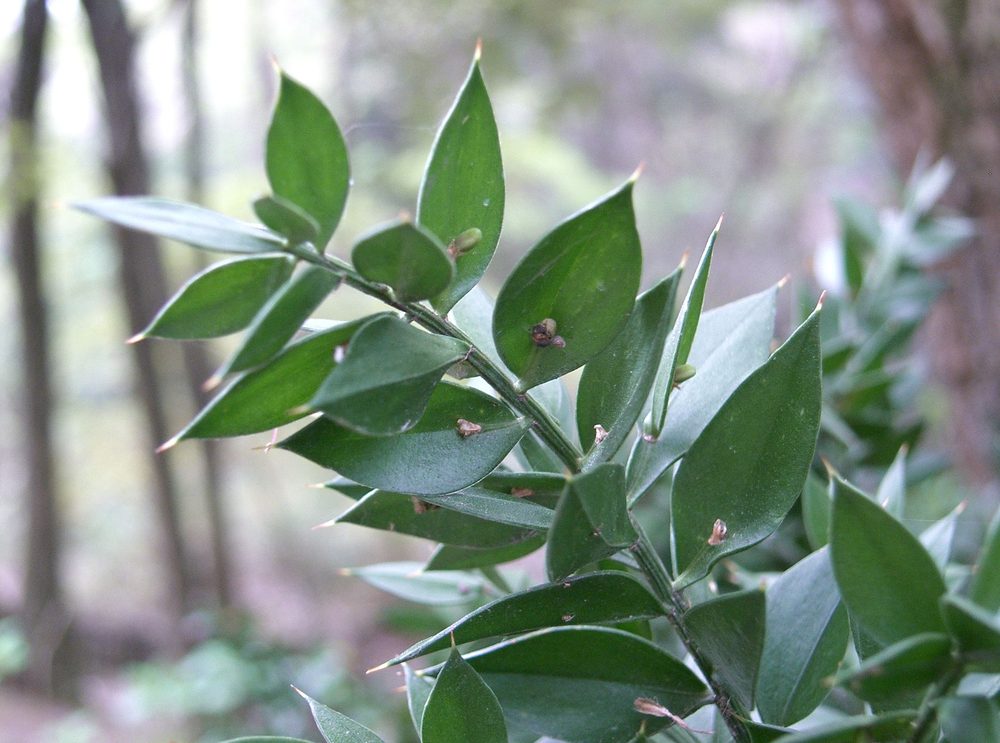
General Description
Small greenish flowers appear in spring, and are borne singly in the centre of the cladodes. The female flowers are followed by a red berry, and the seeds are bird-distributed, but the plant also spreads vegetatively by means of rhizomes. It is native to Eurasia and some northern parts of Africa. Ruscus aculeatus occurs in woodlands and hedgerows, where it is tolerant of deep shade, and also on coastal cliffs. Likely due to its attractive winter/spring color, Ruscus aculeatus has become a fairly common landscape plant. It is also widely planted in gardens, and has spread as a garden escapee in many areas outside its native range. The plant grows well in zones 7 to 9 on the USDA hardiness zone map. The Latin specific epithet aculeatus means “prickly”.
Family Context
The Liliaceae family is widely distributed in temperate regions. Notable medicinal members include:
- Onion — 72 documented uses
- American Hellebore — 52 documented uses
- Glory Lily — 36 documented uses
- Asparagus — 31 documented uses
Geographic Distribution
Butcher’s Broom has been recorded in 10 countries and territories worldwide, including Switzerland, Spain, France, United Kingdom, Croatia, and others.
Traditional Uses
Butcher’s Broom has been traditionally used for digestive health, urinary tract health, and fever management, among other applications.
Digestive health.
- Laxative
For digestive complaints, the herb is typically prepared as a tea or decoction taken before meals. The bitter compounds stimulate digestive secretions and improve nutrient absorption. Some traditions use the powdered root or leaves in small doses as a stomachic tonic.
Urinary tract health.
- Diuretic
- Gravel
Urinary tract applications typically involve drinking the herb as a mild tea, which increases urine production and helps flush the urinary system. It may be combined with other demulcent herbs to soothe irritated tissues.
Fever management.
- Fever
Febrifuge preparations are typically administered as hot teas to induce perspiration, which helps the body regulate temperature. The patient is kept warm and encouraged to rest while the herb promotes sweating.
Active Compounds
Phytochemical research has identified 30 compounds in this species, including a diverse array of phytochemical classes (see the Complete Chemical Inventory below for the full list).
The identified compounds include the following categories:
- Flavonoid: antioxidant compounds that protect cells from oxidative damage
- Sterol: cholesterol-like compounds with anti-inflammatory properties