Botanical Overview
Post Oak (Quercus stellata) belongs to the Fagaceae family. Limited but reliable traditional records indicate this plant has recognized medicinal applications in one or more healing traditions. The beech family (Fagaceae) includes trees with simple, alternate leaves and inconspicuous flowers arranged in catkins. The fruits are nuts partially enclosed in a woody cupule (acorns in oaks). This family dominates many temperate and subtropical forests and provides tannins with astringent medicinal properties.
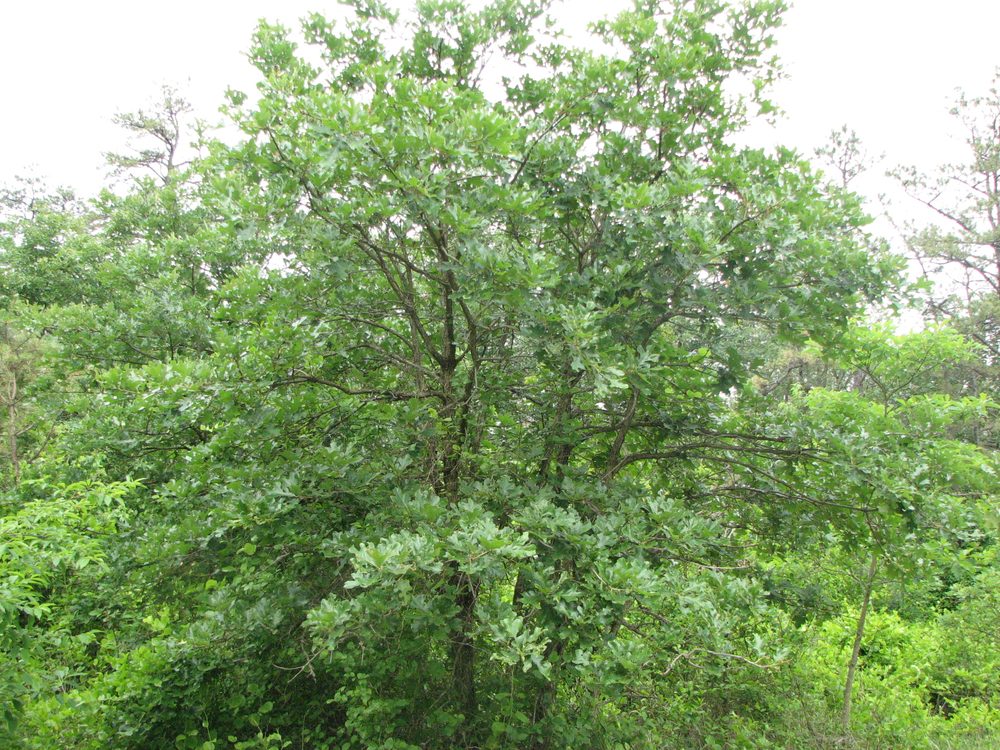
General Description
It is a slow-growing oak that lives in dry areas on the edges of fields, tops of ridges, and also grows in poor soils, and is resistant to rot, fire, and drought. Interbreeding occurs among white oaks, thus many hybrid species combinations occur. It is identifiable by the rounded cross-like shape formed by the leaf lobes and hairy underside of the leaves.
Family Context
The Fagaceae family is widely distributed in the Northern Hemisphere. Notable medicinal members include:
- European Chestnut — 27 documented uses
- White Oak — 15 documented uses
- English Oak — 15 documented uses
- Black Oak — 9 documented uses
Active Compounds
Phytochemical research has identified 24 compounds in this species, including a diverse array of phytochemical classes (see the Complete Chemical Inventory below for the full list).
The identified compounds include the following categories:
- Alkaloid: nitrogenous compounds with diverse pharmacological activities