Botanical Overview
IVORY NUT PALM (Phytelephas macrocarpa) belongs to the Arecaceae family. While not among the most extensively documented medicinal plants, this species has recorded uses that warrant attention from researchers and practitioners. The palm family (Arecaceae) includes trees, shrubs, and climbers with unbranched stems topped by a crown of large, compound, evergreen leaves. The flowers are small and clustered on branched inflorescences, and the fruits are typically drupes. Palms provide oils, waxes, and other useful products.
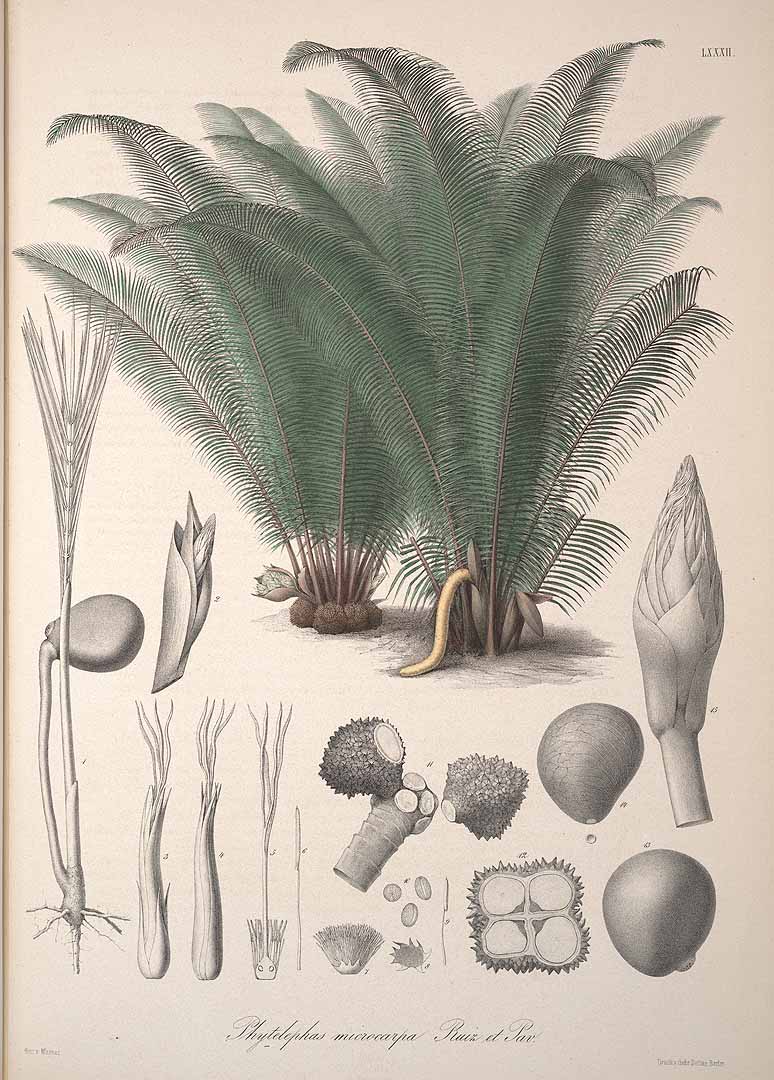
General Description
It has been introduced and cultivated in tropical regions all over the world. The trunk is about 30 cm across, with prominent leaf scars. The crown is made up of about 30 plume-like leaves or fronds, each about 8 m long, dead leaves being persistent. It is one of some 7 species of palm in the genus Phytelephas, all of which have been exploited for vegetable ivory or tagua from the seed or corozo nut. The closely related Ammandra decasperma from Colombia, and Aphandra natalia from Ecuador, are also sources of vegetable ivory, but of inferior quality and therefore not commercially significant. ‘Phytelephas macrocarpa’ translates to ’elephant plant’ with ’large fruit’, the endosperm of the nut having the texture of elephant ivory, and consisting of large, thick-walled cells of two long-chain polysaccharides, mannan A and B.
Family Context
The Arecaceae family is primarily tropical and subtropical. Notable medicinal members include:
- Coconut — 93 documented uses
- Betel Nut — 52 documented uses
- Date Palm — 42 documented uses
- Dragon’s Blood — 13 documented uses
Geographic Distribution
IVORY NUT PALM has been recorded in 10 countries and territories worldwide, including Bolivia, Brazil, Colombia, Ecuador, United Kingdom, and others.
Active Compounds
Phytochemical research has identified 11 compounds in this species, including a diverse array of phytochemical classes (see the Complete Chemical Inventory below for the full list).