Botanical Overview
Phoradendron juniperinum belongs to the Viscaceae family. While not among the most extensively documented medicinal plants, this species has recorded uses that warrant attention from researchers and practitioners. This species belongs to the Viscaceae family, a group of flowering plants.
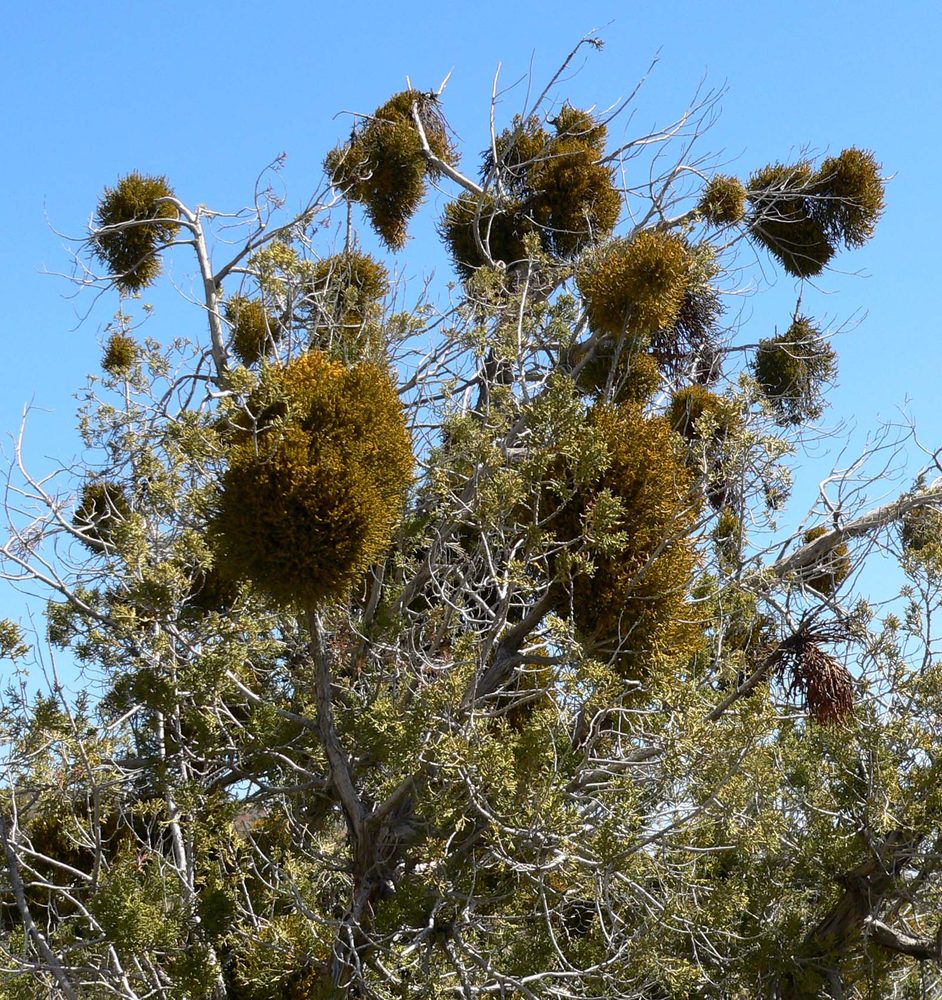
General Description
It is native to the southwestern United States and northern Mexico, where it grows in various types of woodland habitat. It has been reported from California, Nevada, Arizona, New Mexico, Oregon, Utah, Texas, Chihuahua and Sonora. This mistletoe parasitizes species of juniper, including Utah (Juniperus osteosperma), Rocky Mountain (J. scopulorum), and western juniper (J. occidentalis). It is a shrub producing many erect and spreading yellow-green branches 20 to 40 centimeters long from a woody base where it attaches to its host tree, tapping the xylem for water and nutrients. It is hemiparasitic, meaning it contains some chlorophyll and can photosynthesize some energy for itself as well. The smooth, noded branches have flattened, scale-like leaves. The plant is dioecious, with male and female individuals producing different forms of inflorescence with knobby flower clusters. Female flowers yield shiny light pink spherical berries each about 4 millimeters wide. Birds eat the fruits and excrete the undigested seeds on tree branches, where they root.
Family Context
The Viscaceae family is widely distributed. Notable medicinal members include:
- European Mistletoe — 33 documented uses
- Viscum articulatum — 9 documented uses
- Eastern Mistletoe — 4 documented uses
Geographic Distribution
Phoradendron juniperinum has been recorded in Cuba, Mexico, United States, and ZZ.
Active Compounds
Phytochemical research has identified 1 compound in this species: oleanolic-acid.