Botanical Overview
Osage-Orange (Maclura pomifera) belongs to the Moraceae family. While not among the most extensively documented medicinal plants, this species has recorded uses that warrant attention from researchers and practitioners. The fig family (Moraceae) includes trees, shrubs, and climbers with milky sap and alternate leaves. The flowers are small and clustered inside a fleshy receptacle (the fig). Many species produce latex containing proteolytic enzymes and have traditional uses for skin conditions and parasitic infections.
General Description
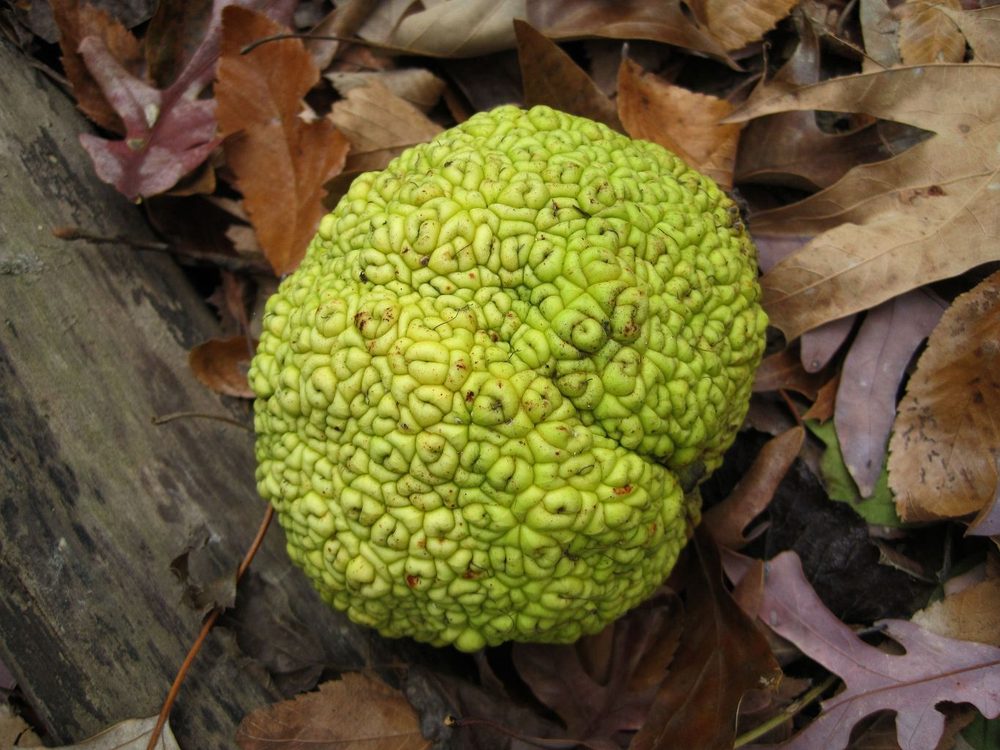
It is a member of the mulberry family, Moraceae. It typically grows about 8 to 15 m (30–50 ft) tall. The distinctive multiple fruit resembles an immature orange, is roughly spherical, bumpy, 8 to 15 cm (3–6 in) in diameter, and turns bright yellow-green in the fall. The fruit excretes a sticky white latex when cut or damaged. Despite the name “Osage orange”, it is not related to the orange. Due to its latex secretions and woody pulp, the fruit is not usually eaten by humans and rarely by foraging animals. Ecologists Daniel H. Janzen and Paul S. Martin proposed in 1982 that the fruit of this species might be an example of what has come to be called an evolutionary anachronism—that is, a fruit coevolved with a large animal seed dispersal partner that is now extinct. This hypothesis is controversial. Maclura pomifera has many common names, including mock orange, horse apple, and hedge apple. The name bois d’arc (French, meaning “bow-wood”) has also been corrupted into bodark and bodock.
Family Context
The Moraceae family is widely distributed. Notable medicinal members include:
- Sang-Pai-Pi — 77 documented uses
- Streblus asper — 35 documented uses
- Fig — 30 documented uses
- Paper Mulberry — 22 documented uses
Geographic Distribution
Osage-Orange has been recorded in 10 countries and territories worldwide, including Argentina, Australia, Canada, France, Greece, and others.
Traditional Uses
Osage-Orange has been traditionally used for cardiovascular health.
Cardiovascular health.
- Cardiac
Active Compounds
Phytochemical research has identified 30 compounds in this species, including a diverse array of phytochemical classes (see the Complete Chemical Inventory below for the full list).
The identified compounds include the following categories:
- Flavonoid: antioxidant compounds that protect cells from oxidative damage
- Sterol: cholesterol-like compounds with anti-inflammatory properties