Botanical Overview
Common St. Johnswort (Hypericum perforatum) is a flowering plant in the Clusiaceae family. This plant has earned a place in traditional medicine through its consistent therapeutic benefits, recorded across multiple cultures. The garcinia family (Clusiaceae) includes trees and shrubs with opposite, leathery leaves and resinous sap that is often yellow. The flowers are typically showy with numerous stamens, and the fruits are often fleshy capsules. Many species produce xanthones and polycyclic polyprenylated acylphloroglucinols (PPAPs) with significant biological activity.
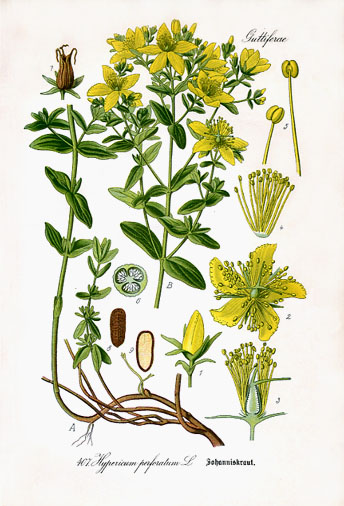
General Description
John’s wort (sometimes perforate St. John’s wort or common St. John’s wort), is a flowering plant in the family Hypericaceae. It is a hairless, perennial herb with woody roots, yellow flowers marked by black glands, and leaves that appear perforated due to translucent glands, producing thousands of seeds per plant. H. perforatum is the type species of its genus, known for its historical use in folklore and traditional medicine. Probably a hybrid between the closely related H. attenuatum and H. maculatum (imperforate St. John’s wort) that originated in Siberia, the species has spread worldwide. It can further hybridize with related species due to its allopolyploid nature. It is native to much of Europe, West and Central Asia, and parts of Africa and China and has been widely introduced elsewhere, thriving in well-drained, temperate habitats such as meadows, hillsides, and open woods with moderate rainfall and mild temperatures. It is a resilient, toxic, and invasive plant that reproduces sexually and vegetatively, supports specialized insect herbivores, suffers from plant diseases, and poses ecological and agricultural threats in many parts of the world. H. perforatum has been used for centuries in traditional medicine, especially for treating wounds and depression. To prepare it for use, the oil from its glands can be extracted or its above-ground parts can be dried and ground into a powder called herba hyperici. H. perforatum exhibits antidepressant effects comparable to drugs with fewer side effects for mild to moderate depression (for which it is approved in the European Union); however, it may interact with various medications by accelerating their metabolism.
Family Context
The Clusiaceae family is primarily tropical. Notable medicinal members include:
- Mamey — 23 documented uses
- Mesua ferrea — 16 documented uses
- Mangosteen — 13 documented uses
- Brindleberry — 5 documented uses
Geographic Distribution
Common St. Johnswort has been recorded in 10 countries and territories worldwide, including Australia, Belgium, Switzerland, Germany, Denmark, and others.
Traditional Uses
Common St. Johnswort has been traditionally used for digestive health, respiratory conditions, and skin and wound care, among other applications.
Digestive health.
- Vermifuge
For digestive complaints, the herb is typically prepared as a tea or decoction taken before meals. The bitter compounds stimulate digestive secretions and improve nutrient absorption. Some traditions use the powdered root or leaves in small doses as a stomachic tonic.
Respiratory conditions.
- Expectorant
- Catarrh
Respiratory conditions are addressed through steam inhalation of the herb’s vapors or internal use as a warm tea. The hot infusion acts as an expectorant, helping to loosen phlegm and clear congestion. Some traditions combine it with honey for coughs.
Skin and wound care.
- Wound
- Sore
For skin conditions, the fresh or dried plant is applied topically as a poultice, wash, or compress. A strong decoction can be used to clean wounds and sores. The antimicrobial properties help prevent infection while promoting tissue repair.
Active Compounds
Phytochemical research has identified 30 compounds in this species, including a diverse array of phytochemical classes (see the Complete Chemical Inventory below for the full list).
The identified compounds include the following categories:
- Phenolic: antioxidant compounds that neutralize free radicals
- Alkaloid: nitrogenous compounds with diverse pharmacological activities