Botanical Overview
Eucalyptus wandoo is a species in the Myrtaceae family. The myrtle family (Myrtaceae) includes trees and shrubs with opposite leaves that contain aromatic oil glands. The flowers are showy with numerous stamens, and the fruits are often fleshy berries or capsules. Many species produce essential oils with antiseptic and antimicrobial properties. Phytochemical data for this species are limited at present.
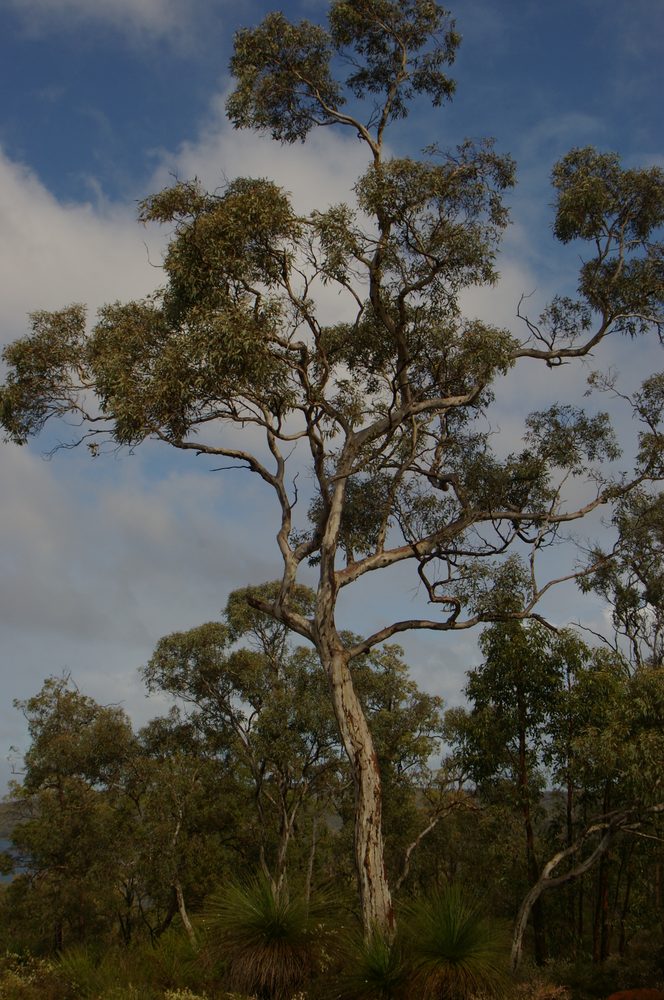
General Description
It has smooth bark, lance-shaped adult leaves, flower buds in groups of nine to seventeen, white flowers and conical to cylindrical fruit. It is one of a number of similar Eucalyptus species known as wandoo. E. wandoo was first described in 1934 by the Australian botanist William Faris Blakely in his book A Key to the Eucalypts using material collected by the English collector Augustus Frederick Oldfield from a sand plain along the Kalgan River. As of January 2023, Plants of the World Online lists Eucalyptus redunca var. elata as a taxonomic synonym of E. wandoo. The range of the tree extends from Morawa in the north extending south through the Darling Range down to around the Stirling Range to the south coast near the Pallinup River. There is an outlying population found to the east of Narembeen at Twine Reserve. It is native to the following IBRA bioregions: Geraldton Sandplains and Avon Wheatbelt in the north through the Swan Coastal Plain and Jarrah Forest to the Esperance Plains and Mallee in the south. E. wandoo was listed as Vulnerable by the International Union for Conservation of Nature (IUCN) as of 2019 as a result of its severely fragmented population.
Family Context
The Myrtaceae family is primarily tropical and subtropical. Notable medicinal members include:
- Guava — 57 documented uses
- Melaleuca leucadendron — 49 documented uses
- Clove — 45 documented uses
- Blue Gum — 44 documented uses
Geographic Distribution
Eucalyptus wandoo has been recorded in 6 countries and territories worldwide, including Australia, Brazil, Morocco, New Zealand, Tanzania, and others.
Active Compounds
Phytochemical research has identified 1 compound in this species: resveratrol.
Research Status
Although this species has documented phytochemical constituents, its ethnobotanical and clinical documentation remains incomplete. The limited documentation available for this species represents an opportunity for ethnobotanical research.