Field Horsetail

Also known as: Horsetail

Botanical Overview

Field Horsetail (Equisetum arvense) is a flowering plant in the Equisetaceae family. This plant has earned a place in traditional medicine through its consistent therapeutic benefits, recorded across multiple cultures. This species belongs to the Equisetaceae family, a group of flowering plants.
General Description

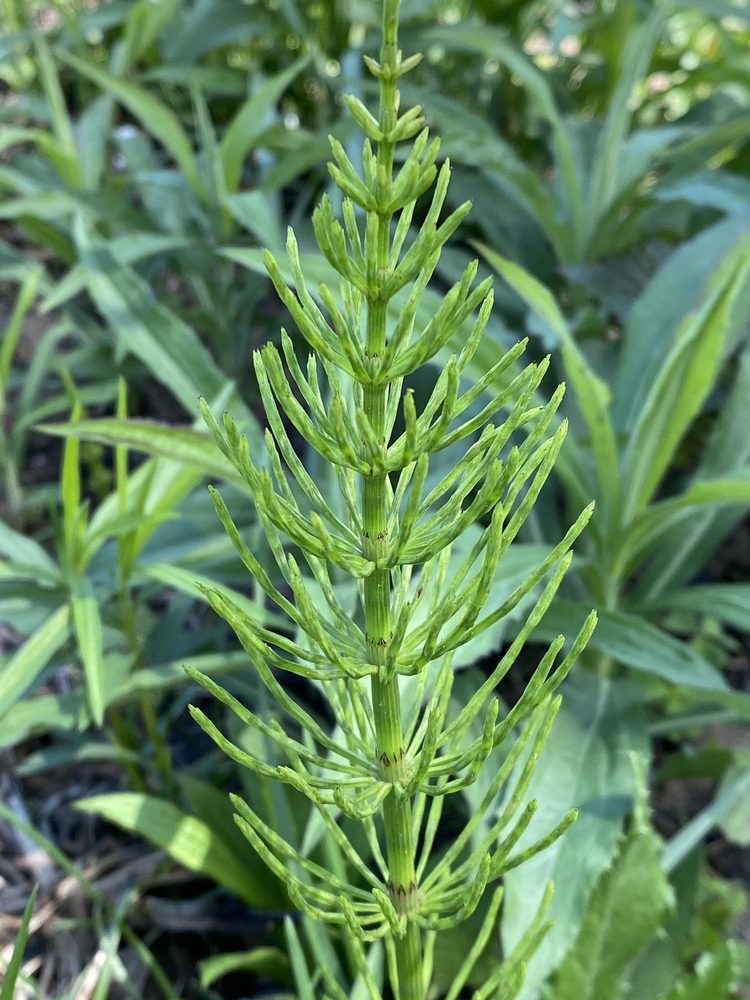
Like all horsetails, it is a type of fern. It is native throughout the arctic and temperate regions of the Northern Hemisphere. It has two distinct growth forms, a fertile spore-bearing stem and a sterile green stem. It is sometimes confused with mare’s tail, Hippuris vulgaris.

ⓘ Information
Description adapted from Wikipedia (CC BY-SA 4.0).

Family Context

The Equisetaceae family is widely distributed. Notable medicinal members include:

Traditional Uses

Field Horsetail has been traditionally used for digestive health, skin and wound care, and urinary tract health, among other applications.

Digestive health.

  • Carminative
  • Diarrhea
  • Dyspepsia

For digestive complaints, the herb is typically prepared as a tea or decoction taken before meals. The bitter compounds stimulate digestive secretions and improve nutrient absorption. Some traditions use the powdered root or leaves in small doses as a stomachic tonic.

Skin and wound care.

  • Sore
  • Wound

For skin conditions, the fresh or dried plant is applied topically as a poultice, wash, or compress. A strong decoction can be used to clean wounds and sores. The antimicrobial properties help prevent infection while promoting tissue repair.

Urinary tract health.

  • Diuretic
  • Kidney
  • Bladder
  • Gravel

Urinary tract applications typically involve drinking the herb as a mild tea, which increases urine production and helps flush the urinary system. It may be combined with other demulcent herbs to soothe irritated tissues.

Active Compounds

Phytochemical research has identified 30 compounds in this species, including a diverse array of phytochemical classes (see the Complete Chemical Inventory below for the full list).

The identified compounds include the following categories:

  • Flavonoid: antioxidant compounds that protect cells from oxidative damage
  • Sterol: cholesterol-like compounds with anti-inflammatory properties
  • Alkaloid: nitrogenous compounds with diverse pharmacological activities
ⓘ Information
Information on this page is compiled from Dr. Duke’s Phytochemical and Ethnobotanical Databases (USDA ARS), a public domain resource. Consult a healthcare professional before using any herbal preparation.
⚠ Caution
Traditional records: This plant has documented uses including Poison. Self-medication with herbs carries risks including allergic reactions, drug interactions, and toxicity. Only use under the supervision of a qualified healthcare professional.

Complete Use Records

CategoryCultural Context
DiureticElsewhere, Germany*, Spain, Turkey, US(Flathead)
TuberculosisHaiti, Kurdistan, Turkey
AntisepticPanama, Turkey
CarminativeChina, Turkey
DropsyElsewhere, Haiti
HemostatElsewhere, Turkey
KidneyElsewhere, Iraq
AlbuminuriaHaiti
AstringentTurkey
Cancer(Bones)Guatemala
DiabetesIraq
DiarrheaHaiti
HematuriaHaiti
PilesTurkey
PoisonUS
SoreCanada(Kwakiutl)
TumorSpain
XlbuminuriaHaiti
BladderElsewhere
GravelElsewhere
HemopoieticElsewhere
WoundCanada(Kwakiutl)
AnodyneChina
CalculusHaiti
CancerMexico
DyspepsiaElsewhere
HemoptysisHaiti
LungTurkey
GoutElsewhere

Complete Chemical Inventory

CompoundFormulaMW
2,4-METHYLENE-CHOLESTEROLC₂₈H₄₆O398.7 Da
24-ALPHA-EHTYL-CHOLEST-5-EN-3-BETA-OL
24-ALPHA-METHYL-CHOLEST-5-EN-3-BETA-OL
3-METHOXY-PYRIDINEC₆H₇NO109.13 Da
4-HYDROXY-6-(2-HYDROXY-ETHYL)-2,2,5,7-TETRAMETHYL-INDANONE
5-CAFFEOYL-SHIKIMIC-ACID
5-O-CAFFEOYLSHIKIMIC-ACIDC₁₆H₁₆O₈336.29 Da
6-CHLOROAPIGENINC₁₅H₉ClO₅304.68 Da
ACONITIC-ACIDC₆H₆O₆174.11 Da
ALPHA-CAROTENEC₄₀H₅₆536.9 Da
ALUMINUMAl26.981538 Da
APIGENINC₁₅H₁₀O₅270.24 Da
APIGENIN-4'-O-BETA-D-GLUCOSIDE
APIGENIN-5-GLUCOSIDEC₂₁H₂₀O₁₀432.4 Da
APIGENIN-5-O-(6'-MALONYL-GLUCOSIDE)
APIGENIN-5-O-(6'-O-MALONYL-BETA-D-GLUCOPYRANOSIDE)
APIGENIN-5-O-BETA-D-GLUCOSIDEC₂₁H₂₀O₁₀432.4 Da
APIGENIN-6-C-BETA-D-GLUCOPYRANOSIDE
APIGENIN-6-C-BETA-D-GLUCOSIDE
ARABINOIC-ACIDC₅H₁₀O₆166.13 Da
ARABINONIC-ACIDC₅H₁₀O₆166.13 Da
AROMADENDRINC₁₅H₁₂O₆288.25 Da
ARTICULATINC₂₁H₂₀O₁₃480.4 Da
ASCORBIC-ACIDC₆H₈O₆176.12 Da
ASH
ASTRAGALINC₂₁H₂₀O₁₁448.4 Da
BETA-CAROTENEC₄₀H₅₆536.9 Da
BETA-CRYPTOXANTHINC₄₀H₅₆O552.9 Da
BETA-SITOSTEROLC₂₉H₅₀O414.7 Da
BRASSINOSTEROIDSC₂₈H₄₈O₆480.7 Da

Data from PubChem (NIH/NLM, public domain).


References & Further Reading

External Research Links

Data Sources