Botanical Overview
Chinese Jack-In-The-Pulpit (Arisaema consanguineum) belongs to the Araceae family. Limited but reliable traditional records indicate this plant has recognized medicinal applications in one or more healing traditions. The arum family (Araceae) includes herbs, climbers, and aquatics with a distinctive inflorescence consisting of a fleshy spike (spadix) surrounded by a modified leaf (spathe). Many species produce calcium oxalate crystals and acrid compounds that cause intense irritation. Despite this, several are used medicinally after proper preparation.
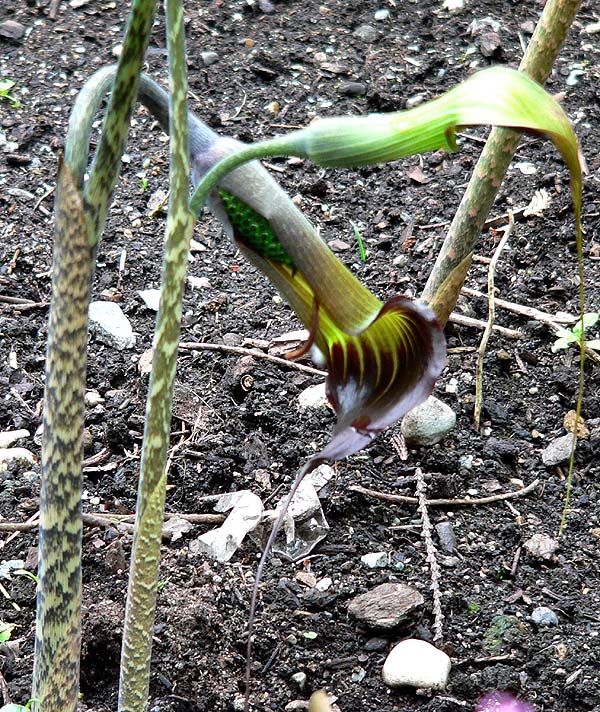
General Description
It is a tuberous perennial native to the Himalayas, Indochina, and China. A single stem, 1 m (3. 3 ft) tall, bears a deciduous leaf with multiple radial leaflets. The flower is a deep maroon hooded spathe striped green and white. It appears in summer, and is followed by a cluster of bright red berries in autumn. It is cultivated as an ornamental plant for a permanently damp, partially shaded or fully shaded, sheltered spot, such as a woodland setting. Though hardy to −5 °C (23 °F), the tuber may require protection during winter. It is reported to cause skin irritation if handled, and gastrointestinal irritation if ingested.
Family Context
The Araceae family is widely distributed. Notable medicinal members include:
- Jack-In-The-Pulpit — 34 documented uses
- Taro — 34 documented uses
- Skunk Cabbage — 33 documented uses
- Dumbcane — 27 documented uses
Geographic Distribution
Chinese Jack-In-The-Pulpit has been recorded in 10 countries and territories worldwide, including Bhutan, China, India, Myanmar, Nepal, and others.
Traditional Uses
Chinese Jack-In-The-Pulpit has been traditionally used for respiratory conditions, skin and wound care, and pain and inflammation, among other applications.
Respiratory conditions.
- Expectorant
Respiratory conditions are addressed through steam inhalation of the herb’s vapors or internal use as a warm tea. The hot infusion acts as an expectorant, helping to loosen phlegm and clear congestion. Some traditions combine it with honey for coughs.
Skin and wound care.
- Abscess
- Boil
For skin conditions, the fresh or dried plant is applied topically as a poultice, wash, or compress. A strong decoction can be used to clean wounds and sores. The antimicrobial properties help prevent infection while promoting tissue repair.
Pain and inflammation.
- Anodyne
- Swelling
- Inflammation
For pain and inflammation, preparations are applied both topically as compresses and taken internally. A warm poultice draws blood to the area and promotes healing, while internal preparations address systemic inflammation.
Active Compounds
Phytochemical research has identified 12 compounds in this species, including a diverse array of phytochemical classes (see the Complete Chemical Inventory below for the full list).
The identified compounds include the following categories:
- Saponin: soap-like compounds with immune-modulating activity