Botanical Overview
Sugar-Apple (Annona squamosa) is a flowering plant in the Annonaceae family. The traditional uses of this species reflect its genuine medicinal value, validated by generations of practical experience. The custard-apple family (Annonaceae) includes trees and shrubs with simple, alternate leaves and distinctive three-petaled flowers. The fruits are typically fleshy aggregates of berries. Many species produce acetogenins and isoquinoline alkaloids with potent biological activity.
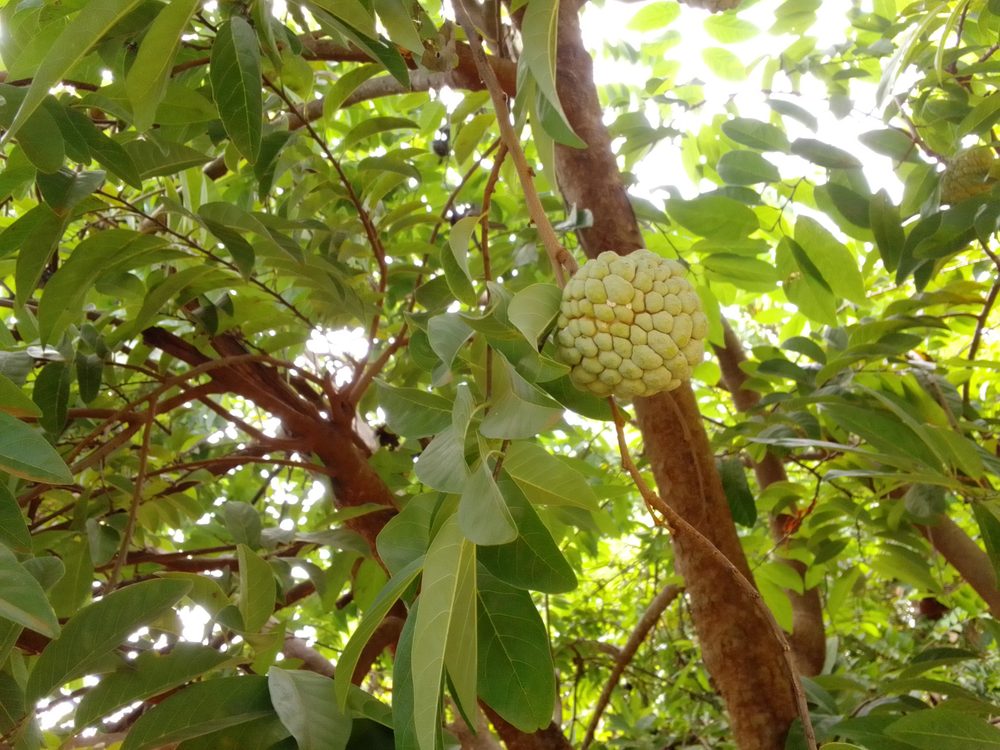
General Description
It tolerates a tropical lowland climate better than its relatives Annona reticulata and Annona cherimola (whose fruits often share the same name) helping make it the most widely cultivated of these species. Annona squamosa is semi-(or late) deciduous, and 3 to 8 metres (10 to 26 feet) tall, similar to soursop (Annona muricata). It is a native of tropical climate in the Americas, and Spanish traders aboard the Manila galleons docking in the Philippines brought it to Asia. The fruit is spherical-conical, 5–10 centimetres (2–4 inches) in diameter and 6–10 cm (2+1⁄4–4 in) long, and weighing 100–240 grams (3. 5–8. 5 ounces), with a thick rind composed of knobby segments. The colour is typically pale green through blue-green, with a deep pink blush in certain varieties, and typically has a bloom. It is unique among Annona fruits in being segmented; the segments tend to separate when ripe, exposing the innards. The flesh is fragrant and sweet, creamy white through light yellow, and resembles and tastes like custard. The seeds are coated with the flesh, It is found adhering to 13-to-16-millimetre-long (1⁄2 to 5⁄8 in) seeds forming individual segments arranged in a single layer around a conical core. It is soft, slightly grainy, and slippery. The hard, shiny seeds may number 20–40 or more per fruit and have a brown to black coat, although varieties exist that are almost seedless. The seeds can be ground for use as an insecticide, although this has not been approved by the US EPA or EU authorities. The stems run through the centre of the fruit connecting it to the outside. The skin is shaped like a Reuleaux triangle coloured green and rough in texture. Due to the soft flesh and structure of the sugar apple it is very fragile to pressure when ripe. New varieties are also being developed in Taiwan and Hong Kong. The atemoya or “pineapple sugar-apple”, a hybrid between the sugar-apple and the cherimoya, is popular in Taiwan, although it was first developed in the United States in 1908. The fruit is similar in sweetness to the sugar-apple, but has a very different taste. As its name suggests, it tastes like pineapple.
Family Context
The Annonaceae family is widely distributed. Notable medicinal members include:
- Soursop — 44 documented uses
- Ethiopian Pepper — 21 documented uses
- Custard Apple — 19 documented uses
- Pondapple — 12 documented uses
Geographic Distribution
Sugar-Apple has been recorded in 10 countries and territories worldwide, including Australia, Brazil, China, Colombia, Indonesia, and others.
Traditional Uses
Sugar-Apple has been traditionally used for digestive health, respiratory conditions, and skin and wound care, among other applications.
Digestive health.
- Dyspepsia
- Purgative
- Vermifuge
- Diarrhea
- Stomachic
For digestive complaints, the herb is typically prepared as a tea or decoction taken before meals. The bitter compounds stimulate digestive secretions and improve nutrient absorption. Some traditions use the powdered root or leaves in small doses as a stomachic tonic.
Respiratory conditions.
- Cold
- Pectoral
Respiratory conditions are addressed through steam inhalation of the herb’s vapors or internal use as a warm tea. The hot infusion acts as an expectorant, helping to loosen phlegm and clear congestion. Some traditions combine it with honey for coughs.
Skin and wound care.
- Boil
- Itch
For skin conditions, the fresh or dried plant is applied topically as a poultice, wash, or compress. A strong decoction can be used to clean wounds and sores. The antimicrobial properties help prevent infection while promoting tissue repair.
Active Compounds
Phytochemical research has identified 30 compounds in this species, including a diverse array of phytochemical classes (see the Complete Chemical Inventory below for the full list).
The identified compounds include the following categories:
- Flavonoid: antioxidant compounds that protect cells from oxidative damage
- Phenolic: antioxidant compounds that neutralize free radicals
- Alkaloid: nitrogenous compounds with diverse pharmacological activities