Botanical Overview
Cohoba (Anadenanthera peregrina) belongs to the Fabaceae family. Limited but reliable traditional records indicate this plant has recognized medicinal applications in one or more healing traditions. The legume family (Fabaceae) includes trees, shrubs, and herbs that produce pods (legumes) and form nitrogen-fixing root nodules through symbiosis with bacteria. The flowers are typically pea-shaped with five petals. This large family provides food staples, timber, and numerous medicinal species.
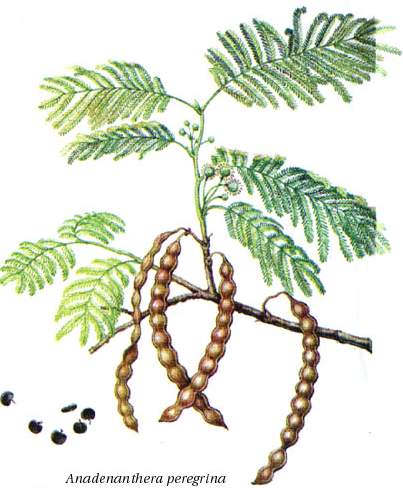
General Description
It grows up to 20 m (70 ft) tall, and has a thorny bark. Its flowers grow in small, pale yellow to white spherical clusters resembling Acacia inflorescences. It is an entheogen which has been used in healing ceremonies and rituals for thousands of years in northern South America and the Caribbean. Although the seeds of the yopo tree were originally gathered from the wild, increased competition between tribes over access to the seeds led to it being intentionally cultivated and transported elsewhere.
Family Context
The Fabaceae family is large and globally distributed. Notable medicinal members include:
- Soybean — 76 documented uses
- Crab’s Eye — 73 documented uses
- Tamarind — 59 documented uses
- Common Indigo — 51 documented uses
Geographic Distribution
Cohoba has been recorded in 10 countries and territories worldwide, including Bolivia, Brazil, Colombia, Dominican Republic, Guyana, and others.
Active Compounds
Phytochemical research has identified 16 compounds in this species, including a diverse array of phytochemical classes (see the Complete Chemical Inventory below for the full list).
The identified compounds include the following categories:
- Phenolic: antioxidant compounds that neutralize free radicals
- Alkaloid: nitrogenous compounds with diverse pharmacological activities
- Saponin: soap-like compounds with immune-modulating activity