Botanical Overview
Alphitonia petriei is a species in the Rhamnaceae family. The buckthorn family (Rhamnaceae) includes shrubs and trees with simple, alternate leaves and small, inconspicuous flowers with four or five petals. The fruits are typically drupes or capsules. Many species contain anthraquinone glycosides with strong purgative activity. Phytochemical data for this species are limited at present.
General Description
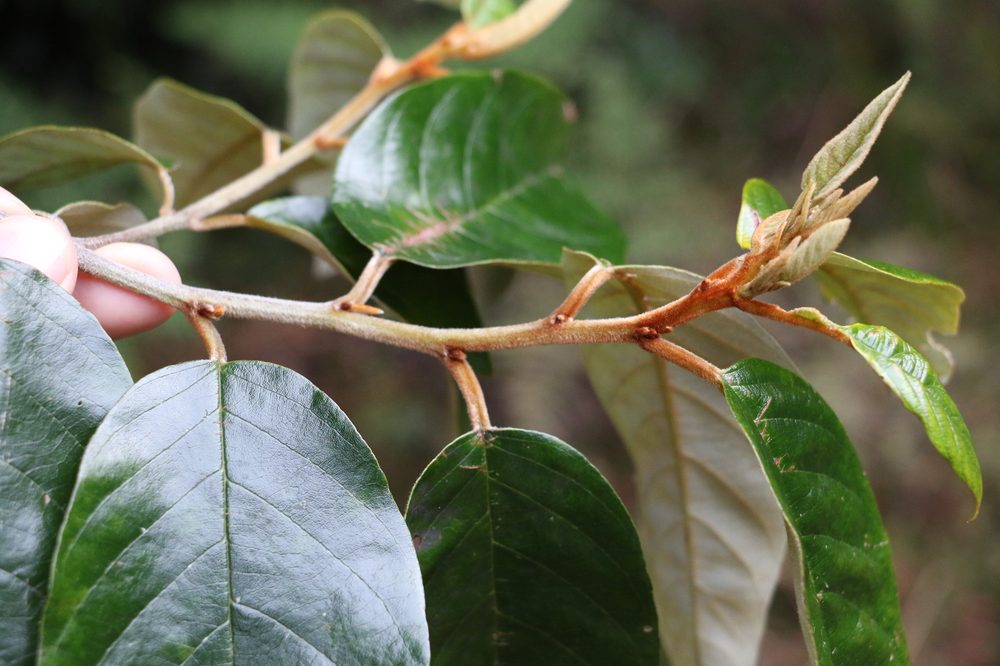
Other common names include red ash, white-leaf, pink almond and pink ash. It was originally collected from the Johnstone River in October 1917 by H. Ladbrook, but the designated type for this species was collected by Cyril Tenison (C. T. ) White in March 1922 from the Barron River near Kuranda. It was described and named in 1925 by K. W. Braid and White who assigned the species epithet petriei in honour of W. R. Petrie, who alerted them to its distinctness. Alphitonia petriei is usually found as a small tree around 20 metres (66 feet) tall. However, it has been recorded at 40 metres (130 feet) tall with a stem diameter of 60 cm in Queensland. The trunk and larger branches bear fissured grey bark (darker brown in Queensland), and peeling or bruising of it gives off a strong scent of liniment, which has been likened to oil of wintergreen. Arranged alternately on the smaller branches, simple narrow leaves measure 7–15 cm (3–6 in) in length and are dark glossy green above and covered with fine white hairs underneath. The tiny (0. 5 cm diameter) creamy flowers have five petals and are found in panicles at the end of branchlets or between leaves. Flowering occurs in September to November, followed by the production of globular dark fruit around 1 to 1. 5 cm diameter from February to July. It is found in coastal rainforest, and in ecotone areas in eucalyptus forest from Darwin and Thursday Island in northern Australia south along the eastern coastline to the Upper Orara River in New South Wales. The leaves and shoots are eaten by farm animals.
Family Context
The Rhamnaceae family is widely distributed. Notable medicinal members include:
- Ceanothus americanus — 21 documented uses
- Buckthorn — 8 documented uses
- Cascara Sagrada — 6 documented uses
- Mabi — 5 documented uses
Geographic Distribution
Alphitonia petriei has been recorded in Australia, Papua New Guinea, Solomon Islands, United States, and ZZ.
Active Compounds
Phytochemical research has identified 2 compounds in this species: betulin, betulinic-acid.
Research Status
Although this species has documented phytochemical constituents, its ethnobotanical and clinical documentation remains incomplete. Additional phytochemical investigation could identify novel bioactive compounds in this plant.