Overview
The sensory organs are specialized structures that detect stimuli from the external environment and convert them into neural signals that the brain can interpret. Each organ is exquisitely adapted to its particular type of stimulus — light for the eye, sound and motion for the ear, volatile chemicals for the nose, and soluble chemicals for the taste buds. Collectively, they provide the information we need to navigate and interact with the world around us.
The Eye
The eye is the organ of vision, responsible for focusing light onto a layer of photoreceptor cells that convert light energy into neural signals. The eyeball (globe) sits within the bony orbit, a four-sided pyramid-shaped cavity formed by the frontal, maxillary, ethmoid, sphenoid, and zygomatic bones. The orbit also contains the extraocular muscles, the lacrimal gland, and the neurovascular supply of the eye.
Structure of the Eyeball
The eyeball is approximately 24 mm in diameter and is composed of three concentric layers (tunics) that surround the internal chambers and the lens.
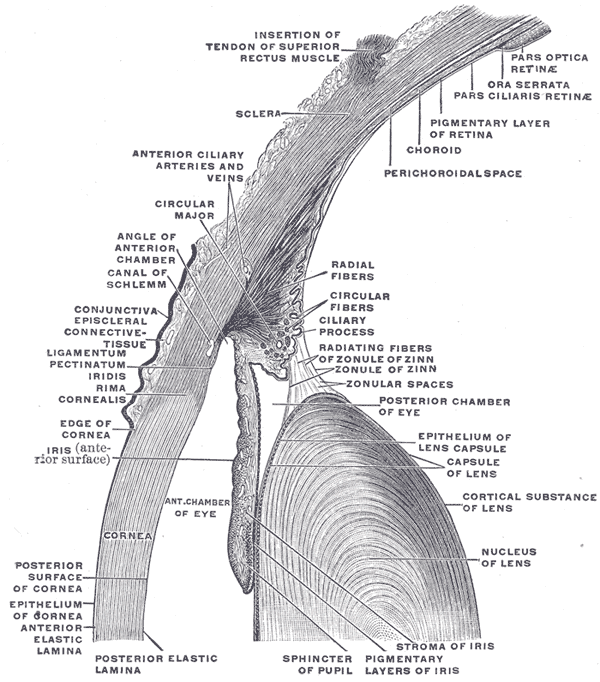
The fibrous tunic is the outermost layer. Its posterior five-sixths is the sclera — tough, white, dense connective tissue that gives the eye its shape and provides attachment for the extraocular muscles. Its anterior one-sixth is the cornea — transparent, avascular, and curved to provide most of the eye’s refractive power. The cornea is richly supplied with sensory nerve endings (making it exquisitely sensitive to pain) and receives its nutrients from the tears and the aqueous humor.
The vascular tunic (uvea) is the middle layer. The choroid is a highly vascular layer that supplies blood to the outer retina. The ciliary body is a ring-shaped structure that produces aqueous humor and contains the ciliary muscle, which controls the shape of the lens for accommodation. The iris is the pigmented diaphragm that controls the amount of light entering the eye by adjusting the size of the pupil. The iris contains two smooth muscles: the sphincter pupillae (constricts the pupil, parasympathetic) and the dilator pupillae (dilates the pupil, sympathetic).
The neural tunic is the retina, which lines the posterior two-thirds of the eye and contains the photoreceptor cells.
The eye is divided into two main chambers. The anterior segment (between the cornea and the lens) contains the aqueous humor, a watery fluid produced by the ciliary body that nourishes the cornea and lens and maintains intraocular pressure. The anterior segment is subdivided into the anterior chamber (between cornea and iris) and the posterior chamber (between iris and lens). The posterior segment (behind the lens) is filled with the vitreous humor, a clear gel that maintains the shape of the eye and supports the retina against the choroid.
| Layer | Parts | Function |
|---|---|---|
| Fibrous (outer) | Sclera, cornea | Protection, refraction |
| Vascular (middle) | Choroid, ciliary body, iris | Blood supply, accommodation, light control |
| Neural (inner) | Retina | Photoreception |
The Lens and Accommodation
The lens is a transparent, biconvex crystalline structure suspended behind the iris by the zonular fibers (suspensory ligaments) that attach to the ciliary body. It focuses light onto the retina by changing its shape — a process called accommodation. For distance vision, the ciliary muscle relaxes, the zonular fibers are taut, and the lens is flattened (reduced refractive power). For near vision, the ciliary muscle contracts, releasing tension on the zonular fibers, and the lens becomes more spherical (increased refractive power). This ability decreases with age (presbyopia), becoming noticeable around age 40.
The Retina
The retina is a thin, multilayered sheet of neural tissue that lines the posterior eye. It contains the photoreceptor cells — rods and cones — as well as the interneurons (bipolar, horizontal, amacrine cells) and the output neurons (ganglion cells) whose axons form the optic nerve.
Rods (approximately 120 million) are highly sensitive to low light levels (scotopic vision) and are responsible for night vision. They contain the photopigment rhodopsin and are concentrated in the peripheral retina. Rods provide no color discrimination.
Cones (approximately 6 million) require brighter light (photopic vision) and are responsible for high-acuity color vision. They are concentrated in the macula lutea, the central region of the retina, and most densely packed at its center — the fovea centralis, which contains only cones and provides the sharpest visual acuity.
The optic disc is the region where the ganglion cell axons exit the eye to form the optic nerve. It contains no photoreceptors, creating a physiological blind spot. The ora serrata is the jagged anterior border where the retina ends and the ciliary body begins.
Extraocular Muscles
Six muscles control the movement of each eye, coordinating to produce conjugate (parallel) gaze. Four rectus muscles (superior, inferior, medial, lateral) originate from a common tendinous ring at the orbital apex and insert on the sclera anterior to the equator. Two oblique muscles (superior and inferior) approach the globe from different angles and produce rotational movements.
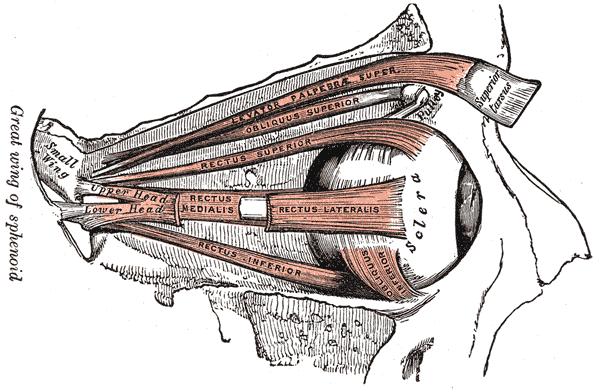
| Muscle | Innervation | Primary Action |
|---|---|---|
| Medial rectus | CN III | Adduction (toward nose) |
| Lateral rectus | CN VI | Abduction (away from nose) |
| Superior rectus | CN III | Elevation, adduction, intorsion |
| Inferior rectus | CN III | Depression, adduction, extorsion |
| Superior oblique | CN IV | Intorsion, depression, abduction |
| Inferior oblique | CN III | Extorsion, elevation, abduction |
Visual Pathway
The visual pathway carries signals from the retina to the visual cortex. Ganglion cell axons from each retina converge at the optic disc and exit the eye as the optic nerve (CN II). The two optic nerves meet at the optic chiasm, where fibers from the nasal (medial) half of each retina cross to the opposite side while fibers from the temporal (lateral) half remain ipsilateral. This arrangement ensures that each cerebral hemisphere receives information from the contralateral visual field.
After the chiasm, the fibers continue as the optic tract to the lateral geniculate nucleus (LGN) of the thalamus, where they synapse. From the LGN, the optic radiation (geniculocalcarine tract) projects to the primary visual cortex (V1, Brodmann area 17) in the calcarine sulcus of the occipital lobe. The lower visual field is represented superiorly (above the calcarine sulcus) and the upper visual field is represented inferiorly (below it).
The Ear
The ear serves two sensory functions: hearing (audition) and balance (vestibular sensation). It is divided anatomically into three parts: the external ear, the middle ear, and the inner ear.
External Ear
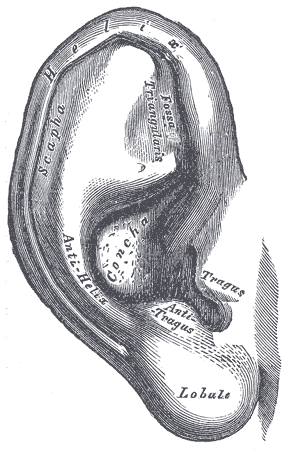
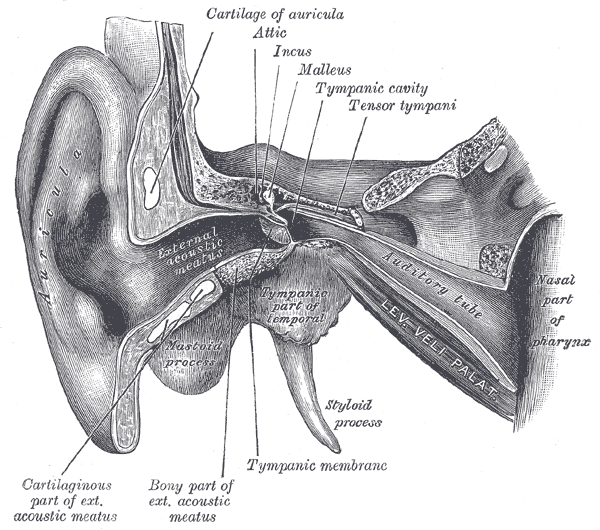
The external ear consists of the auricle (pinna) , a plate of elastic cartilage covered by skin, and the external auditory meatus (ear canal), a 2.5 cm long S-shaped tube that leads to the tympanic membrane. The lateral third of the canal is cartilaginous and contains hair follicles and ceruminous glands that produce cerumen (earwax) for protection. The medial two-thirds is bony, formed by the tympanic part of the temporal bone.
Middle Ear
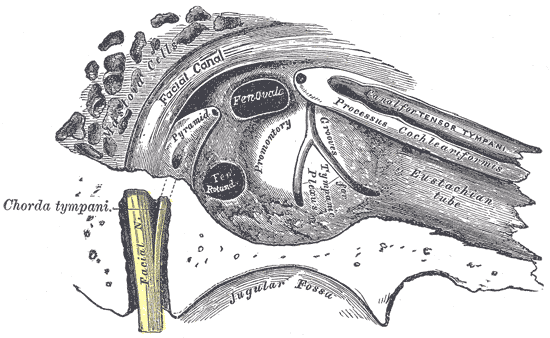
The middle ear (tympanic cavity) is an air-filled space within the temporal bone, lined by respiratory epithelium and connected to the nasopharynx by the Eustachian (auditory) tube, which equalizes air pressure on both sides of the tympanic membrane.
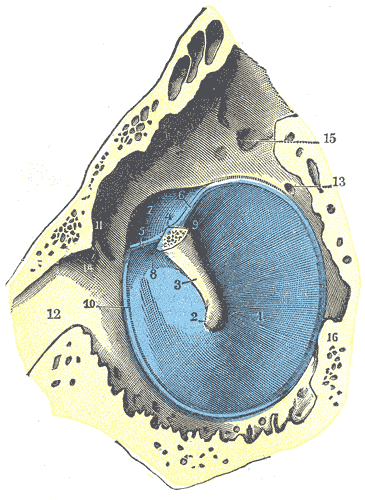
The tympanic membrane (eardrum) separates the external ear from the middle ear. It is a thin, cone-shaped membrane approximately 9–10 mm in diameter, composed of an outer skin layer, a middle fibrous layer, and an inner mucosal layer. The pars tensa is the taut, larger portion; the pars flaccida is the smaller, relaxed portion.
Three tiny bones — the ossicles — transmit vibrations from the tympanic membrane to the inner ear. The malleus (hammer) is attached to the tympanic membrane. It articulates with the incus (anvil), which in turn articulates with the stapes (stirrup). The footplate of the stapes sits in the oval window of the inner ear. The ossicular chain provides a mechanical advantage of approximately 22×, amplifying the pressure of sound waves to overcome the resistance of the fluid-filled inner ear.
Two small muscles protect the ear from loud sounds. The tensor tympani (innervated by CN V₃) pulls the malleus inward, tensing the tympanic membrane. The stapedius (innervated by CN VII) pulls the stapes away from the oval window. The stapedius is the smallest skeletal muscle in the body.
Inner Ear
The inner ear (labyrinth) is a complex series of fluid-filled chambers and tunnels embedded within the petrous part of the temporal bone. It consists of the bony labyrinth (a system of channels in the bone) and, within it, the membranous labyrinth (a continuous system of ducts and sacs filled with endolymph). The space between the bony and membranous labyrinths is filled with perilymph.
The cochlea is the organ of hearing. It is a spiral-shaped tube that makes 2.5–2.75 turns around a central bony core (the modiolus). In cross-section, the cochlea is divided into three parallel chambers (scalae): the scala vestibuli and scala tympani, which contain perilymph and communicate with each other at the helicotrema (the apex), and the scala media (cochlear duct), which contains endolymph and houses the organ of Corti.
The organ of Corti is the sensory epithelium of hearing. It sits on the basilar membrane and consists of inner hair cells (approximately 3,500, the primary auditory receptors), outer hair cells (approximately 12,000, which amplify sound by electromotility), and supporting cells. The stereocilia of the hair cells are embedded in the tectorial membrane, a gelatinous shelf that overhangs them. Sound-induced vibration of the basilar membrane causes the hair cell stereocilia to bend against the tectorial membrane, opening ion channels and generating receptor potentials.
The vestibular apparatus consists of three semicircular canals (anterior, posterior, and lateral) and two otolith organs — the utricle and saccule. The semicircular canals detect rotational acceleration. Each canal is filled with endolymph and has a dilated end (ampulla) containing a sensory ridge (crista ampullaris) with hair cells whose stereocilia are embedded in a gelatinous cupula. Head rotation causes endolymph movement that bends the cupula and stimulates the hair cells. The utricle and saccule detect linear acceleration and gravity. Their hair cells are embedded in a gelatinous matrix containing calcium carbonate crystals (otoliths); gravity or linear acceleration causes the otoliths to displace the hair cell stereocilia.
Auditory Pathway
Sound is transduced into neural signals by the following pathway: the cochlea (hair cells in the organ of Corti) → the spiral ganglion (cell bodies of the auditory neurons) → the cochlear nerve (a division of CN VIII) → the cochlear nuclei (in the brainstem) → the superior olive (sound localization) → the lateral lemniscus → the inferior colliculus (midbrain) → the medial geniculate nucleus of the thalamus → the primary auditory cortex (Heschl gyrus, Brodmann areas 41 and 42 in the temporal lobe).
Olfaction
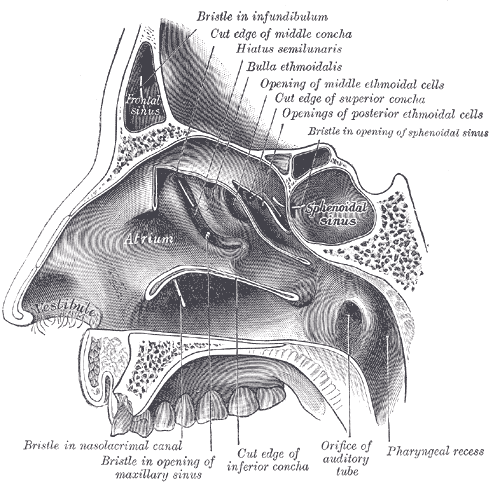
The sense of smell (olfaction) detects airborne chemical molecules. The olfactory epithelium is a small patch of specialized sensory epithelium — approximately 2.5 square centimeters — located in the roof of the nasal cavity, covering the superior turbinate and the upper part of the nasal septum. Despite its small size, it is the only part of the central nervous system that is directly exposed to the external environment.
The olfactory epithelium contains three cell types. Olfactory receptor neurons (approximately 10 million) are bipolar neurons whose dendrites project into the nasal cavity and end in cilia that bear odorant receptors. Each olfactory neuron expresses only one of approximately 350 functional odorant receptor types. Their axons pass through the cribriform plate of the ethmoid bone to synapse in the olfactory bulb. Supporting cells provide structural and metabolic support. Basal cells are stem cells that regenerate olfactory neurons throughout life — the only neurons in the adult nervous system that are regularly replaced.
Bowman glands in the lamina propria secrete mucus that covers the olfactory epithelium, trapping odorants and providing the aqueous environment necessary for odorant-receptor binding.
The olfactory pathway is unique among sensory systems in that it bypasses the thalamus. From the olfactory bulb, the olfactory tract projects directly to the primary olfactory cortex (piriform cortex) in the temporal lobe, as well as to the amygdala and the entorhinal cortex, which is why smells can trigger such powerful emotional memories.
Gustation
The sense of taste (gustation) detects soluble chemicals in the mouth. Taste receptor cells are organized into taste buds — onion-shaped clusters of 50–100 cells — that are distributed across the tongue, soft palate, epiglottis, and upper pharynx. The human mouth contains approximately 5,000 taste buds.
On the tongue, taste buds are housed within three types of papillae (visible elevations of the mucosal surface). Fungiform papillae are mushroom-shaped and scattered over the anterior two-thirds of the tongue, each containing 1–20 taste buds. Circumvallate papillae are large, dome-shaped structures arranged in a V-shaped row at the posterior tongue; each contains approximately 250 taste buds. Foliate papillae are folds on the lateral edges of the tongue. (The numerous filiform papillae, which cover most of the tongue’s dorsal surface, contain no taste buds — they provide texture and friction for manipulating food.)
Each taste bud contains three functional cell types. Type II (receptor) cells express G-protein-coupled receptors (GPCRs) for sweet, bitter, and umami stimuli. Type III (presynaptic) cells detect sour stimuli and form synapses with the afferent nerve fibers. Salt detection (via the ENaC sodium channel) is mediated by a subset of receptor cells. Type I cells are supporting cells, similar to glia.
| Quality | Receptor | Mechanism |
|---|---|---|
| Sweet | T1R2/T1R3 | GPCR → cAMP, IP₃ |
| Salty | ENaC (sodium channel) | Ion channel (direct depolarization) |
| Sour | PKD2L1 (proton channel) | Ion channel (H⁺ influx) |
| Bitter | T2R (25 subtypes) | GPCR → gustducin |
| Umami | T1R1/T1R3 (glutamate) | GPCR → mGluR |
The gustatory pathway carries taste information from the tongue and pharynx to the brainstem. The anterior two-thirds of the tongue is innervated by the chorda tympani branch of the facial nerve (CN VII). The posterior one-third is innervated by the glossopharyngeal nerve (CN IX). The epiglottis and pharynx are innervated by the vagus nerve (CN X). All three converge on the nucleus of the solitary tract (NST) in the medulla, from which second-order neurons project to the ventral posteromedial nucleus (VPM) of the thalamus and then to the gustatory cortex in the insula and frontal operculum.