Embryology is the study of human development from fertilization to birth. In 40 weeks, a single cell transforms into a fully formed human being — arguably the most remarkable biological process in nature. Understanding this process is essential for grasping the origin of every organ system and the basis of congenital anomalies.
Timeline of Human Development
Human development is divided into three periods:
Pre-embryonic period (weeks 1–2). From fertilization through implantation. The zygote divides, forms a morula, then a blastocyst, and implants in the uterine wall.
Embryonic period (weeks 3–8). The most critical period. All major organs and structures form. By the end of week 8, the embryo has a recognizably human form. This is the period of greatest vulnerability to teratogens (substances that cause birth defects).
Fetal period (weeks 9–38). Growth and maturation. Organs become functional, the body grows rapidly, and the fetus prepares for extrauterine life.
Weeks 1–2: From Fertilization to Implantation
Fertilization
Fertilization occurs in the ampulla of the fallopian tube within 12–24 hours of ovulation. The sperm must undergo capacitation (a series of biochemical changes in the female reproductive tract that enable it to fertilize) and the acrosome reaction (release of enzymes that digest the zona pellucida). When a single sperm penetrates the oocyte, the oocyte completes meiosis II, and the male and female pronuclei fuse to form the zygote, a single-cell embryo with 46 chromosomes (23 from each parent).
Cleavage and Morula
The zygote undergoes a series of mitotic divisions called cleavage, producing progressively smaller cells called blastomeres. At approximately the 8-cell stage, the blastomeres undergo compaction — they adhere tightly to one another, forming a dense ball with inner and outer cells.
At approximately 16–32 cells (day 3–4), the embryo is a solid ball called the morula (from Latin, “mulberry”). The morula enters the uterine cavity from the fallopian tube.
Blastocyst Formation
Fluid accumulates within the morula, forming a central cavity (blastocyst cavity, blastocele). Cells separate into two populations:
- Inner cell mass (embryoblast). A cluster of cells at one pole that will form the embryo proper.
- Trophoblast. The outer cell layer that will form the placenta and fetal membranes.
The zona pellucida degenerates, allowing the blastocyst to expand and interact with the endometrium.
Implantation
Implantation begins at approximately day 6–7 and is complete by day 12. The blastocyst attaches to the endometrial epithelium (usually in the posterior fundus of the uterus). The trophoblast differentiates into:
- Cytotrophoblast. Inner layer of mononucleated cells, which continue dividing.
- Syncytiotrophoblast. Outer layer of multinucleated, invasive cells that erode into the endometrium, creating spaces (lacunae) that fill with maternal blood.
Human chorionic gonadotropin (hCG) secreted by the syncytiotrophoblast maintains the corpus luteum and is the basis of pregnancy tests.
Week 3: Gastrulation and Trilaminar Disc
Gastrulation is the most important event of the third week. It establishes the three primary germ layers from which all tissues and organs develop.
Formation of the Primitive Streak
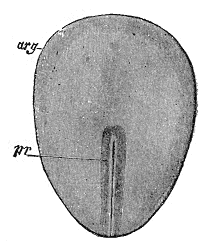
On day 15, cells of the epiblast (now called the embryonic disc) proliferate and migrate toward the midline, forming the primitive streak — a groove along the caudal midline of the embryonic disc. Cells migrate through the primitive streak (ingression) and form the three germ layers:
- Ectoderm. The outer layer. Gives rise to the central and peripheral nervous system, epidermis, hair, nails, mammary glands, pituitary gland, and sensory epithelia (eye, ear, nose).
- Mesoderm. The middle layer. Gives rise to the skeleton, skeletal muscle, heart, blood vessels, kidneys, gonads, dermis, and connective tissues.
- Endoderm. The inner layer. Gives rise to the epithelial lining of the gastrointestinal and respiratory tracts, the liver, pancreas, thyroid, parathyroids, and urinary bladder.
At the cranial end of the primitive streak, a specialized group of cells called the notochordal process extends cranially to form the notochord, a transient rod-like structure that defines the body axis and induces the formation of the neural plate.
Week 4: Neurulation and Organogenesis Begins
Neurulation
The neural plate (a thickened region of ectoderm anterior to the primitive streak) folds to form the neural tube, the precursor of the central nervous system:
- The neural plate invaginates along its midline, forming the neural groove with neural folds on either side.
- The neural folds elevate, approach each other, and fuse in the midline, forming the neural tube.
- Fusion begins in the cervical region and proceeds both cranially and caudally (like a zipper).
- The neuropores (openings at each end) close by days 24 (cranial) and 26 (caudal).
Failure of neural tube closure causes neural tube defects: anencephaly (cranial neuropore) or spina bifida (caudal neuropore). Folic acid supplementation before and during early pregnancy significantly reduces the risk.
Somites
Alongside the neural tube, the paraxial mesoderm segments into paired blocks called somites. Each somite differentiates into:
- Sclerotome. Forms the vertebrae and ribs.
- Dermomyotome. Forms the dermis of the back and the skeletal muscles of the trunk and limbs.
Somite formation is so regular that the number of somite pairs can be used to determine the embryo’s age. By the end of week 4, 30–35 pairs have formed.
Pharyngeal Arches
Four pairs of pharyngeal (branchial) arches develop during weeks 4–5. These are bars of mesenchymal tissue separated by grooves. Each arch contains an artery, a nerve, a cartilage bar, and muscle tissue. The pharyngeal arches contribute to the formation of the face, neck, ears, and cranial structures.
| Arch | Nerve | Artery | Skeletal Derivatives |
|---|---|---|---|
| 1st (mandibular) | V (trigeminal) | Maxillary artery | Malleus, incus, mandible |
| 2nd (hyoid) | VII (facial) | Stapedial artery | Stapes, styloid process, hyoid bone (lesser horn) |
| 3rd | IX (glossopharyngeal) | Common carotid | Hyoid bone (greater horn and body) |
| 4th–6th | X (vagus) | Aortic arch, ductus arteriosus | Thyroid, cricoid, arytenoid cartilages |
Limb Development
Limb buds appear at week 4 (upper limb at day 26, lower limb at day 28). Each limb bud consists of a core of mesenchyme covered by ectoderm. The apical ectodermal ridge (AER) at the tip of the bud induces outgrowth. By week 8, the limbs have distinct fingers and toes.
Weeks 5–8: Organogenesis
During weeks 5–8, the major organ systems take shape:
Heart. The heart begins beating at day 21–22. Initially a simple tube, it loops, septates, and divides into four chambers by week 8.
Lungs. The respiratory diverticulum (lung bud) appears at week 4. Branching morphogenesis continues through the fetal period, with the majority of alveoli forming after birth.
Digestive system. The primitive gut tube is divided into foregut, midgut, and hindgut. The midgut undergoes physiological herniation into the umbilical cord (week 6) before returning to the abdominal cavity (week 10).
Urogenital system. The mesonephros (intermediate kidney) functions temporarily. The metanephros (permanent kidney) begins developing at week 5. Primordial germ cells migrate from the yolk sac to the developing gonads.
Face. The frontonasal process, maxillary processes, and mandibular processes fuse to form the face. The palatal shelves fuse in the midline by week 8. Failure of fusion causes cleft lip and/or cleft palate.
By the end of week 8, the embryo is approximately 3 cm long and has a recognizably human form. All major organ systems are present, though most are not yet functional.
Fetal Period (Weeks 9–38)
The fetal period is characterized by growth, maturation, and functional development:
Weeks 9–12. The fetus grows to approximately 8 cm. External genitalia become distinguishable (male vs. female). The kidneys begin producing urine. Fetal movement begins (but is not yet felt by the mother).
Weeks 13–16. The fetus grows to approximately 16 cm. Ossification of the skeleton accelerates. The skin is thin and transparent. Quickening (the mother’s perception of fetal movement) typically begins.
Weeks 17–20. The fetus grows to approximately 25 cm. Lanugo (fine hair) covers the body. Vernix caseosa (a protective waxy coating) appears. The heartbeat is audible with a stethoscope.
Weeks 21–25. The fetus reaches viability — survival outside the uterus becomes possible (with intensive care). The lungs produce surfactant (essential for breathing). The eyes open.
Weeks 26–29. The fetus grows to approximately 37 cm. The nervous system matures rapidly. The lungs are capable of gas exchange. The fetus assumes a head-down position in most cases.
Weeks 30–34. The fetus grows to approximately 42 cm. Subcutaneous fat accumulates, smoothing the skin. The immune system matures with maternal antibody transfer.
Weeks 35–38 (full term). The fetus reaches approximately 50 cm and 3–3.5 kg. All organ systems are mature enough for extrauterine life. The lungs are fully mature. The fetus descends into the pelvis (engagement or “lightening”).
Placenta and Fetal Membranes
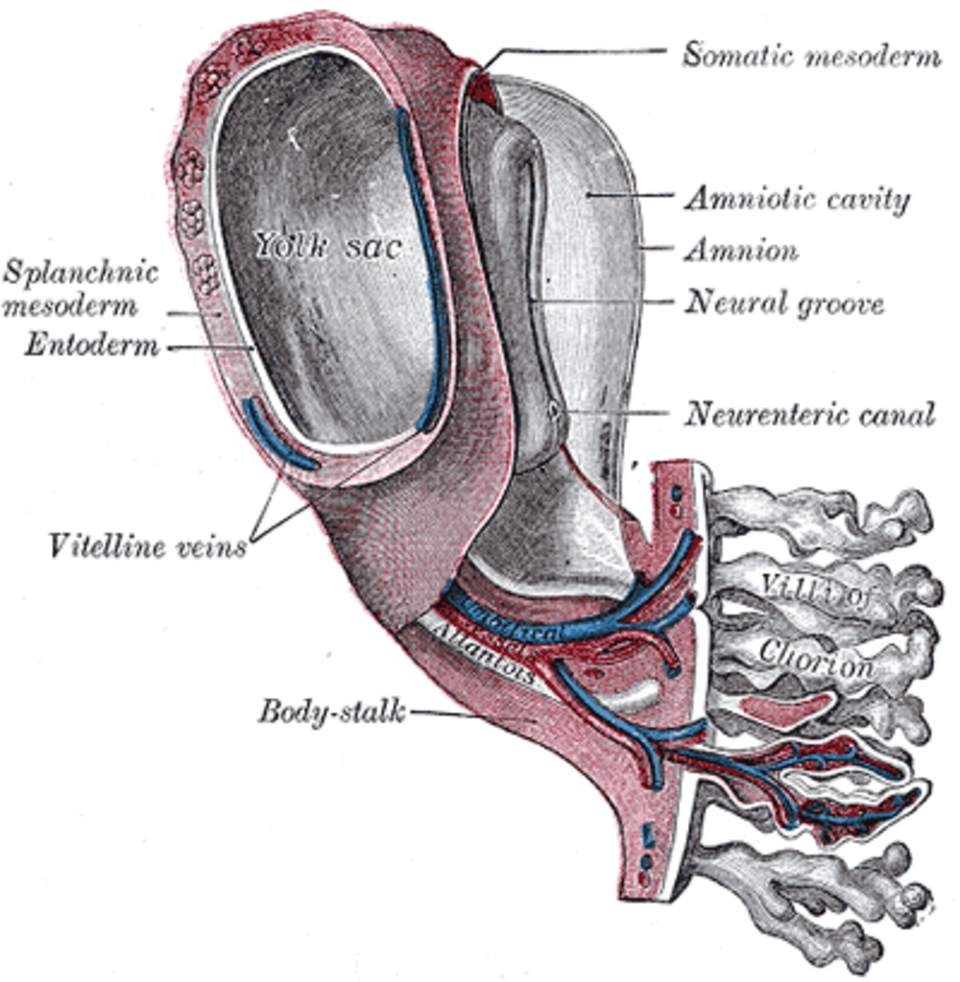
The placenta is the organ of exchange between mother and fetus. It is derived from the trophoblast and the underlying endometrium. By term, the placenta is approximately 20 cm in diameter and weighs 500 g.
Functions of the placenta:
- Gas exchange (O₂ and CO₂)
- Nutrient and waste transfer
- Endocrine function (hCG, progesterone, estrogen, human placental lactogen)
- Immune barrier and immunoglobulin transfer (IgG)
The umbilical cord contains two umbilical arteries (carrying deoxygenated blood to the placenta) and one umbilical vein (carrying oxygenated blood to the fetus), surrounded by Wharton jelly (mucoid connective tissue).
Fetal membranes:
- Amnion. The inner membrane, lining the amniotic cavity. Amniotic fluid (approximately 800 mL at term) cushions the fetus, allows movement, and prevents amniotic adhesions.
- Chorion. The outer membrane, derived from the trophoblast and extraembryonic mesoderm.
Fetal Circulation
The fetal circulation has several shunts that bypass the non-functioning fetal lungs and liver:
- Ductus venosus. Shunts blood from the umbilical vein to the inferior vena cava (bypassing the liver).
- Foramen ovale. An opening in the interatrial septum allowing blood to pass from the right atrium to the left atrium (bypassing the lungs).
- Ductus arteriosus. Connects the pulmonary trunk to the aorta (bypassing the lungs).
At birth, these shunts close: the ductus venosus becomes the ligamentum venosum, the foramen ovale closes (becoming the fossa ovalis), and the ductus arteriosus becomes the ligamentum arteriosum.
Critical Periods
Each organ has a critical period — a window of development when it is most susceptible to teratogens:
| Weeks | Structures Developing | Teratogen Sensitivity |
|---|---|---|
| 3–4 | Neural tube, heart begins beating | Extremely high |
| 5–6 | Face, palate, heart septation, limbs | Extremely high |
| 7–8 | Ear, external genitalia, digits | High |
| 9–38 | Brain, palate, genitals | Moderate (brain remains sensitive) |
The central nervous system is exceptional in that it remains vulnerable throughout the entire gestational period and into childhood.
Summary
Human development proceeds through pre-embryonic (weeks 1–2), embryonic (weeks 3–8), and fetal (weeks 9–38) stages. Gastrulation (week 3) establishes the three germ layers; neurulation and organogenesis (weeks 4–8) form all major organs; the fetal period perfects and grows them. The placenta supports fetal nutrition, gas exchange, and hormonal function. Understanding embryology explains the origin of every organ system and provides the framework for understanding the causes and timing of congenital anomalies.